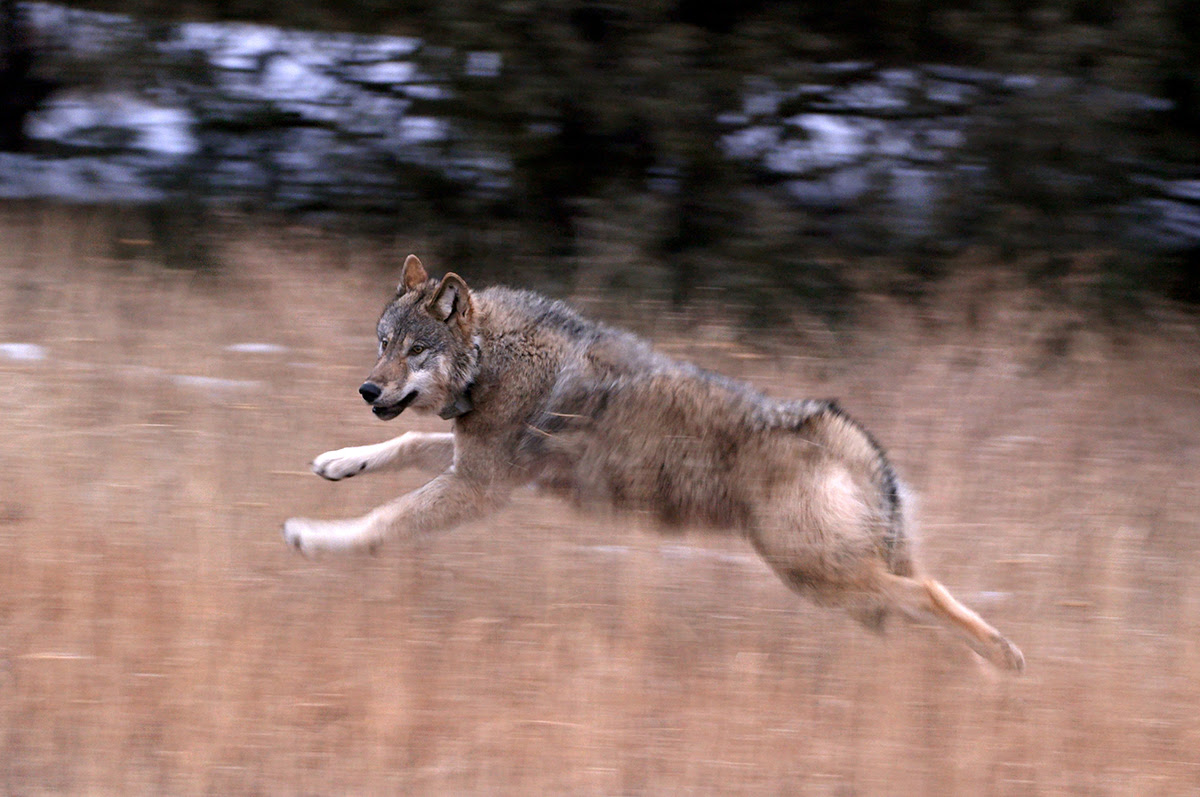
Wolves roamed Colorado for millions of years. At the end of the last ice age, they managed to survive the mass extinctions of megafauna such as mammoths, mastodons, sabertooth tigers, giant cave bears, and huge sloths, an extinction event that was probably caused in part by the arrival of humans from Asia at about the same time.
Until the much later arrival of Europeans, those early Americans were living in the stone age. Their weapons were stone-tipped spears and arrows. They didn’t even have horses. But they hunted in a way that was deadly to large herding animals and the predators of the herds: They used fire.
Don’t believe the myth that they killed only whatever they could eat. They didn’t eat all the six-ton wooly mammoths, believe me.
The truth is that they killed as humans are known to kill: They killed only whatever they could.
The wolves survived those humans and their fires. As large-ish mammals go, wolves are smart. Pack hunting involves a lot of socialization, planning, communication, hierarchy, and cooperation.
If you think you and a pack of friends could bring down a moose with your bare hands, try it sometime. And you weigh much more than a wolf.
It wasn’t until Europeans arrived just a few centuries ago with firearms, poison traps, and the intention to raise cattle and sheep on the open range, that humans succeeded in exterminating wolves in Colorado.
Even then, it took a while. The last wild wolf was seen in Colorado as late as the mid-1940s. The last known wild grizzly bear in Colorado was not killed until 1979. Mountain lions never went extinct in Colorado, and now there are about 4,000 of them here.
To some of the people who spent their lives hiking, climbing, adventuring, and growing up in Colorado, the absence of wolves seemed a pity, an upsetting of the age-old natural order.
I’m in that group.
Apart from sentimentality, there’s a biology issue. Biologists say that the absence of wolves has produced huge destructive herds of their natural prey – elk. The elk overgraze the grasslands, leaving it prone to erosion. Ironically, this is to the detriment of the grazing cattle and sheep for whose benefit the wolves were eliminated.
More elk are now in Colorado – over a quarter million – than in any other state, including Alaska, Montana and Wyoming.
That surprised me. For animals that can weigh nearly half a ton and stand tall as a man, these Wapiti – or “ghosts of the forest” – are very shy. In a long lifetime of hiking thousands of miles of the Colorado backcountry, I’ve seen them fewer than a couple dozen times.
I may not see elk often, but I may finally be granted my wish to dance with wolves. A citizens’ referendum a few years ago put to the people the question whether wolves should be reintroduced in Colorado. It passed.
It hasn’t been hard to find wolves for the reintroduction task. They never went extinct in most of the west, including Wyoming, Montana, Idaho, Oregon, Washington, California, Arizona, Alberta and British Columbia. They’re also in Michigan, Wisconsin and Minnesota.
The Colorado referendum provided that ranchers would be compensated fairly for the livestock the wolves prey upon. Nobody in their right mind believed that wouldn’t happen.
And it has. We now have about 30 reintroduced wolves in Colorado, and they kill a few dozen cattle and sheep a year.
Let’s put those numbers in context. Those 30 wolves are less than 1% of the 4,000 mountain lions. In case you’re worried about being eaten, wolf attacks on humans are practically non-existent, while mountain lion attacks on humans, labradoodles and other semi-intelligent domesticates occur with some regularity.
Those 30 Colorado wolves are about 0.001% of the 2.6 million cattle here. Colorado cows outnumber wolves by nearly 100,000 to 1.
The few dozen wolf predations on livestock don’t compare to the thousands of cattle and sheep lost to winter weather, lost to collisions with cars, and sometimes just plain lost – or stolen – on the wide-open range of National Forest lands where ranchers lease grazing rights on the cheap.
At the rate wolves are eating Colorado cattle, it would take them approximately a quarter million years to finish dinner – but dinner has a life span of only about 18 months.
I know those figures are cold comfort to a dead cow preyed upon by a wild wolf. But being dead and eaten is the fate of that cow anyway, right?
As for the cow’s owner, the taxpayer money paid as compensation to ranchers for wolf predation is generous.
As for the taxpayers who pay that compensation, even at generous rates it doesn’t amount to much because it happens so seldom. The total is only something in the low to mid-six figures a year. That’s roughly a nickel per year per Colorado resident.
I’m happy to pay my nickel. If the nickel is a sore spot with you, I’ll pay yours too.
Apart from the dollars, cents and sense at issue here, the debate over wolf reintroduction rages emotionally. I’ve noticed a certain tribal aspect to it. It’s my tribe – conservatives – who tend to be opposed to wolf reintroduction, while it’s the opposing tribe – liberals – who support it.
I’m not sure why. Teddy Roosevelt was both a conservative of sorts and a conservationist who was instrumental in protecting Yellowstone and the wildlife there. I’m certain he would support wolf reintroduction to Colorado.
Nonetheless, the range war goes on, Hatfield and McCoy style. Somehow, somewhere along the way, wolves got thrown to the wolf-bin of environmental issues – that grab bag of global warming, wind power and plastic straws. The more one side supports it, the more the other side opposes it.
Wolves have become collateral damage in the culture wars. People on each side, who don’t know or care much about the substance of the issue, bark and howl at their counterparts on the other side.
To my tribe of conservatives, wolves are equated with globalist transexuals in fur coats who are after their children. To the opposing tribe of liberals, wolves are seen as sacred angels of Gaia.
Both are wrong and destructive. The wolves deserve better than to be tools in this ridiculous culture war that they didn’t start, don’t fight, and can’t win.
And we deserve better. Forget about Gaia. We conservatives and conservationists deserve a God-given land with the natural creatures He put there. We conservatives would do well to conserve well.
Glenn Beaton has lived over 60 years in Colorado, has climbed 50 of the Colorado 14ers, and is a former Full Member of Mountain Rescue Aspen.
 the Aspen beat
C’mon Glenn, our forfathers killed the wolves to protect their sheep and cattle or the loss was theirs. There was no government reimbursement to them in those days. Now it is our responsibility to re-introduce wolves to our culture? What about the grizzly bears, the buffalo, the spruce beatles, the prairie grass and gophers that have had to give way to man? God told Mosesj regarding the promised land: “I will not drive them out from before thee in one year; lest the land become desolate and the beast of th field multiply against thee.” Exodus 23:29 Apparently Man was more important to the Creator than the beasts that multiply.
There seems to be a lot of folks that find it much easier to be in the company of beasts, rather than in the company of God’s people who He made in His image.
I think the choice is not whether we should have no wolves or no humans. That’s a classic false choice.
Rather, the choice is whether the presence of wolves is worth the accommodation of humans. My answer to that choice is yes, though reasonable people can differ. I don’t see it as an issue of religion, except to the extent that we are all God’s creatures.
Glenn, I am shocked that you fell for the false premise of “reintroduction” of wolves. Way back in 2014, the CPW had to admit that wolves were living in Colorado. This despite the fact that ranchers and outdoorsman had been telling them this for decades. (Like most bureaucrats they told the plebes that they were fools who had no idea what they had actually seen, but that’s a whole other story).
It is not possible to “reintroduce” or “introduce” for that matter an animal that is already present in the ecosystem. A more adept term maybe to “artificially overpopulate”.
As an avid reader of yours for years, I’m shocked that you did no research for this column. I lived in Aspen for 20+ years and now live in the mountains of Central Idaho. A quick search would reveal the negative consequences of wolf “reintroduction”. In Idaho for instance, elk, deer, and countless other native species numbers have been decimated since the “reintroduction” of wolves. Additionally, wolves “thrill kill” livestock. Not killing them for meat, but rather seemingly for pleasure (although I’m yet to interview one and glean their true intention). They can legally be hunted year round, 24/7, trapped, etc. Citizens are paid anywhere from $400-$2000 for each wolf they kill, yet our population numbers still far exceed the target population numbers.
It seems as though you wrote a column based on emotion rather than your brilliant intellect. As a big fan let me say that your intellect and wit are why I’ve read you since you were published in the paper. Trust me, it makes for a much better column, and far more insightful.
Of the state’s 64 counties, just 13 (Denver, Boulder ..) supported Canadian wolves on lands west of the Continental Divide..
The introduction will further punish family farmers, ranchers / food producers, outfitters, guides, rural motels, restaurants, and..
Wolves do not kill for food only. Mass killings for fun, too. Pictures are easy to find. Cows, sheep.. do not eat when harassed and lose their babies. Margins are already financially tight for many family ranchers.
Imported, not native Canadian timber wolves are expensive to catch and manage. Hurts TABOR refunds that help the middle class / seniors on fixed incomes trying to afford food, medical care, rising property taxes and other fees..
Like a train to Craig and other political schemes to financially reduce TABOR refunds as the election efforts to kill TABOR failed, for now.
It doesn’t seem like you interviewed any ranchers. Sadly, they are the ones who have to suffer the cost from the Front Rangers’ vote. City folk want wolves back…just not in their back yards. Let’s make the ranchers deal with it.
Oh, and what are the chances that CPW will willing pay for depredations?
https://www.coloradoan.com/story/news/2025/07/24/cellphone-recording-unveils-colorado-wolf-investigation-tampering/85319701007/
Our current administration is a disgrace. What did Reagan say about the scariest 9 words in the English language?
Pingback: Colorado must choose between wolves and cows | the Aspen beat
Hunt, kill, eat
What did Colorado voters who decided to import wolves expect? That the animals would grow lettuce in secret gardens, safeguard the bunnies, frolic in old-growth forests, and perform moon-howling concerts for the enjoyment of the townspeople?https://completecolorado.com/2026/02/19/colorado-imported-wolf-ballot-box-biology-bust/