
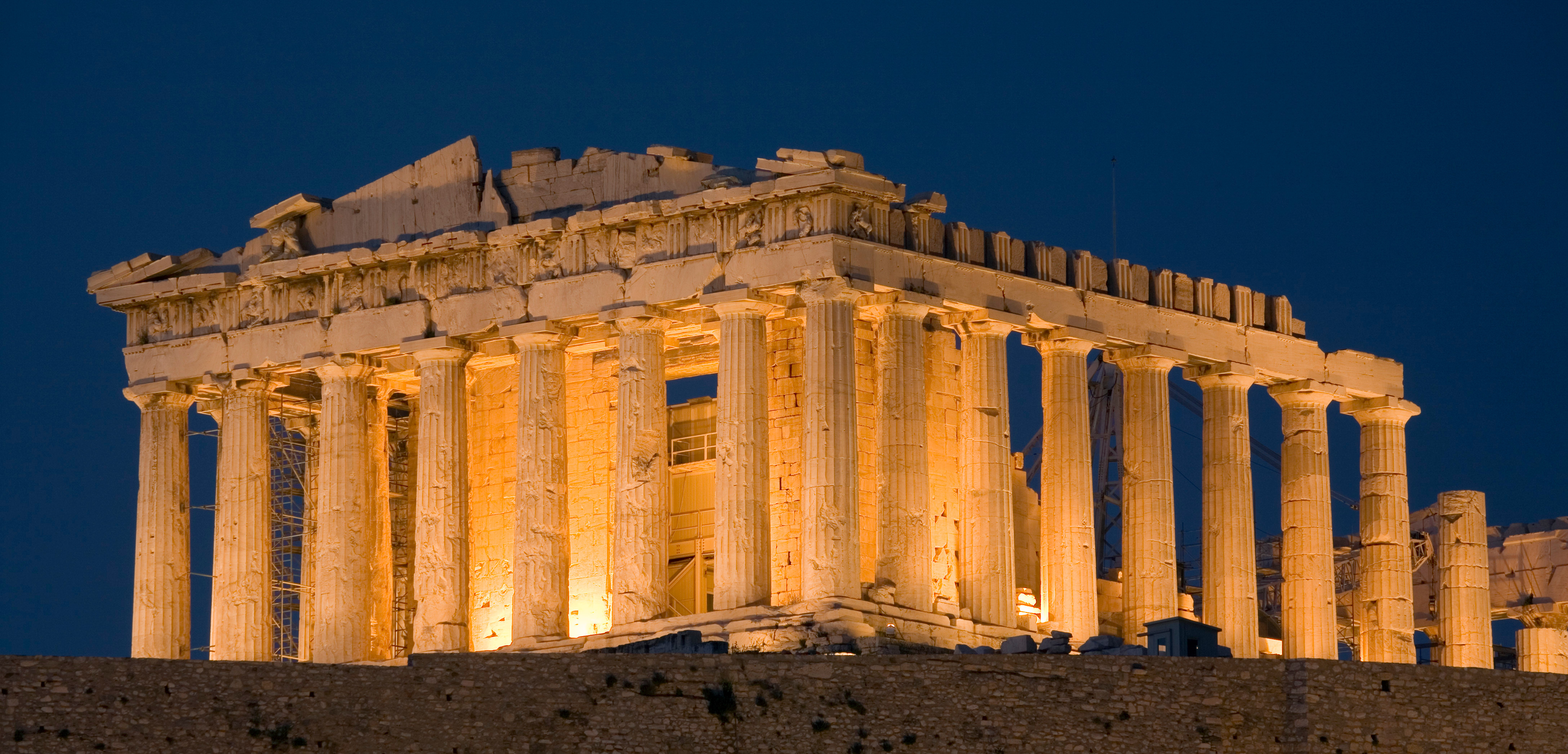
Note to readers: This is the first of a three-part series. I’ve given this first installment the modest title “The Rise of Western Civilization.”
Western Civilization and its political systems are rooted in the Greek culture of about 2,500 years ago. Athens was famously a “democracy” (a Greek word) in its heyday, though only free men born of two Athenian parents were allowed to vote.
Most other Greek city-states, though not democracies, used political systems that recognized a role for the people and had a basic concept of individual rights and ethics.
Greek culture was similar to our own in other ways as well. The Greeks loved live entertainment. Actors, readers, musicians, singers and elaborate physical sets presented multimedia extravaganzas.
This passion for engagement extended to debating issues of the day, not unlike our online debates. They had a concept that speech was not exactly free, but somewhat protected. The death of Socrates for corrupting the youth with his orations might be an exception proving the rule.
Greek gods were depicted as having human forms. This was unusual for the time. In Egypt and Crete, for example, their gods were typically animals or part-animal/part-human.
What defined Greek geopolitics were their long wars with the Persians. Hundreds of rival Greek city-states sometimes came together for alliances against Persia. Nothing establishes an identity for a group quite as well as a common adversary who threatens to enslave or exterminate them.
Those Persians were barbarians in both the Greek sense and the modern sense. In Greek, the word “barbaros” merely means “foreigners.” The Persians were certainly foreigners. They came from what is now Iran, which is across the Aegean Sea and nearly 2,000 miles from Athens.
In the modern sense, too, the Persians were barbarians. They subjected their defeated foes to a degree of cruelty and punishment that generally exceeded what the Greeks meted out.
In that regard, however, it should be mentioned that the first rule of history is not that it is written by the winners. The first rule is that it is written by the writers. Greek writing was sufficiently advanced to record history, while Persian writing was comparatively primitive. We thus have no Persian accounts of the Persian wars, only the Greek accounts.
The Greeks’ recordation of the Persian wars was only a small part of their writings. Better known today are their epic poems embodying much of their culture and beliefs, primarily the Iliad and the Odyssey.
The epic poems, originally oral traditions but reduced to writing early in Greek culture, are still considered some of the best literature in Western Civilization. They’ve influenced Western thought for over two millennia.
The Greeks were never conquered and exterminated. Rather, they were subsumed into the Roman empire.
Technologically, the Romans far surpassed the Greeks. In architecture and engineering, they invented the arch and its three-dimensional equivalent, the dome, which allow for loads to be suspended over a void using materials that are high in compressive strength but low in tensile strength, such as stone. They improved concrete with the use of aggregates and ash to build huge structures that still survive and in some cases are still used such as the Roman Pantheon. Their advances in metallurgy were applied effectively in weaponry, building materials, coins and tools.
They nearly conquered the world – or at least the part they could reach, from England to the Middle East.
When it came to art, however, the Romans never quite overcame their inferiority complex. They adopted much of Greek art, sometimes by slavishly copying it. Roman reproductions of Greek statues were common.
To some degree, the Romans adopted Greek ideas of government, as well. Rome never adopted the direct democracy of Athens but did use the representative democracy of a republic.
Yes, both the Greeks and Romans used slaves, but so did practically every other society in the ancient world, including the societies from which the Greeks and Romans sourced their slaves.
Even after the Roman republic gave way to an empire after Julius Caesar, the Romans retained ideas of individual rights and ethics inherited largely from the Greeks.
In Roman culture, Greek culture thus lived on.
The Romans, like the Greeks, were never really conquered and exterminated. Their culture and language were instead assimilated into the rest of Europe.
The Enlightenment, the Renaissance, the scientific method, and Western notions of ethics and individual rights are all rooted in Roman culture, which is, in turn, rooted in Greek culture.
In America in particular, this was very conscious. Just glance at the neoclassical architecture of the government buildings of Washington, D.C.
Let’s pause. What you’ve just read used to be common knowledge taught in high schools throughout America. You’re probably well aware of it all. Forgive me for boring you with my amateur synopsis.
But I suspect it’s no longer taught to youngsters. In today’s curriculum, Maya Angelou has replaced Homer, Richard Pryor has replaced Ovid, and climate change zealots have replaced Aristotle.
So, humor me – and yourselves. Inflict this synopsis onto some young unsuspecting victim of today’s bastardized school curriculum. Be a hit at Christmas dinner with a dramatic reading!
Note to readers: Watch for the second in this three-part series in a few days, called “The Fall of Western Civilization.”
 the Aspen beat
another column reminding me how
lucky I am that my grandchildren are going to Liberty classical academy in New Castle Colorado we’re part of their education is to learn about Greeks and Romans and ancient Egypt and ancient China and how all those things affected each other and us. Thank you for the reminder My public school teachers in Illinois did teach these things. But that was 50 years ago
Good for you — and your grandchildren!
Bravo Zulu Glenn.
Your brief synopsis of Greco-Roman history during the Age of Antiquity reminded me of an ISI (Intercollegiate Studies Institute) Seminar I was fortunate to attend some twenty years ago … the subject was titled The Roots of American Order.
The various keynote speakers were an array of conservative professors from Hillsdale College and/or other universities, but the professors were all conservative; I remember Victor Davis Hanson speaking at one of these events.
The Roots of American Order are based upon the writings of Russell Kirk, a giant thinker in the 20th Century conservative movement and a close ally of William F. Buckley Jr.
Kirk uses the “analogy of the four cities” to best describe modern day conservatism here in America and our Constitutional Republic. He lists the cities, in this order … Jerusalem, Athens, Rome, and London.
Jerusalem is listed first as it here where the belief of a monotheistic God, the God of Abraham, is first established thereby setting a cornerstone of Western Civilization. You have already covered the next two cities, Athens and Rome, as the next cornerstones. The fourth city is London, and this is from where our concepts of modern economics emanate … think of Adam Smith and his Wealth of Nations.
From these four cities comes a fifth city, Philadelphia, in which our brilliant Founding Fathers took the best from each of the four cities to design a constitution and republic that we are all so lucky and blessed to have, and that we are also so very defensive and protective of. So here, Kirk’s analogy of the four cities kinda morphs into the tale of five cities.
Anyways … I am not writing this to impress you or anybody else. I actually learned about this at the ISI seminars many years after I had graduated from college. Of course, I was never exposed to such ideas during any of my high school government and/or social studies classes, and not during any of my lower level college courses or later criminal justice studies. So, for me, this analogy by Kirk has resonated with me ever since those seminars. I suppose it was as if someone had shot a crystal pure diamond into my grey matter, and everything became much more clearer.
Here are a few links for reference:
https://theimaginativeconservative.org/2013/10/russell-kirk-the-roots-of-american-order.html
https://kirkcenter.org/kirk-essay-order-the-first-need/
https://kirkcenter.org/pillars-of-american-order/
Lastly, I just stumbled upon this link in which Kirk’s concepts will be taught to 6th through 8th graders. This gives me hope for the future.
https://kirkcenter.org/pillars-of-american-order/
G’day … and wishing you a very Merry Christmas.
Bravo Zulu Glenn.
Your brief synopsis of Greco-Roman history during the Age of Antiquity reminded me of an ISI (Intercollegiate Studies Institute) Seminar I was fortunate to attend some twenty years ago … the subject was titled The Roots of American Order.
The various keynote speakers were an array of conservative professors from Hillsdale College and/or other universities, but the professors were all conservative; I remember Victor Davis Hanson speaking at one of these events.
The Roots of American Order are based upon the writings of Russell Kirk, a giant thinker in the 20th Century conservative movement and a close ally of William F. Buckley Jr.
Kirk uses the “analogy of the four cities” to best describe modern day conservatism here in America and our Constitutional Republic. He lists the cities, in this order … Jerusalem, Athens, Rome, and London.
Jerusalem is listed first as it here where the belief of a monotheistic God, the God of Abraham, is first established thereby setting a cornerstone of Western Civilization. You have already covered the next two cities, Athens and Rome, as the next cornerstones. The fourth city is London, and this is from where our concepts of modern economics emanate … think of Adam Smith and his Wealth of Nations.
From these four cities comes a fifth city, Philadelphia, in which our brilliant Founding Fathers took the best from each of the four cities to design a constitution and republic that we are all so lucky and blessed to have, and that we are also so very defensive and protective of. So here, Kirk’s analogy of the four cities kinda morphs into the tale of five cities.
Anyways … I am not writing this to impress you or anybody else. I actually learned about this at the ISI seminars many years after I had graduated from college. Of course, I was never exposed to such ideas during any of my high school government and/or social studies classes, and not during any of my lower level college courses or later criminal justice studies. So, for me, this analogy by Kirk has resonated with me ever since those seminars. I suppose it was as if someone had shot a crystal pure diamond into my grey matter, and everything became much more clearer.
Here are a few links for reference:
https://theimaginativeconservative.org/2013/10/russell-kirk-the-roots-of-american-order.html
Lastly, I just stumbled upon this link in which Kirk’s concepts will be taught to 6th through 8th graders. This gives me hope for the future.
G’day … and wishing you a very Merry Christmas.