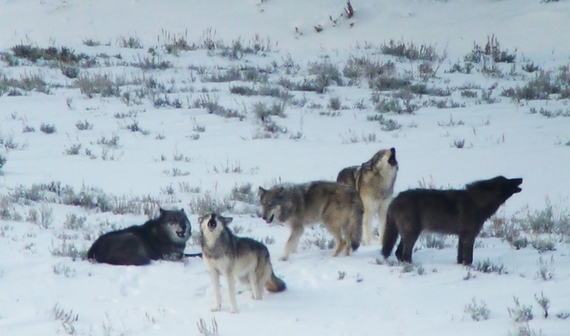
I wrote a piece last year firmly supporting the reintroduction of wolves into Colorado to share the mountain landscape with cattle ranchers. I’ve changed my mind.
My reasoning at the time was that wolves are part of the natural landscape here. They help the huge deer and elk herds by taking the old and weak out for dinner.
As a lifelong hiker and mountaineer, I also liked the mere idea of having wolves in the Colorado mountains even if I never saw one (and I never have). After all, they’d been here for millions of years until they were eradicated in the 20th century.
As for wolves’ occasional predation on cattle, well, that’s the price to pay. Under the reintroduction program, ranchers get compensated for those predations.
But there’s a problem, which I should have recognized back when I wrote that piece.
Wolves are like other predators. They look for easy meals. For a wolf, there’s no easier meal than a calf.
That’s because domesticated cows in a wild setting are not equipped to fend off an attack on a young calf. Cows are big, to be sure – bigger than a deer and often bigger than an elk – but they lack both antlers and speed.
Moreover, a calf has a distinctive scent which attracts predators. In contrast, elk and deer fawns are born with very little scent, and their mothers ordinarily lick them spotless immediately after they are born. Deer and elk usually eat the placenta after giving birth. That, too, lessens the scent around the birth site. Cows out in a forest also do that sometimes, but less often.
Fawns naturally hide in-place in shrubbery and tall grass. Their natural coloration makes them very hard to spot, and their lack of scent makes them very hard to smell. And fawns make for a smaller meal than a calf.
If I were a wolf, I’d go after calves, not fawns. Calves are easier to find, easier to kill, and make for a bigger meal – enough for not only me but also my packmates, some of whom helped me by distracting the cow while I took the calf.
It’s impossible to teach wolves not to kill calves. What are you going to do? Smack them with a rolled-up newspaper each time they kill a calf?
The Colorado state agency responsible for the wolf reintroduction program has made a hash of it. They reintroduced the wrong wolves into the wrong areas at the wrong times. In at least one case, they violated their own written policy by reintroducing particular wolves who were known to be cattle predators. We now have more calves killed than wolves reintroduced.
Maybe a more competent agency with more competent professionals would have done a better job, but I doubt it. Managing the reintroduction of predators into a mountainous cattle ranching environment is a tall order for a few government employees
The end result is this. We have to decide between cows and wolves. In my mind, that decision is not an easy one. Here are some considerations.
First, there’s the tribal consideration. The conservative tribe generally chooses the cows. That’s mainly because liberal tribe chooses the wolves. The liberal tribe chooses the wolves because – you guessed it! – the conservative tribe chooses the cows.
If you’re tribally conservative – or tribally liberal – then read no further. You already have the information you need to make this decision.
The rest of us will want to consider some other factors. It’s true that wolves were a natural part of the Colorado mountains for millions of years. The importance of that fact, however, will depend on your personal aesthetics. It’s also true that malaria has been a natural part of Africa for millions of years, but nobody thinks we ought to preserve it for millions more.
It’s equally true that cattle ranching in the Colorado mountains has a colorful history going back almost two centuries. I don’t particularly like cows (though I do eat them once in a while) but I kinda like their owners, namely the cowboys and cowgirls. You could even say that cowboys and girls are my favorite sort of pickup drivers (but that’s a very low bar).
There are considerations of economics. If we don’t have cows eating grass on the National Forests of Colorado, then where on earth will they?
Texas. A little research suggests that the role of the Colorado National Forests is very small in economic terms. The cumulative “cow-days” of ranching in Colorado National Forests is maybe a few percent of the “cow-days” attributable to the enormous private ranches of Texas. Taking the cows out of Cow-lorado would have no effect on the price of hamburgers.
That’s no surprise. The terrain, climate and acreage of the Colorado mountains is far less hospitable to cows than the grasslands of Texas – even if the grass in Colorado is free because it’s growing on the public lands of the National Forests.
In any event, nearly all cattle from everywhere eventually get sent to feed lots in places like Kansas where they get fattened up for a few months with grain, and then slaughtered.
People sometimes complain that these feedlots are inhumane to the cows. I’ve never been to one, but I can imagine that’s probably true. The slaughtering part in particular sounds bad, but I doubt it’s as bad as being eaten alive by a wolf pack.
On a broader point, one school of thought holds that eating animals, at least sentient animals, is morally wrong.
For me, that’s a hard question. Eating animals is clearly natural, for people have been doing that for as long as there’ve been people. But people have also been murdering one another for as long as there’ve been people (see, e.g., Abel and Cain) and that doesn’t make it morally right.
Where do you draw the line? It’s easy to say that eating dogs is wrong, and it’s a short step to say the same about pigs and cows. But what about deer and elk? Is it wrong for us to eat deer and elk but right for wolves to?
What about eating frogs? What about insects? What about mushrooms and cheese mold? What about apples and pears?
I admit that I don’t like what cows do to my National Forests. Their sheer size is rough on the landscape, muddies the hiking trails, and tramples the small trees.
That’s a small point, I suppose, in comparison to the livelihood of a family that has been cattle ranching for four generations, but it’s still a point. I pay taxes, and those National Forests are partly mine and I own some of that free grass the cows are eating. (OK, it’s not exactly free, since the ranchers pay nominal grazing fees for National Forest access.)
I won’t tell you how I come out on all this after having reconsidered it – whether we should choose the cows or the wolves. It’s largely a matter of competing values and aesthetics. Your opinion is as good as mine.
But I’ll say this: It doesn’t work to have both cows and wolves in the Colorado mountains. Let’s choose wisely.
 the Aspen beat
“The Colorado state agency responsible for the wolf reintroduction program has made a hash of it.”
I don’t have a solution, Glenn. But at least you’ve identified the problem.
Close to Dave Barry.
I always enjoy the articles whether I agree or not. Thanks.
Sunlight grows the grass which we can’t digest, cows convert it to food we can digest. It’s solar powered sustainable calories that would be a shame not to use.
I don’t see it as a real problem. You state yourself the herd size is insignificant. Certainly the number of wolves is the same. Control the size of the wolf population through hunting permits and reimburse the ranchers through vouchers for their lease fees. There should probably be caps on claims, human nature being what it is. Wolves aren’t the only species that likes a “fat one on the ground”.
Pingback: Today’s News 2-11-2026 |
I’m an expert from the government and I’m here to screw up everything because us government experts are never wrong and never misjudge the possible consequences of our actions.
As far as reimbursing the ranchers, how about they agree to absorb whatever losses they incur as a result of leasing property to graze their cattle on rather than buying their own property?
Culling wolf packs via targeted hunting isn’t a bad idea either. Letting the ranchers shoot every wolf they can find on government land isn’t a good idea though.