Don’t it always seem to go
Joni Mitchell
That you don’t know what you’ve got ’til it’s gone
They paved paradise, put up a parking lot
Ooh, bop-bop-bop-bop, ooh, bop-bop-bop-bop
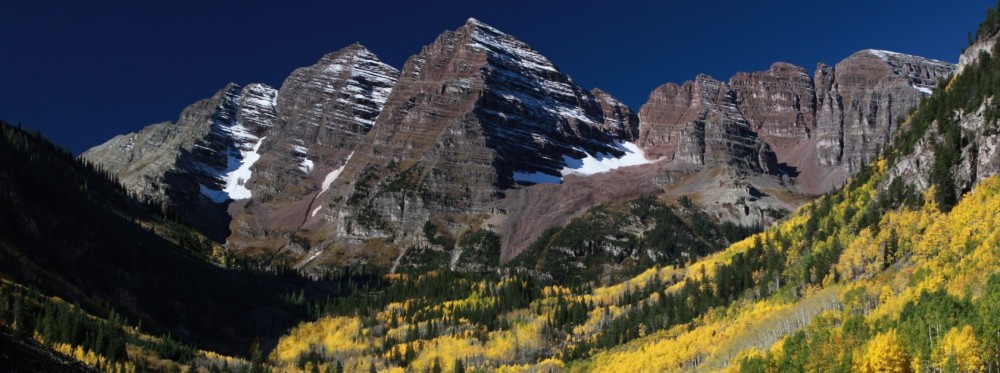
The “Front Range” of the Colorado Rocky Mountains stretches a few hundred miles from Wyoming to New Mexico. It’s where the plains meet the mountains. It’s high plateaus of grasslands, gnarly ponderosa pines and sandstone bluffs.
It’s anchored by 14,107-foot Pikes Peak, named in honor of the 1806 expedition to the region led by explorer Zebulon Pike.
“Pikes Peak or Bust” was the slogan of intrepid gold rush pioneers making their way across the Great Plains to Cripple Creek and other gold camps west of Colorado Springs. Those early gold rushers traveling on foot, horses and wagons were able to see Pikes Peak from the Kansas border 160 miles to the east, where they were still a week away from it.
I grew up a few miles from Pikes Peak, in the shadow of nearby Cheyenne Mountain. After traveling the world and summiting some of the great mountains, I still admire the majesty of what locals and former locals like myself call “The Peak.”
Today, the Front Range is rapidly turning into an extended suburbia. Metropolitan Denver to the north is growing at double the national average. Colorado Springs, 60 miles to the south, is growing even faster. The entire Front Ranch threatens to become a strip city. Call it Denver Dings.
Roughly in the middle of the sprawl is a large, preserved, open space that looks much like it did when Zeb Pike rode through, called Greenland Ranch. It once stretched from the Front Range all the way to the Kansas border. What remains today is about 17,000 acres – about 26 square miles. This fantastic landscape is home to coyotes, elk, deer, bear, mountain lions and prairie dogs.
Greenland Ranch was bought by cable television entrepreneur John Malone five years ago. He has invested tens of millions in the Ranch, but not to develop it. Rather, he spent his money to ensure the opposite. He granted a permanent conservation easement to preserve it forever.
Malone happens to be politically conservative. He donated $250,000 to Donald Trump’s campaign. Like many conservatives, he’s no environmentalist but he does believe in conservation. He therefore worked in conjunction with local governments which bought thousands of adjacent acres for permanent conservation.
As a result of the efforts of John Malone, there will always be Greenland Ranch to remind us of the Old West, whatever bad things happen to the rest of the Front Range.
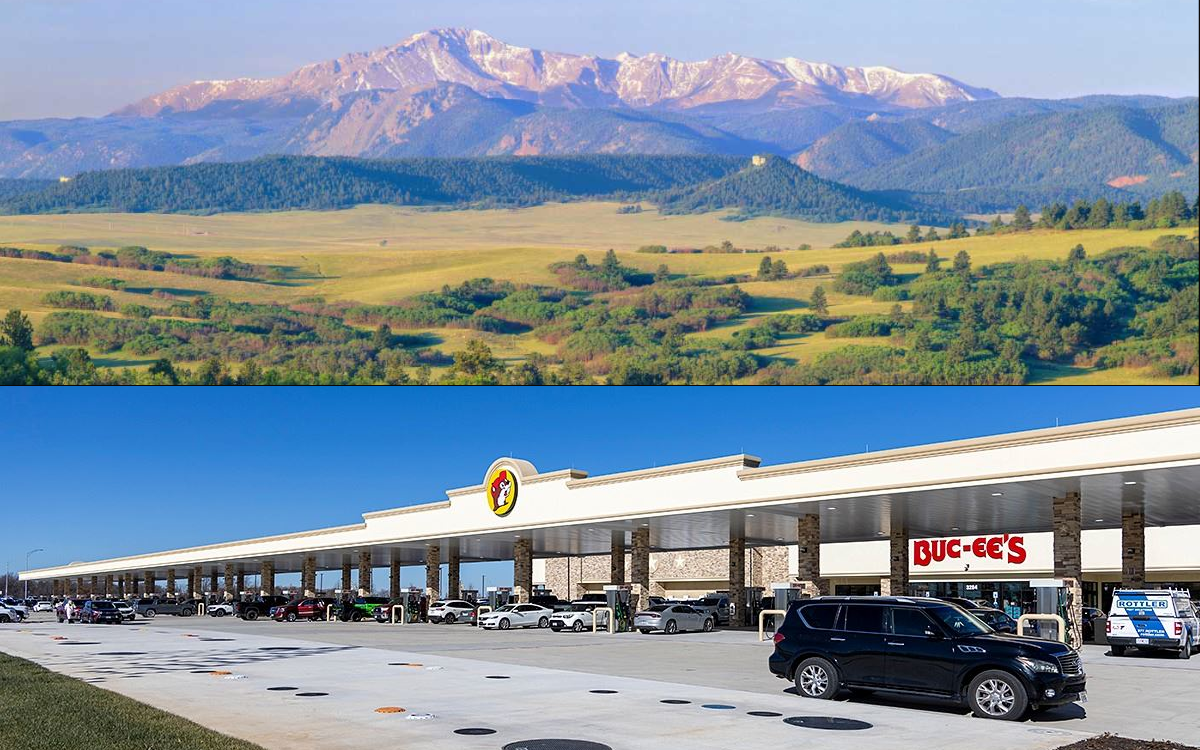
Like Buc-ee’s.
I’m not intimately familiar with Buc-ee’s. It’s apparently a chain of gas station/convenience superstores. Think of a monster truck stop, but without the charm or grace.
Buc-ee’s wants to put up one of its superstores adjacent the Greenland Ranch and open space. They’ve sold the politicians running the nearby local town of Palmer Lake on the idea with the promise that their superstore would generate a million dollars a year in tax revenue.
Politicians like tax revenue.
The locals who are not politicians are less enthused. The issue has sharply divided Palmer Lake between the politicos who want tax revenue and the people who want the semi-wild landscape they came for.
Buc-ee’s proposal is to build and pave about 41 acres. They anticipate 11,000 cars a day and 60 gas pumps.
A recent article in the Wall Street Journal described the imbroglio. It was a decent piece, better than some of the pap that has appeared lately in the Journal.
As interesting as the piece itself, were the comments to it. The commenters were as sharply divided as the town of Palmer Lake, but for a different reason. The reason for division between the commenters was pure tribal politics.
The commenters saw Buc-ee’s as a political statement. To them it’s a symbol of truck stops, gasoline (and gas), fast food, big RVs, and American pie (or at least pie).
And so, the commenters favored or disfavored the Buc-ee’s proposal based on whether they were conservatives or liberals. A sampling:
Buc-ee’s brings much more joy to people than John Malone
Is it that Buc-ee’s is just “too American” for these people?
If you live in a town with either a Buc-ees or a Wawa [convenience store] you are blessed.
The usual Colorado leftist hypocrisy.
Buc-ee’s is awesome and a welcome stop anytime you do a road trip.
Ten dollars says that the Buc-ee’s opponents are card carrying Democrats.
This cult following around a business really shows Americans are starved for culture in these parts of the country.
The WSJ doesn’t have a clue what the spirit of the west is, just a bunch or rich spoiled elitists who think they know better how to live our lives than we do.
You can’t have a Buc-ee’s because it would make the elk sad is about the dumbest argument I have ever heard.
I love Buc-ee’s.
I love the Beaver Nuggets
Anybody who opposes a Buc-ee’s has never been to a Buc-ee’s
For me, the question is not whether Buc-ee’s is an appealing place or not (though I happen to think it’s probably not, to me anyway). Rather, the question is a land use question: Is this the right use for this land?
We frequently make decisions about how to use land. That’s why we have zoning laws.
Unfortunately, the debate over this Buc-ee’s at this particular location has devolved into a tribal fight. Conservatives favor Buc-ee’s because liberals oppose it, and liberals oppose it because conservatives favor it.
It’s today’s American politics in a microcosm. Whether you like Buc-ee’s or not, and whether you favor this particular Buc-ee’s location or not, this much is true: The American political system has become tribalized to the point of dysfunction.
 the Aspen beat
Go to all the trouble to dis Buc-ees and get one key fact wrong. They have no parking for big rigs. Truckers can find a distant spot and hike in…but rarely do. Decidely not trucker friendly.
Buc-ees is a travel plaza, not a truck stop.
Try their beef brisket sandwich once and your ideas about Buc-ees may begin to evolve.
I agree with your sentiment and well-said. I check-in with the “Beat” from time-to-time and find Beaton’s outlooks very refreshing. This time he misses the mark. When he remarks that he is unfamiliar with Buc-ee’s and then can’t resist the snark comparison to “monster” truck stops, Beaton labels himself much to closely with what many readers would deem an “Aspen” attitude, i.e. privileged and stuffy. Since most fly-in anyway, local residents will never enjoy Buc-ee’s famous sandwiches or the immaculate bathrooms. Alas.
You’re proving my point that the matter has become tribalistic.
The pertinent question is not whether buc-ee’s is good or bad, nor is the question whether it caters to elites or ordinary folk. The question is whether it belongs in that particular spot.
Going full tribal obscures the pertinent question and the answer to that question. The result is a blight on one of the last great open spaces along the Colorado front range.
160 miles, a week away. That’s optimism!
Indeed. But these were optimistic people. Remember, their plan was to strike it rich in the gold mines.
Today, the Front Range is rapidly turning into an extended suburbia. Metropolitan Denver to the north is growing at double the national average.
Very much thanks to a pervert(ed) idea of freedom formerly held at bay by a clearly western ethic.
Glen:
I have enjoyed your columns for years. This time I have an issue. My family has been in the locale since 1871. I am not a greedy politician nor a damn liberal. You see this from only one point of view while ignoring the real issues including the survival of one-small-town. The following is a recall of the growth along the Denver/Colo. Springs I-25 corridor since 1967.
So, Buc-ee’s is a bridge too far some say!
In the late 1960’s intelligent people knew that one day, in the future, most of the I-25 corridor would be commercially developed between the Denver, Colorado Blvd./I-25 on-ramp and Colo. Springs. This, then obvious, “change” is now well underway. From that on-ramp about the only thing of note on the east side of I-25 was a restaurant called “The Hungry Dutchman” that looked like a Dutch windmill. The Denver Technical Center was just a gleam in someone’s eye.
Castle Rock was far-far smaller with undeveloped open space visible to the west Front Range Mountains and not much of anything between it and the Monument I-25 exit except for the travel-park to the north of Larkspur. What was there were the many ranches of varying size on both sides of the highway.
Monument’s population was also far less than the 12,000+ of today. There was a place called the Lamp-Lighter Inn, a Phillips 66 filling station, a Dairy Queen, the famous Mug Restaurant, and a shop/studio for locally made pottery by Pankratz. There were a few other small businesses between the open-lot, now a Safeway, and the current I-25 on-ramp, south. From that on-ramp there was little, almost no visible, development until you reached the Gleneagle housing development. Past North-Gate Blvd. and on the east side of I-25, again, there was little or no development other than ranches, ranchettes and so forth until you neared the Academy Blvd. (exit) which consisted of a 3-way intersection with a STOPLIGHT (on the Interstate Highway.) Most folks going to the Springs downtown would pass Academy Blvd. and then take the Nevada Street exit.
The above described opens spaces were filled with Deer, Antelope, Coyotes, Foxes, Mtn. Lions, Raccoons, Gophers and many cattle. These sanctuaries of domestic herds and wildlife where the Deer and the Antelope played were present from the early to mid/late 1990’s.
And then, beginning in the 1990’s along came y’all by the tens of thousands carving out your little piece of paradise which you willingly, if not wantonly, destroyed, slowly at first, then rapidly. Congratulations! This was the change you newcomers brought and the rest of us have, for the most part, lived with all the time knowing resignedly that this change was inevitable. As Joni said,
“Don’t it always seem to go…
That you don’t know what you’ve got ’til it’s gone…
They paved paradise, put up a parking lot.”
It’s sad and funny at the same time that some people are concerned about the loss of “Dark Skies” in our area. The last time, in my memory, that we had close to a Dark Sky was maybe in the 1970’s when on a clear night you might lay in the grass of your yard, let your eyes adjust, then look up and see maybe 6,000 or more stars of about the 100 billion stars making up our Milky Way Galaxy, so many that the stars blended into a white mass of soft light. Today, what you mainly see are the planets and brightest of suns relatively nearby. You want a dark sky? Go to Florissant Colo. which may be the nearest truly dark sky area.
Palmer Lake is a small town of about 2,600 souls and is essentially landlocked on all four sides. There is little room for commercial activity of the type that would generate the tax revenue that is essential (my opinion) to the town’s economic survival. Despite the above, consider this: We support the only local history museum, supported by the town of P.L., and also serving Monument, Woodmoor, the Air Academy, and east to Table Rock. Our lake is small but crowded with folks from all of the surrounding area, often filling up the parking area, which also serves the Santa Fe trail, western access, to the point that residents may have to pay for the right to park and access their own lake as well as the county trail.
Until 2024 this small town has put up the only genuine 4th of July fireworks display in the area since 1987. The event was organized by volunteers who had to raise funding from sponsors of the event. In 2023 the event was loved-to-death by the very-large crowds from everywhere. The costs in time and money to safely put up the event in 2024 made the suspension occur. Hopefully the means to reinstate the fireworks will be found. (There was a fine display in July of 2025.) Local residents have to pay for parking at the main-access point to the trails above the town mainly from the huge influx of non-residents to access the Pike Forest trails.
Some folks say that we should be “good neighbors” to the communities around us and oppose Buc-ee’s. I say we have long been and will continue to do just that even when the Nimby’s we are surrounded by do not seem to give a hoot-in-hell of being a good neighbor to Palmer Lake. Example: A critical and relatively small grant to the areas only local history museum, supported in significant part by the Town of Palmer Lake, was denied by a certain “well-off” community to our east.
We must have enough sales tax revenue or at some future point we may go-bankrupt as a town. This may mean absorption into another town or being an unincorporated part of the county. From what I read here, do the Nimby’s even care, a little? Answer would seem to be NO! [We have a thriving Ice-Cream-Parlor but the towns share of the tax from a single scoop cone is only 15 cents. Real commercial money is required.]
I am a 5th generation resident of the area including Palmer Lake with both sides arriving in Colo. Springs, by covered wagon, in July of 1871. One side initially homesteaded on the grounds of the Air Academy. The other side went into banking and mining concerns around the state.
[The Buc is not a truck stop. Semi’s are banned. It is on the south edge of Greenland already zoned commercial with residential areas to the west and east, hard on the I-25. What dumb bunny would build next to an interstate with an interchange? Our politicians are not greedy nor am I. I simply would like our small town to survive. The revenue required to survive let alone prosper will never be generated by an eatery or two and there is no land in the town that can host an income producing entity that would.
The people of the town are divided, yes. There are the realists who see things for what they are and those who don’t or won’t.
The lot in question is more like 30 acres, not 41. If people want a pristine chunk of land next to an interstate, then pony up buttercup and buy it. Make the owner an offer he can’t refuse!
Greenland will always be there and be spared the mass of humanity that the national parks have to endure. Have you been to Yellowstone or Yosemite during the season?]
I have another post that covers what our poor, almost broke town could do with the Buc Bucks. A million? I’d settle for a 3rd of that.
Roger Davis
Palmer Lake, CO 80133
Director: Lucretia Vaile Museum and retired USCG CWO4 Warrant Officer.
Thanks for your thoughtful comment, Roger.
For the record, I didn’t arrive in Colorado in the 90s. My family moved to Colorado Springs in 1962. I grew up there, went to CU Boulder, then DU Law School, practiced law in Denver for 30 years, and have lived a total of 61 years in Colorado.
I’ve found that many if not most long-time locals feel the way I do about a Buc-ee’s at that location. In contrast, I’ll note that the Texans seem to love the idea.
Anyway, again, thanks for your comment. I’m glad we can disagree without being disagreeable. Glenn