
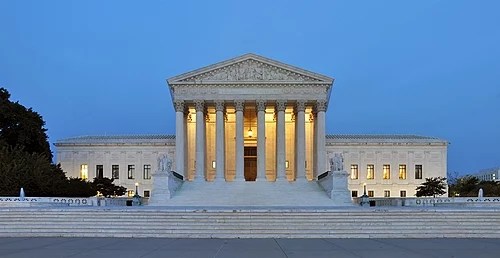
Although this is not what I hoped for, it is what I predicted. The Supreme Court struck down the bulk of the Administration’s tariffs. All three liberal Justices went against the tariffs, and half of the six conservative ones did as well – which included two appointed by President Trump.
Not bothering with any legal analysis, the President instead declared that the six Justices who went against him are “very unpatriotic” and “fools” that he’s “ashamed of.”
He went on to call them “pooh-pooh breaths.” OK, I made that one up.
Years ago, another public figure employed similar language to criticize the Supreme Court. He characterized the Justices as “black-robed despots” for whom he had “utter contempt.”
That was after the Court unanimously declared racially segregated schools to be unconstitutional. That public figure was Alabama Governor George Wallace.
Bullying the Supreme Court didn’t work back then, and it’s not working now.
Let’s take the President’s name-calling one epithet at a time. First, the President says the Justices are “unpatriotic.”
OK, Mr. President, here’s something non-legal that you should be able to understand. At big law firms, each of these Justices could be making ten to twenty times their present income. They instead choose to be judges to serve the people as best they can.
Deciding a case against you, Mr. President, does not make them unpatriotic.
They’re “fools” you say? At least seven of the Supreme Court Justices are extraordinarily smart lawyers with sterling backgrounds, and the other two are no slouches.
In contrast, your own legal background consists of being sued a lot.
And, Mr. President, you say you’re “ashamed of” the Justices?
Frankly, it comes as news to the country that you’re capable of shame. I voted for you three times, and your shamelessness continues to astonish me.
So, disagree with the Supreme Court – I sometimes do. Criticize their legal reasoning – it’s occasionally wrong.
But recognize that the job of a judge is not to be a Republican or a Democrat. The job is to apply the law of the land to the facts of the case.
If you personally don’t understand the law applicable to a case, or if you don’t have all the facts, then you aren’t criticizing. You’re just spouting off.
When that spouting off crosses the line into name-calling of dedicated professionals, you’re just being childish. I want more than that in my President.
Glenn K. Beaton practiced law in the federal courts, including the Supreme Court.
 the Aspen beat
More from the wonderful people who brought you Dred Scott?
I’m pretty sure those were different people.
I’m pretty sure those were different people.
Nevertheless, the same institution. What I am saying in an oblique way, though not in the way that should go over the head of anyone whose IQ exceeds their temperature (in degrees F), is that the problem is the institution, not the people who are members of it at any given time.
I was in their building once, on State of the Union day in 2012. Coincidence that it was that day, I was visiting a relative I had not seen in decades and we went to Washington on that day. All I can say is that the Supreme Court building is one of the strangest places I have been in my life and that I have never been around a bunch of people who had a higher opinion of themselves that the justices obviously had.
Anybody who belongs to the same institution that produced Dred Scott ought to have at least a little shame and as little doubt about themselves. I didn’t see it.
Now, to what was wrong about Dred Scott. All of C.J. Roger Brooke Taney’s waxings on the subject of race aside, everybody knew that a chattel slave was a human being in a condition of bondage and that special rules had to apply because of that fact that did not apply to normal personal possessions. You could not treat a chattel slave like that person was a simple possession to which the owner had unlimited rights, kind of like their suit of clothes, their pocket watch, their boots or their tobacco pouch.
But that was exactly what the Supreme Court did in that decision. It invented a 14th Amendment right to the equal use of all property everywhere the jurisdiction of the United States existed, before there was a 14th Amendment.
The Court may rule differently in different cases and maybe the membership matters. The principle is always the same though. The Court’s decisions are always based on the same errors of thought, and the rest of us spend our lives trying to work our way around what the Court does. At least Ruth “Why does she need three name, she’s not on death row?” Ginsburg was forthright about what she was doing. She once said something about how being a justice meant “deciding what the features of society were going to be.”
All true, and how have they done? For that matter, who intended for the Supreme Court to be the institution that had that power?
Contact me, Glenn, through my sign in email, and I’ll tell you more.
I practiced law before the Supreme Court. Suffice to say that my experience with the Court and the Justices in the course of a 30-year law practice was significantly different than your experience in visiting the building once.
As for your point that the institution is to blame for the Dred Scott decision, I suppose that’s true in a sense. In that same sense, however, then they are also to be credited with the decision in Brown v. Board of Education.
Your notion that current institutions should be blamed or credited for bad and good things they’ve done in the past, has broader application. For example, you’re left with blaming the papacy for bad things that popes did in the Middle Ages.
By the same token, since, in your view, credit and blame lies in an institution and not the people running it, then you should credit the bad popes of the Middle ages with the good things that popes have done recently.
For that matter, I suppose it would make sense to blame the white people of today for the slavery conducted by their race centuries ago.
I’m not comfortable with that. For me, existing people and their current institutions deserve credit and blame for only the acts they themselves are responsible for.
BTW, I’m sorry that the Justices did not make you feel at home when you visited the Supreme Court building. It’s possible that they had other things on the agenda that day. But they should have at least offered you a cup of coffee, showed you around, and apologized for that Dred Scott decision . . .
The justices were not in the building when I was there. If they had been and I had seen one of them, they might have made me feel more at home than I did just looking the interior of the building, the statuary and the oil painting outside the chamber. I think they come into the building and their chambers by a back entrance though. I asked in the cafeteria if any of justices ever came in there. The worker told that the only one who ever did was Elena Kagan.
I stick with my argument. Dred Scott is the measure of the flaws of the institution. The reasoning and construction of the 1954 Brown v. Topeka decision was pretty insipid too. I don’t dispute the finding itself. Where I grew up, you lived in the same neighborhood, you went to the same school, and we did.
The Brown decision was highly based on Kenneth Clark’s doll studies. What? Basing one of the foundational legal findings in the history of world jurisprudence on pop psychology? Not worthy and bad in its impact too.
I have seen videos of what are purported to be the doll studies, and I believe they are authentic. First of all, the dolls did not look like the kind of dolls kids play with. The kids themselves looked like they were dumb as rocks, not lively kids. They possibly were very fatigued too. The setting itself looked harsh and outside of normal experience and the kids looked like they were intimidated.
To me it looked what the kids were doing in their six and seven year old way was reaching for the answers they thought the researchers wanted to hear.
Not only that, but how do you know that just because the kids picked the white dolls, it meant what the researcher said it meant. Maybe it did, but you still have to prove it. You have prove not only that the kids picked the white dolls, but that the fact that they did also proved that they had been brainwashed into believing that white was better.
Remember what I said. I said that where I grew up, you lived in the same neighborhood, you went to the same school.
As far as I am concerned, the only foundational racial ruling the Supreme Court ever made which was properly reasoned was Plessy v. Ferguson (separate but equal), and let me explain. Plessy v. Ferguson was lipstick on pig and under the circumstances a necessary exercise in legal realism. What Plessy v. Ferguson actually represented was an order to the former slaveholding states to provide facilities and services to blacks which were nominally equal to those provided to whites.
The Southern states did in fact dutifully comply, particularly in education, where they created actually parallel educational systems through the level of master’s degree study. Don’t get lost in the weeds of self-righteousness. I said parallel and nominally equal, meaning the systems offered the same levels through all grades up master’s degrees. They were not fully equal but the survivors of the process did end up equal nevertheless.
I know a little bit about survival myself. I sometimes call myself a poverty survivor, and I am. If something can kill before your time and you live through it, then you are a survivor. Maybe the survivors of segregated education were better off than I am. At least they had a parallel system they could progress in. I didn’t and I don’t.
The 1948 restrictive covenants decision was another properly reasoned racial decision. It was based on the simple idea that the constitution from the 14th Amendment forward said there was only one kind of citizen. Loving v. Virginia had the same basis. These decisions were not foundational on the level of Dred Scott, Plessy v. Ferguson, Brown or Duke Power.
I am not going to hold forth on the topic of the disparate impact (affirmative action) system. If you have practiced before the Supreme Court, you should have enough ability as a researcher to find me based on my handle here (casteanddestiny). You can read my master’s thesis in literature, which is descriptive of ethnic and racial caste in America and you can contact me and ask me what my take on the disparate impact system is too.
I meet the legal definition of a public figure even though my name is not known. You don’t have to be nice.
First, you say this is from “the wonderful people who brought you “Dred Scott.” When I point out that it was a different set of people who brought us Dred Scott, you tell me you weren’t talking about the people, as any moron would know notwithstanding your use of the word “people,” but the institution.
Then you say that based on your visit to the Supreme Court building, you “have never been around a bunch of people who had a higher opinion of themselves that the justices obviously had.” But then you admit that you never even saw a single one of them in the course of that visit or any other.
Then you retreat to criticisms of Dred Scott. That’s not exactly new ground. Dred Scott has been roundly criticized for nearly two centuries. The Justices who decided it have been dead for over one century.
Nonetheless, you still maintain that this decision in the century before last is “the measure of the flaws of the institution.”
Absent from that overreach is any explanation as to why. As in, WHY is a decision two centuries ago — which has since been both overturned by Constitutional Amendments and disavowed by the Supreme Court itself — still the measure of the flaws of the institution?
As for “finding you” and reading your . . . drum roll . . . Masters Thesis in Literature (Ohhhwwww), I couldn’t care less about you or it.
Bye.
I call the Dred Scott decision the measure of flaws of the institution (the Supreme Court) because it points to how the Court, when it steps beyond the matters of normal law and gets into making major decisions about what the features of society will be, produces travesties. Confronted by the Dred Scott case, the Court had two choices essentially. One of them was to find the obvious – that a chattel slave was a human being in a condition of bondage, a circumstance to which special rules had to apply. The other choice was to say that the chattel slaves was an item of personal property to which same rules that governed your ownership as use of personal property applied.
Dred Scott was an especially bad decision because the existing body of law governing the institution of slavery was based on the former concept, not the latter.
I’ve covered this ground already. There were two dissents in the Dred Scott case. I should find them and read them if just to find out if they support my view.
Of course, the membership of the Court matters. Good membership helps ameliorate the defects of the institution. But it doesn’t fix them or obviate them. They are still there. That’s my argument, and now I have a question.
What makes the Supreme Court so special that other people cannot have an opinion about the Court as an institution, that they are required to believe that the character of institution is determined only by what the membership happens to be at any moment and not by any enduring factors, and that they are not allowed to believe that the members are not particularly qualified to make the major decisions they do about what the features of society will be.
Let me go about why I think I got (or “groked” to resurrected a hippie era term) what the Court is about. First of all, I’m just good at it. Sorry, but I am.
There was another thing that happened during that trip which bears on the same idea. While I was visiting my relative in Virginia, we also visited the historic Berkeley Plantation east of Richmond. I think I got what that was about too.
What? Because there were no – sorry I can’t say the word – there out in the site of the quarters, working in the big house or out in the big field, it wasn’t possible that I understood what the plantation was about and what life there was about both for the overclass and the slaves?
Now let me go on to my thesis. Having an academic graduate degree makes me an accredited member of the intelligentsia. Because I studied at a public college which does not offer doctorate degrees and I knew that there were going to be people who based where I had earned my graduate were not going to be willing to accept that the degree merited recognition, I knew in advance that I would have to force on them the idea that my graduate degree was a valid degree.
My thesis is entitled “Caste and Destiny: Literary Naturalism in the Prairie and Southwestern Fiction of Willa Cather”. You should have no trouble finding it. It’s in WordPress and in Google Scholar. Probably in other places too. The part I send people to, although I don’t think anybody has read it, is the second chapter called “Literary Naturalism and its American Iteration.”
You should read it. There’s nothing in it that requires detailed knowledge of any fictional work and it is only about 7000 words. The first chapter of the thesis is the weakest, unfortunately. I offered to stay and put more work into it. The department did not want to extend the time limit probably because it was bureaucratically complicated even with COVID going on. Most of the formatting is lost in the WordPress version. I put it up there for people who know me to read.
I don’t know what business you had with the Supreme Court or what the cases were. I had a friend whose girlfriend was an immigration lawyer in San Francisco. She once said something about communicating with the appeals court and Supreme Court. Maybe you should name the case you were involved in and report whether you won or lost. Or if you did not personally argue the case in front of the justices, come clean about what you did or what contact with the Supreme Court you had. Honestly, I don’t think that someone who had regularly argued Court of Appeals and Supreme Court cases would express themselves as you have, but I do know that it is not impossible for you to have been there, to have been part of a case behind the scenes or have had contact with the Court.