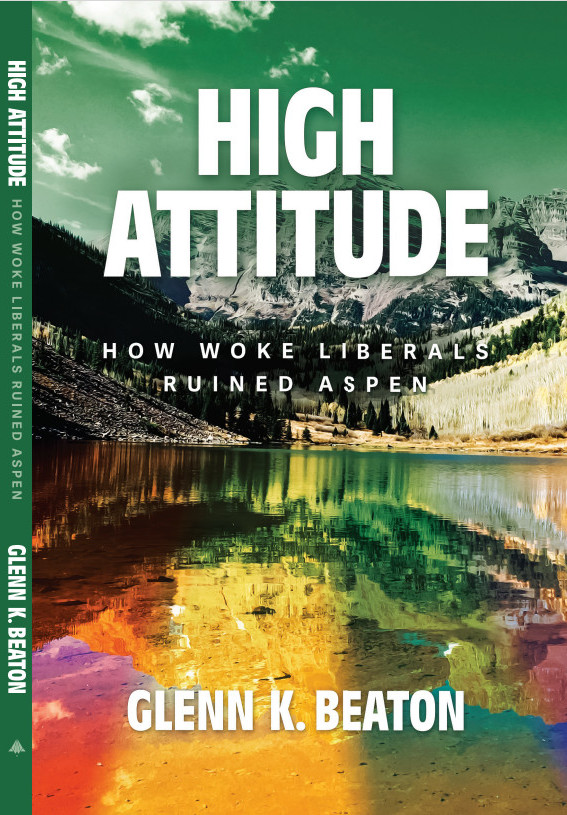
Glenn K. Beaton is a writer and columnist living in Colorado. He has been a contributor to The Wall Street Journal, RealClearPolitics, Powerline, Instapundit, Citizen Free Press, American Thinker, Fox News, The Federalist, and numerous other print, radio and television outlets. His most recent book is "High Attitude — How Woke Liberals Ruined Aspen"
Despite whatever click-bait headlines you’re seeing on Fox News, and the predictable rage of rage-aholics, it’s been reported by the Wall Street Journal that Republicans and Democrats have basically reached a debt deal. Credit the skillful negotiations of Republican Speaker Kevin McCarthy and the fumbling negotiations of President Joe Biden.
Biden’s opening card in this game was something he specializes in: nothing. He gambled this spring that he could portray the Republicans as intransigent extremists by refusing to negotiate with them, and the Republicans would wind up having to simply raise the debt ceiling without any concessions from the Democrats. More borrowed money to spend now and repay later, and no conditions on spending it.
This has been a very emotional time for me. The time I’m referring to is the seven decades in which I have lived or, rather, until my recent discovery, merely existed.
From the time I was born, I was uncomfortable with the society-imposed notion that I was sometimes wrong. I knew deep down that it was a lie. I knew deeeeep down that I was an infallible trapped in a fallible body. I knew deep down that I’m always right.
It hurt. It hurt to be told by infalli-phobes that I was not infallible. How dare they! Teachers, parents, friends, and aye, even – especially – lovers, told me I was not perfect. They hurt me. That makes them wrong. And evil.
I was … ohhhhh, it hurts to re-tell this … I was cut from the freshman baseball team when I was about 14. There I was – infallible at ball and all – and the shop teacher/coach – the shop teacher! – cut me. Thinkin’ I should sue his estate, but shop teachers tend to be judgment-proof. No matter. I’m totally over it now.
In a 168-page commentary by a former wisenheimer local newspaper columnist, one doesn’t expect to find the breadth and depth of Alexis de Tocqueville or the wit and wisdom of H.L. Mencken when it comes to vibrant, insightful social analysis.
But in his newly-published book “High Attitude: How Woke Liberals Ruined Aspen,” Glenn Beaton has his moments.
Here’s one of them: “Aspen and the rest of America changed in the ’60s, in some ways for the better but mostly for the worse. America recovered, but Aspen never did.”
I guess this explains why, when I first came to the valley 14 years ago for the first time in 30 years, I was seeing men my age looking and acting pretty much as they had, say, in 1970 — with pony tails, tie-dye, a religious belief in the redemptive power of art and “sustainability,” and an absolute giddiness in anticipation of the first pot dispensaries following the legalization of a drug that profits no man, apart from the money to be made.
Let’s face it: Aspen and its environs constitute a uniquely hybridized subculture that, like most others, is intoxicated by its own importance and largely dismissive of what it has taught itself to dislike.
Enter an alien intelligence, with origins in conservative Colorado Springs and a truly liberal education leading to endeavors in both civil engineering and the practice of law and ultimately to his present career as a freelance gadfly, who likes to hold one of those illuminated, magnifying cosmetic mirrors up to our faces, revealing, well, whatever it reveals.
And while he is at it, he also provides us with a basic literacy in our prior history. Like most people strolling down Main Street, I didn’t know Paepcke from Plato, as Beaton puts it; but thanks to his book, I’ve developed a considerable appreciation not only for Elizabeth and Walter Paepcke, but for people named Wheeler, Fiske, Litchfield, Pfeifer, Anderson, and other “founders” of present day life in Aspen.
And, alas, I am also far better acquainted with the adventures of people named Thompson (a person for whom “narcissism is too generous a term,” says Beaton), Braudis, Grabow, Sheen and Mueller, Sabich and Longet, Trump and Maples, multiple Kennedys, and many others — those who prompt Beaton to opine that “if America in the ’60s was like a conventional mom and dad who occasionally got drunk and passed out, (post-’60s) Aspen was like their 13-year-old kid who got into meth and never recovered.”
His history of the place, from Ferdinand Hayden’s 1873 survey through Skico’s contemporary paternalism, is basically a parade of foil characters who mirror each other’s virtues and vices. To appreciate the integrity of the Aspen Center for Physics, for example, one only need consider the steadily more partisan, virtue-signaling, woke drift of the Aspen Institute Ideas Festival and Aspen Music Festival and School.
To understand true, selfless, largely-anonymous virtue, as distinct from feel-good displays of moral superiority, one only need consider the men and women of Mountain Rescue Aspen.
It’s all there in front of us. What Glenn Beaton does is sharpen our vision and periodically allow us to laugh.

 the Aspen beat