More Fear and Loathing

Hunter S. Thompson — gonzo author of “Fear and Loathing in Las Vegas” and keeper of dynamite in the basement and toxins in the refrigerator — was the last of the Aspen undomesticated types.

In my recent column, I lamented the substitute poseurs who are more interested in conventional socialism than unconventional socializing.

Indeed, as I noted, we’re now so lacking in fearsomeness and loathsomeness that the sane and sanitized readers of Travel + Leisure voted Aspen their “favorite town.” Ugh. Readers emailed me, called me and even stopped me on the street to add names to my growing list of extinct and endangered exotica. So here are a couple more:

Meet Claudine Longet. Born in Paris, this winsome woman danced in Las Vegas well before Thompson arrived. One day, she had the good fortune of her car breaking down — because her rescuer was one Andy Williams. They married a year later when she was 19.

By age 21, Continue reading

Fear and Loathing in Aspen

Hunter S. Thompson was a gritty character. He was a member of the National Rifle Association. He accidentally shot a person while attempting to scare a bear away. In his house near Woody Creek, he kept dynamite.

He never graduated from high school. He worked for Time magazine till it fired him for insubordination. He once was charged as an accessory to robbery.

His breakthrough novel was about the Hells Angels. For that, he lived with the Angels for a year till one night they beat him almost to death. He later wrote a series of deviant “Fear and Loathing” novels beginning with the classic “Fear and Loathing in Las Vegas.”

He once said, “I hate to advocate drugs, alcohol, violence, or insanity to anyone, but they’ve always worked for me.”

Whatever you think of how he wrote (well) or lived (less well) or died (badly), say this for the guy: He was a true character.

I thought of Thompson when I saw that the buttoned-down readers of Travel + Leisure magazine recently voted Aspen their “favorite town.” What’s next? Will Aspen be Continue reading

The Umbrella

My recent walk of the Camino de Santiago — the ancient 500-mile pilgrimage/trek across Spain — was not always as bucolic as I might have implied in my recent series on the subject.

One day, I took an off-Camino route (deliberately that time). It was a long, challenging, hilly route through obscure countryside that seldom saw a pilgrim. Every few miles was a half-abandoned town of a few pathetic buildings losing a centuries-old battle with nature.

It rained hard all day. Little droplets came down in sheets in the gusty wind. After a couple of hours, I was really wet and starting to shiver. My boots filled with water, which squished out with every step.

Every so often a car would roll past me on the potholed, one-lane road. Sometimes the driver would stop and ask who I was and where I was going since I was clearly not on the Camino and perhaps not of this planet.

In some of the dilapidated towns were the remains of bus stops, though quite obviously no bus had come through for decades. They were just rusted-out, weed-infested lean-tos of corrugated steel. I would stop at each so that I could consult my GPS out of the rain, mostly.

Then I got a break. At one of the bus-stop ruins, my guardian angels who always got me into and out of so much trouble, had left me an umbrella. I couldn’t believe my luck. It was a pretty nice one, too. I decided this rainy clime was like Seattle, where everyone accidentally swaps umbrellas on the bus (never mind that the bus stops here were obviously in disuse).

So I helped myself to the umbrella. I promised those angels that I would avoid overdrawing my karma bank by dropping it off somewhere down the way.

The umbrella helped, but I was already soaking wet, and besides, the umbrella did nothing to shield me from the portion of the rain that came down sideways. At one point I tried to calculate my elapsed mileage based on my elapsed time. When I was unable to perform the simple arithmetic in my head, I realized I was in the early stages of hypothermia. I considered knocking on a door of one of the rare inhabited houses and asking for a cup of coffee.

I also realized, however, that I looked irresistibly pathetic. I presented a shivering, drenched pilgrim with a backpack and umbrella bracing himself against the buffeting, wet wind as he shuffled along with water squishing out of his boots. Wearing shorts.

Surely one of the infrequent cars would stop and I’d be offered a ride. I decided I would allow myself to be talked into accepting one.

Sure enough, one stopped and I was offered a ride. I pretended to resist. We went back and forth in his Spanish and my Spanglish. I pointed to the umbrella and tried to assert that it helped a lot. He kept saying “no.” He didn’t seem to think the umbrella would help much. His wife was in the passenger seat, and his 6-year-old daughter was in back. He kept looking over to the wife, and they would talk fast between themselves, too fast for me to understand. The little girl just stared at me through the back window.

I finally decided that my pretended objections to accepting the ride had gone far enough to preserve my dignity, so I reached for the back door to let myself in. Just then, the driver finished an exchange with the wife. He looked right at me, pointed to the umbrella, and said slowly and distinctly and loudly:

“That ours.”

Mortified, I realized that he had no intention of letting me into his car. He was there simply because someone had stolen the family umbrella and he wanted it back. I stammered two of my most used Spanglish phrases, “gracias” and “lo siente.” He was unimpressed with my thanks and apologies. He just wanted his umbrella.

I shook the water off it, folded it up, handed it to him and again mumbled “gracias.” He snatched it, rolled the window up, hit the gas and spun into a 180 and roared back toward town. The little girl in the back seat was scowling through the window as if to say, “Filthy wet umbrella-stealin’ pilgrim.”

And I stood in the middle of the road alone in the wind-whipped rain.

Published in The Aspen Times on Nov. 10, 2013 at http://www.aspentimes.com/opinion/8801369-113/umbrella-bus-stop-wet

Mountain Climbing for the Over-50 Set

If you thought the 14th hole was pretty that time a rainbow settled onto the green, wait until you get up at 2 a.m., climb into a sky with more stars than you’ve ever seen, and watch a “snowbow” form over the Emmons Glacier at 12,000 feet as the ice crunches under your boots.

Such are the glories of mountaineering.

Many people are trying their hand at guided climbing in later life, and with good reason. The scenery is stunning; the goals are challenging but achievable; and the rewards—physical, emotional and spiritual—are hard to top. The bonus: Because climbers never go faster than 3 miles an hour, at least not on purpose, guided climbing is safer than most people think. (No, it isn’t safer than golf, even when you consider there is no cart involved. So if being safe is your only objective, this might not be your game.)

WSJ pic

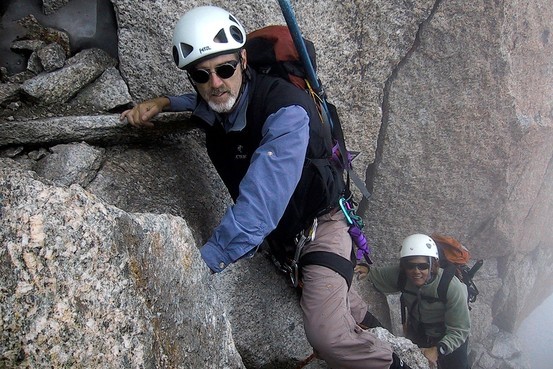
‘The rewards—physical, emotional and spiritual—are hard to top’: The author on the Zinalrothorn in Switzerland.. Howie Schwartz

I grew up in Colorado Springs, Colo., with a love of the mountains. When I was 11 years old, my father, older sister and I hiked up and down Pikes Peak—all 25 miles of it—in a single day. After college, and while practicing intellectual-property law, I “peak bagged” (reached the summit of) the 54 Colorado “14ers” (mountains with elevations of 14,000 feet or more). I vacationed in the mountaineering centers of the Alps, the Spanish Pyrenees, Peru, Canada, Alaska and Mexico, and stood atop classic peaks like the Matterhorn and the Eiger (both in Switzerland) and Mount Cook (in New Zealand).

I gradually became what I had imagined long ago: a real climber. I completed the transition from hiking late, but not too late. I got serious about climbing in my late 40s and became a competent mountaineer in my early 50s. I’m not alone. Every year climbers in their 50s and 60s stand atop Mount Everest. The strongest high-altitude mountaineers are often in their late 30s or early 40s.

So how do we—the over-the-hill crowd—get up the hill? Here are some things to consider: Continue reading

All the Way

Editor’s note: This is the last of four columns about the writer’s walk of a 500-mile pilgrimage/trek across northern Spain dating back to the Middle Ages called the Camino de Santiago, or “Way of St. James.”

At the noon worship show in the Cathedral de Santiago, the highlight for pilgrims is when they swing a big smoky thing around, called a “butafumiera,” which is Latin for “big smoky thing to swing around.” (Yeah, it’s all fun and games till someone’s eye gets knocked out.)

Later I showed a church clerk my “pilgrim passport” with colorful stamps from Waystops spanning my 500-mile walk so that they could give me a certificate stating that I’m forgiven for my sins according to some guy from the 12th century who wore a lampshade for a hat.

The clerk pretended to inspect my pilgrim passport, asked some questions in Spanish that I didn’t understand, got some answers in English that she didn’t understand and then looked up “Glenn Beaton” in a book to get the Latin translation because they write the name in Latin on the certificate because, I guess, St. Peter doesn’t read English or Spanish.

The book had no Latin for “Glenn Beaton.” That made them suspicious. Continue reading

The Hard Way

Editor’s note: This is the third of four columns about writer Glenn K. Beaton’s ongoing walk of a 500-mile pilgrimage/trek across northern Spain dating back to the Middle Ages called the Camino de Santiago, or “Way of St. James.”

People ask, “Why?” Why walk 500 miles across Spain? Isn’t it hard on the feet? Isn’t it boring?

Yes, it’s very hard on the feet. And ankles, shins, knees, thighs, hips, back and shoulders. No, it’s not boring. It’s fascinating and beautiful.

As for “Why walk?” that question takes us down a path to bigger ones. “Why do anything?” In short, “Why are we alive?”

On my first Camino a couple of years ago, the walk was hard. It was the coldest and wettest April in decades. A fierce headwind drove rain, snow and sleet into my face, tormenting my bad eye for a month as I slogged through deep mud and slush. In my journal, I wrote that people who say God is all around us don’t get out much: It’s really the other guy who is all around us. I screamed and cursed at the demented wind.

Also taunting me was the knowledge that pilgrims have been doing this for 1,100 years, some barefoot and diseased. Old cemeteries and the ruins of medieval hospitals reminded me that many died along the Way. They pilgrimmed themselves to death.

For them it wasn’t adventure travel, but a war for their mortal lives and eternal souls. How could they be so strong and I so weak?

One day, I quite literally stumbled onto answers. Physically and emotionally exhausted, I stopped fighting. I surrendered. I decided that I would let go of the pain and the cold and the worry, and my vanity and pride too, and simply put one foot in front of the other till he stopped me. He didn’t.

My surrender accidentally succeeded, and that day by grace this pilgrim pretender was made a real one. Weeks later, half a thousand miles of walking behind each of us, humbled faces wet with rain and sweat and tears, I stood with other pilgrims before the Catedral de Santiago.

This time a different challenge presents to me. If last time the challenge was to answer the question, “Why do we live?”, this time it’s to answer the question, “How?”

Upbeats

The Celts dominated Europe at one time but were overrun by Romans and Germanic tribes. They wound up squeezed into a few remote corners like Ireland, Scotland and this spot in the northwest corner of Spain that they call Galicia. Red hair is common, and the style in women’s fashion this millennium seems to be the same as the last three: long legs.

The Celts went into battle wearing nothing but paint. They had no written language but were the finest metal-workers in the world, especially in silver, an artistry that survives in tiny jewelry shops. Many people here understand the ancient Gaelic tongue and some speak it as their first.

I was accosted by one such person a few towns ago and allowed him to drag me into his restaurant for dinner. What a dinner. Thick Galician soup, grilled chicken, cheesecake, another incredible local wine, all in a stone building that has been hosting pilgrims for a thousand years.

Blue eyes twinkling, the accosting owner talked and talked as he served me. Boar haunches hung from dark timbers. Though I understood not a single word he said, I gathered from all of them together that he runs his little restaurant because that’s what he enjoys. I told him he has a bueno restaurante.

After dinner he insisted that we throw down shots of grappa at the bar. As a person whose grandfather immigrated from Aberdeen, I like to think he recognized in me a fellow Celt, but he might have just recognized in me a fellow drunk.

Whatever the reason, we drank till the wee hours. Well, till 10:30 anyway. Others apparently lacked the capacity for alcohol of us two Celts, for they kept laughing and pointing our direction.

He invited me back for deseyuno at 10 a.m. the next day so that we could get an earlier start on his hydration schemes. But I had a date with the Camino, most of which is now behind me.

Published in The Aspen Times on Oct 13, 2013 at http://www.aspentimes.com/opinion/8451020-113/beaton-walk-camino-celts

Still on the Way

Editor’s note: This is the second of several columns about Glenn K. Beaton’s ongoing 500-mile pilgrimage-trek across northern Spain, a walk that dates back to the Middle Ages and is called the Camino de Santiago, or “Way of St. James.”

There are as many caminos as there are apostles. This time I’m walking the Camino del Norte, the northern route along the Atlantic coast of Spain.

The terrain is complicated, rugged and spectacular. Bays, harbors and estuaries separate the sea from hills, mountains and canyons. Silver salmon swim cold, clear creeks. The rocky coast of the Atlantic lies to your right and the mountains of the Picos de Europa to your left.

The Way sometimes clings to a seaside cliff by a cable and sometimes just shoulders a four-lane highway. Sometimes you’re on stone pathways laid by the Romans.

Mostly, it’s dirt trails that have been walked since the Middle Ages through lush woods, vineyards, orchards, fields, pastures, hills and meadows. In the ancient villages, old men in the plaza look up from their dice game to mumble, “Buen Camino,” children laugh and chase, women walking arm-in-arm nod, dogs bark, and once they rang the church bell 12 times to celebrate my noon arrival. It was so much excitement for the day that everyone then took a nap.

Pilgrims are rare in late September on this camino, and the silence between villages is broken by only the shuffle of your feet and the dinging of cowbells. I occasionally stop to pick wild blackberries. Untended boxes along the Way sell apple cider (it’s fermented, I learned) on the honor system.

Downbeats

A couple of weeks ago, I got off-route again. Walking through a gorge, I passed under a bridge that went my desired direction. I scrambled up the steep wall of the gorge to reach it.

I discovered that the bridge over the gorge was a train bridge. It was very narrow with a set of waist-high guardrails guarding each edge. As I reconnoitered from the hillside, a train came. It filled the entire width of the bridge from one guardrail to the other.

Some would have been discouraged by this sight, but not your correspondent. After all, if a train had just come, there wouldn’t be another for a while, right? I started across.

It was more than 100 yards. The first half of the crossing went well. So did the last half. But between the first half and the last half, another train came. I first heard a whine in the tracks. It deepened. I felt vibrations underfoot. A train screamed around the corner onto the bridge. It charged directly at me, horn bellowing, whistle blowing and, I imagined, conductor cursing. It filled the space between the guardrails and was getting bigger fast.

From the time I heard the whine in the tracks to the time the train appeared was only four or five seconds. Quick math told me I would be under the train in another two. The distance to the ground was more than 100 feet. I knew that if I jumped over the guardrail, I would not survive the fall. But the thought flashed through my mind that it might be a friendlier end than under the train.

In those two seconds, I decided on a third option. I would lean over the guardrail. The front-to-back thickness of my body is about 8 inches, and my backpack stuck out another 7 inches, so it would be a real close call. Facing the guardrail, I held it with both hands, bent at the waist, and leaned over into the void. I remembered to tuck my toes under the guardrail to save my heels, too.

The blast of wind from the locomotive pushed me even farther over, but I held on. In another instant, the train was shrinking into the distance.

Upbeats

All of this trail-walking and train-dodging made me hungry. That night I ordered gambas, which we call shrimp.

They arrived grilled nicely and delicious. Exactly 20 of them were carefully arranged on my plate. But the entire animal was there ­­­— 20 of them — heads and tails and shells and multiple little insect-like legs. In their arranged formation, they looked like an entire battalion of crustacean toy soldiers staring me down with their ghoulish, garlicky eyes.

I was hungry and would eat them anyway. After all, I was outnumbered but had the mammalian advantages that I’m warmblooded and sometimes care for my young. But I couldn’t decide if I was supposed to eat the whole critter or behead and peel it. I imagined the kitchen staff peering at me from the kitchen door. If I beheaded and peeled them, they would snigger, “Holy Toledo! Get a load of this girly Americano,” the way we would see a person who can’t eat an apple without peeling it.

But if I ate them whole, and was wrong, I also could imagine them. “Madre de Jesus,” they would murmur as they made the sign of the cross and averted their eyes from the gruesome sight.

In the end I ate all 20, including one head and bits amounting to about three shells. It was apparently exactly the combination that one is supposed to eat, for the locals said nothing.

By the way, soon after the bridge, the train tracks disappeared into a tunnel. Quick learner that I am (even though Spanish is not my first language), I decided at that time to discontinue my rail travel.

Published in The Aspen Times on Sept 29, 2013 at http://www.aspentimes.com/opinion/8256331-113/train-bridge-beaton-camino
On the Way

I’m currently testing my dilapidated body and derelict mind on a 500-mile walk across northern Spain. It’s a cross-country route called the Camino de Santiago or, en Ingles, the Way of Saint James. This is the first of several columns about my walk.

This route began as a religious pilgrimage a thousand years ago. Now it’s a long-distance trek or, depending on one’s faith and mood at any given moment, sometimes it’s still a pilgrimage. Sometimes it starts as one but becomes the other.

Before leaving, I did a little looking into this James fellow whose way I will follow. He was one of the apostles. The apostles were the disciples of Christ (with the exception of Paul, who never met the corporeal Christ) plus Mary Magdalene and minus Judas. They were a ragtag band of fishermen, a tax collector, a prostitute and others of varying disrepute.

Insofar as I know, none was as low as a newspaper columnist, but several did publish stuff that became quite popular over the next 2,000 years.

All but one were martyred for their faith. James was said to have been beheaded, and his head is said to reside in Jerusalem. James, while alive, had preached in what became Spain. So his colleagues, the legend goes, transported his headless remains back there. They interred the remains near a place in the northwest part that the Romans called “the end of the earth.”

The remains were discovered in about 900 A.D. The faithful soon began making pilgrimage to them. Eventually a magnificent cathedral was built to house them. When the Pope a few hundred years later declared that one could be forgiven for his sins by making this pilgrimage, the place became a regular medieval tourist attraction.

The pilgrimages petered out as the Middle Ages did. They resumed with the recent resumption of the Middle Ages, but in numbers that are still far less than in the original Middle Ages. The movie “The Way,” released a couple of years ago starring Martin Sheen on such a pilgrimage, might generate additional pilgrimages for a while.

The names of James and these other Apostles always have confused me. There was Paul, who was really Saul. There was Mark, who sometimes went by John. There was John, who always went by John even though Mark sometimes did, too. There was Simon whom Jesus called Peter even though that wasn’t his name and there was another Simon whom Jesus called Simon even though that was his name.

Jesus must have had the patience of Job, considering how many times he had to say “No, the other one.”

There was Mary Magdalene, whose skull was gilded and has been on display in a church in France since the 1200s but who is not to be confused with the Virgin Mary. There was Matthew, who also went by Levi, even though there was no other Levi and no other Matthew. There was Thomas, whose first name was Doubting but who ultimately became so doubtless that he founded the church in India.

It’s a miracle that Jesus could keep their names straight.

Which brings us to James, of whom there naturally was more than one. Of the apostles there were two Jameses, and altogether in the New Testament there were as many as seven, including the James who was Jesus’ brother (or perhaps half-brother depending on your flavor of faith) and wrote the Book of James but is not ordinarily considered an Apostle.

As mentioned, this particular James whose way I’m walking and about whom I’m talking went to the place we now call Spain. He became known as James the Greater. The other of the two apostolic Jameses became known — or rather, unknown — as James the Lesser, about whom we know much less.

James the Lesser is sometimes called Jim. (OK, I made that part up.)

In any event, I’m glad that I won’t be known for eternity as “The Lesser.” It’s bad enough to be known as a lawyer-turned-newspaper-columnist. On the other hand, “lesser” is relative. It’s probably no shame to be deemed less than the Apostle James the Greater, who 2000 years ago was beheaded for bringing good news to souls at the end of the earth.

Me? I’m just hoping to squeeze a few more miles out of this body that’s already a testament to modern medicine.

Downbeats

For a place of gastronomical renown, Spain serves a lousy breakfast. It’s typically coffee and pastry.

Upbeats

It’s easy to find a fantastic bottle of inexpensive wine. I’m changing my breakfast menu. There is hope.

Published in The Aspen Times on Sept 15, 2013 at http://www.aspentimes.com/opinion/8090648-113/james-became-char-jesus

Roasting the Greedy Fat Cats

The City Council is fomenting a new scheme to punish people the president name-called “greedy fat cats.”

You know who they are. They’re the people who worked hard and risked everything to transform Aspen from a near-abandoned ex-mining town with all the charisma of Gypsum into a world-class resort that attracts everyone from Hillary Clinton to Hunter Thompson.

As usual, the council’s weapon of choice for its class warfare is the housing regulations.

Here’s the story: A certain greedy fat cat would like to exercise his property rights, for which he paid millions, by renovating his building to include a top-floor residence. The owner’s plan is in compliance with the building code.

The comrades on the City Council haven’t earned enough money for similar digs. So they naturally hope to deny them to anyone who has.

Their hoped-for scheme is breathtaking in its audacity. They propose to exclude greedy fat cats who own expensive digs from the protection of the law, beginning with the noise ordinances. That’s right: The council proposes to prohibit rich people from complaining about noise violations.

Notice that the council does not propose abolishing the noise ordinances. No, that wouldn’t do, because the council members know that noise ordinances are a good thing — that’s why they’re on the books, after all — and they want their favored persons to be protected. But under their proposal, if you’re not one of their favored people, then you won’t be.

Leaving aside the violation of the Equal Protection Clause of the U.S. Constitution, imagine the irony and humor of this in practice. If a bar has an affordable-housing unit on one side, where someone enjoys taxpayer-subsidized housing, and an expensive residence on the other, then the guy receiving the taxpayer subsidy could complain about the noise, but the greedy fat cat who is subsidizing him could not.

What about when the greedy fat cat is just walking along the street? Can he call from the street to complain so long as he’s not in his residence? If he leaves his residence and rents a room at The Little Nell, can he call from there?

What happens if the greedy fat cat and the subsidized guy become friends and visit each other? Can the subsidized guy call to complain from the greedy fat cat’s residence? Or does he have to go back to his own residence to make the call?

What if a passing police officer hears the noise by happenstance? Is he permitted to enforce the law only if he determines that the noise does not bother the greedy fat cat and not permitted to enforce the law if the noise does bother the greedy fat cat? Does it matter if the officer is married to a rich lady on Red Mountain? Does it matter if he’s acquainted with the greedy fat cat and thinks he’s not so greedy and not so fat and, really, kind of a cool cat?

How far will the council go in exercising its envy? Will it exclude greedy fat cats and their families from the protection of the laws against burglary, vandalism, assault and rape? Will it prohibit them from calling an ambulance if they need emergency medical attention?

Will greedy fat cats be guillotined at the fountain and their heads mounted on ski poles? Burned at the stake on a rare day when the fire danger is not deemed “extreme”? Won’t this be bad for local business?

Downbeats

A reader advises that the former mayor who was term-limited out of office three months ago still nurses a Facebook page. And on it, he’d posted a rebuttal to my recent column about the government-mandated restaurant. His rebuttal was to advise that Aspen is “not for everyone” and to invite me personally to “move on.”

That rebuttal failed to persuade me that my column was in error.

I noticed two other items on his Facebook page. The first are his pictures of himself that he posts almost daily, often in spandex. The second is his boast in the first line that he has been mayor from “June 2007 to present.”

I wonder if the mayor sworn in three months ago is aware that the former mayor is the “present” mayor. Maybe he just means mayor of his Facebook page.

Upbeats

The contest to name that upcoming government-mandated restaurant and its entrees nearly boiled over. First place with the prize of one free dinner at said restaurant goes to Maurice Emmer for the entree “Pol Pot Pie.” Second place with two free dinners goes to Paul Menter for the name Castro’s Corner..”

The third-place prize was all you dare to eat from the government-mandated restaurant. I can’t bring myself to award that prize — it’s just too dangerous.

Speaking of danger, remember that Mountain Rescue Aspen is raising tax-deductible donations for a new headquarters. Mountain Rescue members spend thousands of hours of personal time risking their lives to rescue everyone, from greedy fat cats to altruistic skinny cats. Not a single one gets paid a single cent. And they like it that way. There is hope.

Published in The Aspen Times on Sept 1, 2013 at http://www.aspentimes.com/opinion/7911743-113/fat-greedy-cat-cats

Roasting the Greedy Fat Cats

The City Council is fomenting a new scheme to punish people the president name-called “greedy fat cats.”

You know who they are. They’re the people who worked hard and risked everything to transform Aspen from a near-abandoned ex-mining town with all the charisma of Gypsum into a world-class resort that attracts everyone from Hillary Clinton to Hunter Thompson.

As usual, the council’s weapon of choice for its class warfare is the housing regulations.

Here’s the story: A certain greedy fat cat would like to exercise his property rights, for which he paid millions, by renovating his building to include a top-floor residence. The owner’s plan is in compliance with the building code.

The comrades on the City Council haven’t earned enough money for similar digs. So they naturally hope to deny them to anyone who has.

Their hoped-for scheme is breathtaking in its audacity. They propose to exclude greedy fat cats who own expensive digs from the protection of the law, beginning with the noise ordinances. That’s right: The council proposes to prohibit rich people from complaining about noise violations.

Notice that the council does not propose abolishing the noise ordinances. No, that wouldn’t do, because the council members know that noise ordinances are a good thing — that’s why they’re on the books, after all — and they want their favored persons to be protected. But under their proposal, if you’re not one of their favored people, then you won’t be.

Leaving aside the violation of the Equal Protection Clause of the U.S. Constitution, imagine the irony and humor of this in practice. If a bar has an affordable-housing unit on one side, where someone enjoys taxpayer-subsidized housing, and an expensive residence on the other, then the guy receiving the taxpayer subsidy could complain about the noise, but the greedy fat cat who is subsidizing him could not.

What about when the greedy fat cat is just walking along the street? Can he call from the street to complain so long as he’s not in his residence? If he leaves his residence and rents a room at The Little Nell, can he call from there?

What happens if the greedy fat cat and the subsidized guy become friends and visit each other? Can the subsidized guy call to complain from the greedy fat cat’s residence? Or does he have to go back to his own residence to make the call?

What if a passing police officer hears the noise by happenstance? Is he permitted to enforce the law only if he determines that the noise does not bother the greedy fat cat and not permitted to enforce the law if the noise does bother the greedy fat cat? Does it matter if the officer is married to a rich lady on Red Mountain? Does it matter if he’s acquainted with the greedy fat cat and thinks he’s not so greedy and not so fat and, really, kind of a cool cat?

How far will the council go in exercising its envy? Will it exclude greedy fat cats and their families from the protection of the laws against burglary, vandalism, assault and rape? Will it prohibit them from calling an ambulance if they need emergency medical attention?

Will greedy fat cats be guillotined at the fountain and their heads mounted on ski poles? Burned at the stake on a rare day when the fire danger is not deemed “extreme”? Won’t this be bad for local business?

Downbeats

A reader advises that the former mayor who was term-limited out of office three months ago still nurses a Facebook page. And on it, he’d posted a rebuttal to my recent column about the government-mandated restaurant. His rebuttal was to advise that Aspen is “not for everyone” and to invite me personally to “move on.”

That rebuttal failed to persuade me that my column was in error.

I noticed two other items on his Facebook page. The first are his pictures of himself that he posts almost daily, often in spandex. The second is his boast in the first line that he has been mayor from “June 2007 to present.”

I wonder if the mayor sworn in three months ago is aware that the former mayor is the “present” mayor. Maybe he just means mayor of his Facebook page.

Upbeats

The contest to name that upcoming government-mandated restaurant and its entrees nearly boiled over. First place with the prize of one free dinner at said restaurant goes to Maurice Emmer for the entree “Pol Pot Pie.” Second place with two free dinners goes to Paul Menter for the name Castro’s Corner..”

The third-place prize was all you dare to eat from the government-mandated restaurant. I can’t bring myself to award that prize — it’s just too dangerous.

Speaking of danger, remember that Mountain Rescue Aspen is raising tax-deductible donations for a new headquarters. Mountain Rescue members spend thousands of hours of personal time risking their lives to rescue everyone, from greedy fat cats to altruistic skinny cats. Not a single one gets paid a single cent. And they like it that way. There is hope.

(Published Sept 1, 2013 in The Aspen Times at http://www.aspentimes.com/opinion/7911743-113/fat-greedy-cat-cats)