
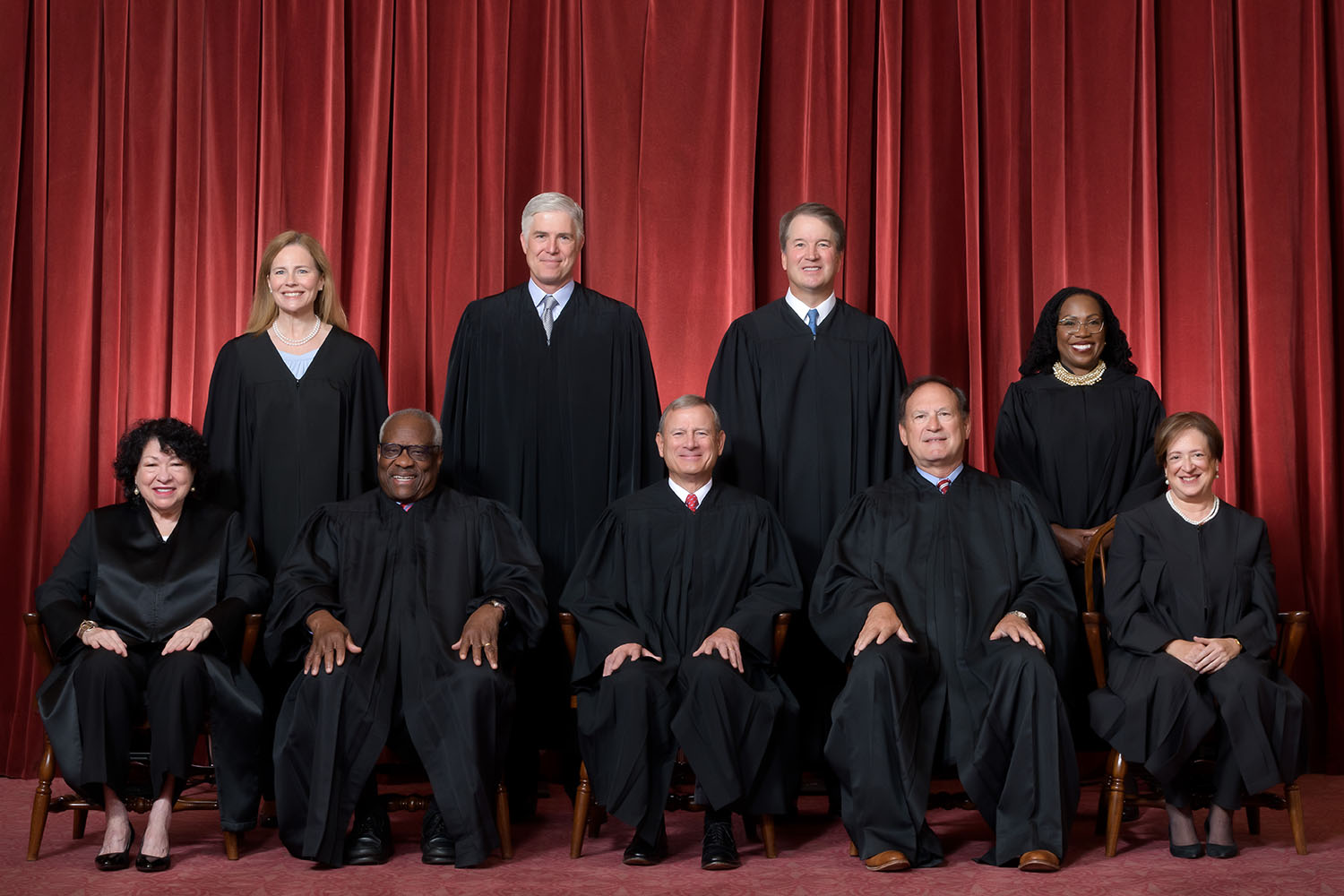
In a Supreme Court term with several important cases on executive power, two stand out. Both will be decided this Spring.
One is the tariffs case, argued a few weeks ago. The three liberal Justices will go against Trump, of course, because Orange Man Bad. But even the conservative Justices – especially the three appointed by Trump – appeared skeptical that the President could unilaterally impose broad tariffs.
Tariffs are much like a tax. The taxing power is generally held by Congress, not the President.
Yes, there is a loophole allowing for emergency actions by the President, but the Justices were not buying the argument that there was an emergency requiring tariffs on coffee from South America, wine from France, machines from Germany, pharmaceuticals from Switzerland, cars from Japan, etc. etc. etc.
(Apart from the legal issue, I’ve written that the tariffs are somewhat defensible from an economic perspective.)
You may argue that the “emergency” is the overall trade deficit. That trade deficit emergency, goes the argument, requires sweeping action.
I won’t argue the point. I’m just telling you that the Supreme Court is not buying it. Expect a 7-2 decision against Trump, or maybe even a 9-0 decision.
Already, companies that have paid the tariffs (including some that we assume are on the righthand side of the political spectrum, such as Costco) have filed lawsuits against the government for a refund of the tariffs they’ve paid.
Confusion will ensue. The decision is likely to be fractured with multiple opinions expressing different reasoning, and will also be complicated since the tariff scheme itself is complicated.
The other case at the Supreme Court concerns whether the President has the power to fire the leaders of so-called “independent agencies.” Trump will win this one.
Independent agencies are curious creatures. Scour the Constitution, and you’ll never find a mention of them. They are largely the creation of New Deal legislation from the 1930s. Over the ensuing century, they took on a life of their own in the fertile and fecund federal bureaucracy, like slimy salamanders spontaneously generated from warm mudpuddles.
There’s no doubt the President can fire ordinary agency leaders, but these independent agency leaders seem to have a special status in the minds of Washington politicians.
They clearly are part of the executive branch, since they’re not part of the judicial or legislative branch, but purportedly cannot be fired by the chief executive – the President – because they’re “independent.” They effectively make policy and enact legislation without oversight from Congress or the President.
This raises two questions. First, how can Congress delegate away its legislative power under the Constitution to entities never mentioned in the Constitution?
Could Congress also delegate away their legislative power to private foundations like the Gates Foundation and foreign entities like the United Nations? (Congress thinks the answer is yes, and to some extent they already have.)
In any event, it’s quite ironic that the defenders of these independent agencies accuse Trump of violating the law by firing the agency leaders, when the very existence of the agencies is in violation of the Constitution.
The second question is, if the President cannot fire the leader of an independent agency, then who can?
Not Congress, since Congress wields no hiring and firing power beyond its own internal staffing. Outside that, its power to hire people is non-existent and its power to fire people is limited to the draconian and rarely-used power to impeach.
And not the judiciary, either. Judges have no power to hire or fire members of the executive branch. They can barely hire and fire their clerks and secretaries.
So, if the President has no power to fire these independent agency leaders, then they are virtually untouchable.
Presidents and Congressmen come and go, but bureaucracies go on and on – especially if their leaders cannot be replaced. The deep state lives forever.
This is of course the outcome desired by most Democrats, since the agencies are controlled by Democrats. In fact, Democrat federal employees outnumber Republicans two to one.
But it’s also the outcome desired by a certain cohort of never-Trump Republicans. It’s amusing to see their pseudo-scholarly rhetoric decrying the administrative state – until it’s Trump (gasp!) who proposes modest control over it. Then, and only then, reining in the unaccountable, unconstitutional administrative state run by unelected bureaucrats is . . . you know what’s coming . . . a threat to democracy.
The Supreme Court decision on this will likely be less hypocritical than those pseudo-scholar never-Trumpers. All nine Justices know that the administrative state of Democrats spawned by independent agencies is an unconstitutional cancer on democracy, and that the only means to rein it in is through the President.
Based on that common understanding, the six conservative Justices will side with the President and the three liberals will side against him.
Unlike freshmen college students, I can do the math. The math says Trump wins that one 6-3.
 the Aspen beat