
“Black” voting districts are unconstitutional, unfair, and condescending

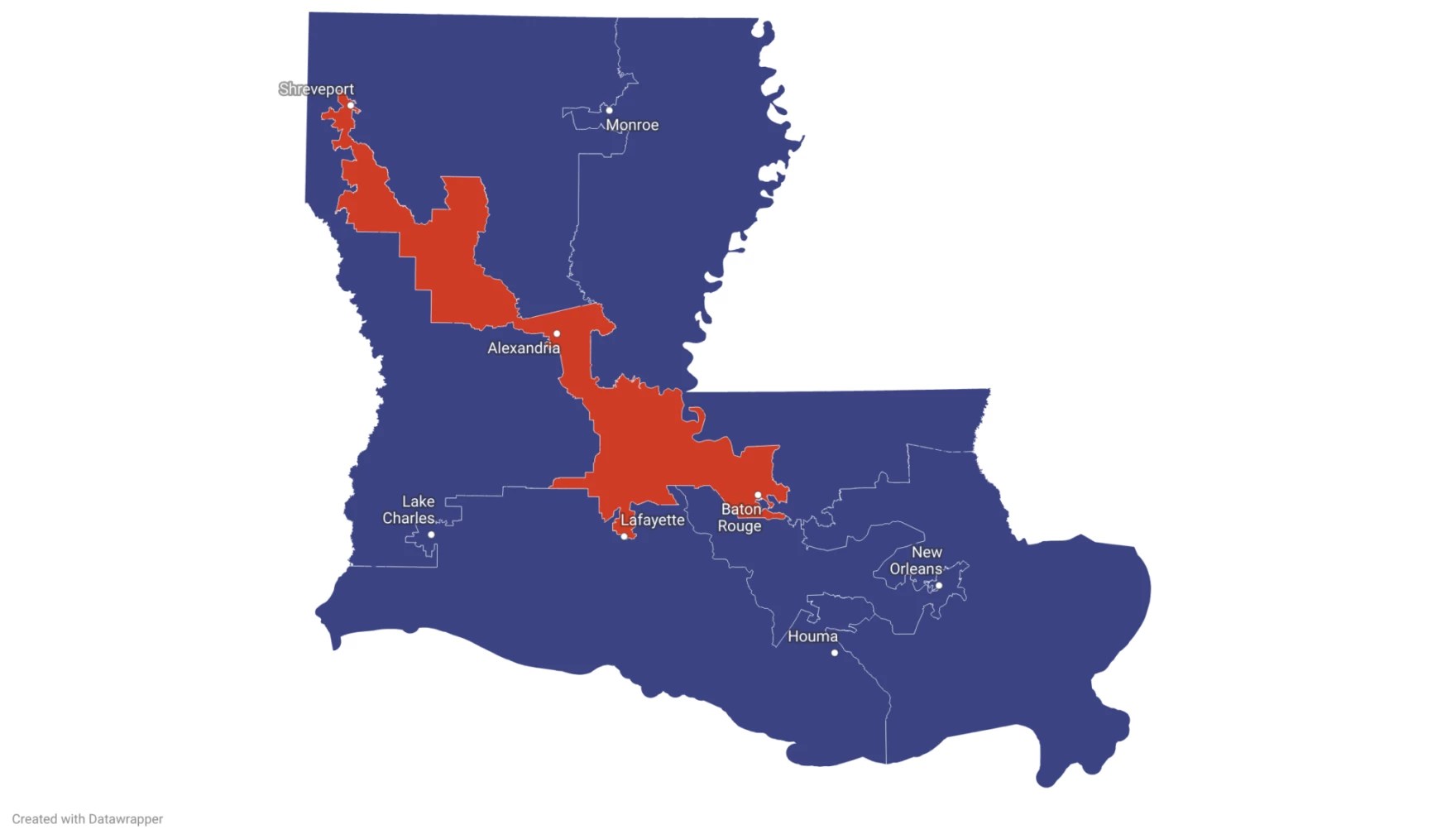
The map shows the contorted Congressional District in Louisiana that is at issue in the Supreme Court case that was argued yesterday.

You won’t see this map in most of the news reports on the case – not because it’s not newsworthy, but because it is. This picture speaks a thousand words about the absurdity at issue.

All parties to the case – and the Supreme Court Justices, as well – agree that this strange amalgamation was created for the express purpose of establishing a district that is supposedly Black* so that Blacks could be assured of electing Black representatives.

(I say “supposedly Black” because most Blacks in Louisiana, as in other American states, are actually of mixed race.)

There are several problems with this notion of Black Congressional Districts. First, it assumes that people identifying as Blacks can be represented in Congress only by other people identifying as Blacks. Why is that the case? I’m white and I’ve voted for Black candidates, and I’m sure many Blacks have voted for white candidates. In fact, Donald Trump got a substantial share of the Black vote last year.

Second, the flip side of concentrating Blacks into Black districts is to concentrate whites into white districts. If we’re to have separate Congressional Districts, should we also have separate schools? Separate drinking fountains?

In a region of the country with a sordid Jim Crow history of “separate but equal,” having separate Congressional Districts strikes me as a vile throwback.

Third, what happens if one of the white districts in Louisiana elects a Black? That would result in Blacks having too many seats, right? Conversely, what happens if a Black district elects a white? Does that mean we need to go back to the racial gerrymandering board to re-draw the districts again?

Fourth, this notion that Blacks are entitled to Congressional representation in exact proportion to their population (or more in the event a Black gets elected in a white district) would seem to apply equally to other races.

In Washington State, for example, about 10% of the population is of Asian descent. Many of their ancestors were exploited and discriminated against. Should we gerrymander the Congressional Districts in Washington to ensure that 10% of the representatives are Asian?

What do we do if the Asian voters don’t go along? What do we do if they “wrongly” vote for a white or Black or Hispanic rather than for the Asian candidate that they’re supposed to vote for? What if they vote for politicians on the basis of policy, not race? Or on the basis of the content of their character, not the color of their skin?

Gee, that’d be horrible, huh?

What about other minorities? In New York State, about 11% of the population is Jewish. Should we gerrymander some Jewish districts? Does it matter whether the Jews are observant or not?

What about transexuals? In California, about 97% of the population is transexual.

OK, I made that up, but you get the point.

The premise to this racial gerrymandering is that Blacks are unique among minorities, in (1) possessing “Black issues” that only they care about, and (2) lacking the ability to persuade non-Blacks to their side of those issues.

I disagree. I think Blacks are fully functional citizens who can vote their minds on all issues, side-by-side with the rest of us, and they have the ability to persuade the rest of us on those issues. They are not in need of child-like allowances any more than Asians or Jews or transexuals or Hispanics or Scots. It’s time to end the separate-but-equal Congressional Districts and end the soft bigotry of racial condescension.

*Although much of my tribe disagrees with me on this, I use “Black” rather than “black” when referring to American Blacks. That’s not because the AP Style Manual calls for it, but because I’m willing to call a race by the name that a majority of the race prefers. If a majority of whites start asking to be called “Whites,” or a majority of Scots start asking to be called “scots,” then I’ll go along with that, too.

If everybody is racist, then nobody is

Now that racism has been outlawed in business, and racists have been driven from the public square, you don’t witness much racism in America. Being racist is a bad move socially and career-wise. That’s good.

But black achievement in America still lags badly behind white, Asian and Hispanic achievement. The black illegitimacy rate is triple the white rate and the black murder rate is 7x the white rate. Both figures are worse than before affirmative action, worse than before the Great Society programs of the 60s and 70s, and even worse than the days of Jim Crow laws. 

The latest explanation for this continued malaise is that there’s a type of racism that you can’t see, but can only feel, and it’s getting worse. They call it “systemic racism.”

Systemic racism in America is like water to a fish in a pond. It’s everywhere, but undetectable except in its effect. That effect is to keep American blacks uniquely – not Asians or Hispanics or even black African immigrants – oppressed.

A scientific sounding name has been assigned to this: “Critical Race Theory.” The people who dreamed up the name ironically seem to think that calling it a “theory” makes it true. As in, “It’s like Einstein’s theory of relativity and Darwin’s theory of evolution. It’s a scientific theory, you know.”

CRT was originally an ordinary academic idea that people tend to see their world through the prism of race. The racists and race-baiters of the world twisted that uncontroversial idea into the notion that white people systemically persecute black people, even as the white people favor the black people in admissions, hiring and promotions. The racists and race-baiters now have persuaded ordinary well-intentioned white people to chant such nonsense as, “I’m a racist.”

There’s less to this conspicuous white show of self-flagellation than meets the eye. When questioned about their racism, such people recite, catechism-like, that everybody sees things through the prism of race, and so everybody is a racist.

So all they’re really confessing is that they’re racist just like everyone else. But they think they’re actually a little better than the other racists because, unlike the others, they admit to their racism.

It reminds me of certain religious people who go around advertising that they’re sinners, just like everyone else. But they imply that they’re a little better than the other sinners because, unlike the others, they admit they’re sinners.  

I submit that the premise of the racism-admitters is correct but their conclusion is erroneous.

Their premise that humans see things through the prism of race is correct. The person who says “I don’t even notice a person’s skin color” is obviously lying. We do notice skin colors. There are good anthropological reasons for that. Hominids who didn’t distrust hominids who looked different were often invited over for dinner.

But the conclusion does not follow the premise. Seeing things through the prism of race may make us racists in an anthropological sense but it doesn’t make us racists in an evil societal sense.  

There are racists and there are racists. Yes, we all (white, black and other shades) see the world to some extent through the prism of race, just as we see the world to some extent through the prism of our gender, our height, our weight and our socio-economic background. It’s a behavioral instinct rooted in our DNA.

But such instincts do not make us evil racists, misogynists, misandrists, dwarf-tossers, fat shamers or snobs. What does make us those things is when we allow our primitive behavioral instinct to control our modern feelings and actions. Civilized people don’t let that happen. They use their minds to control their racist instincts, just as they control their violence, anger, procreation and other animal instincts.

The erroneous conclusion that we don’t control our racism instinct – that we’re all racist because we all see the world through the prism of race – is destructive in several ways.

First, it dilutes the meaning of racism. If everyone is racist, then nobody is. Racism becomes seen as the ordinary human condition. It’s normalized. And then the real racists – the rare white supremists and Islamic (and European and American) Jew-haters and the Black Panther types – are given cover. 

Second, stating that everyone is a racist implies and sometimes outright states a corollary that “everyone” doesn’t actually mean everyone. It doesn’t include non-whites. Non-whites cannot be racist, says this corollary.

But that corollary can’t be right. If racism is embedded in humans anthropologically, then it’s equally embedded in whites, blacks and Asians. Worse, that false corollary either (1) dehumanizes blacks and Asians by implying that they’re not part of the world of “everybody” or (2) condescends blacks and Asians by implying that while they’re racist like everyone else, only whites are strong enough to bear the label.

Third, this notion that whites systemically but secretly persecute blacks even as they formally favor them undermines black achievement. It sends a powerful message to blacks that the system is stacked against them and that their failings are not their fault.

The way to encourage achievement by any group is to celebrate their achievements, not to pound into them the notion that they’re permanent victims for whom achievement is impossible.  

Fourth, amplifying this premise – that race is a prism through which people sometimes see the world – into this conclusion that race-is-destiny, sets the stage for governance by race. Like so much in this field, this approach is sufficiently bad that it has earned a euphemism. The euphemism is “Identity Politics.”

And so we’ve officially started judging people by the color of their skin rather than the content of their character. Today, anti-racism not only permits but perversely requires racial discrimination — all while denying and disguising it.

Interestingly, this dishonest act of anti-intellectualism is committed most often by the intellectual elites. In academia and big corporations, it’s official policy. Their unfair and immoral policy to subordinate character – or merit – to skin color does not bode well for them. Nor does it bode well for science, culture, mathematics, religion, philosophy, engineering or anything else where there is such a thing as good versus bad, right versus wrong, truth versus falseness and success versus failure.

Stated another way, abolishing merit will produce less of it and less of the advances that depend on it – which are pretty much all of them.

Good white people may feel extra good about themselves for buying into the bunk that they, alone among the races, are innately and irredeemably racist merely because they see through the prism of race. But this self-indulgent feel-goodery is expensive. It’s harmful to themselves, to our culture and to the non-whites that are the supposed beneficiaries of it. 

Such people are usually well-intentioned. But for the good of humanity, I wish they would start thinking with their heads and not their hearts.

That leaves the question, what do we do about black underachievement? I don’t know what the answer is. (By the way, I don’t think the problem is one of IQ, as the left implies in their insistence that black achievement be measured on a scale that accounts for their race.)

But I do know what the answer to this problem is not. It’s not to do more of the same. It’s not to continue the same failed policies that have enabled and perpetuated it for over half a century.