Glenn K. Beaton is a writer and columnist living in Colorado. He has been a contributor to The Wall Street Journal, RealClearPolitics, Powerline, Instapundit, Citizen Free Press, American Thinker, Fox News, The Federalist, and numerous other print, radio and television outlets. His most recent book is "High Attitude — How Woke Liberals Ruined Aspen"
I always disliked Rob Reiner as a liberal activist, though I’ve admired his work including When Harry Met Sally and A few Good Men.
His work and his politics, however, don’t matter today. What matters is that he and his wife were murdered in their home. Their troubled son has been arrested.
It’s a horrible, violent tragedy, any way you look at it.
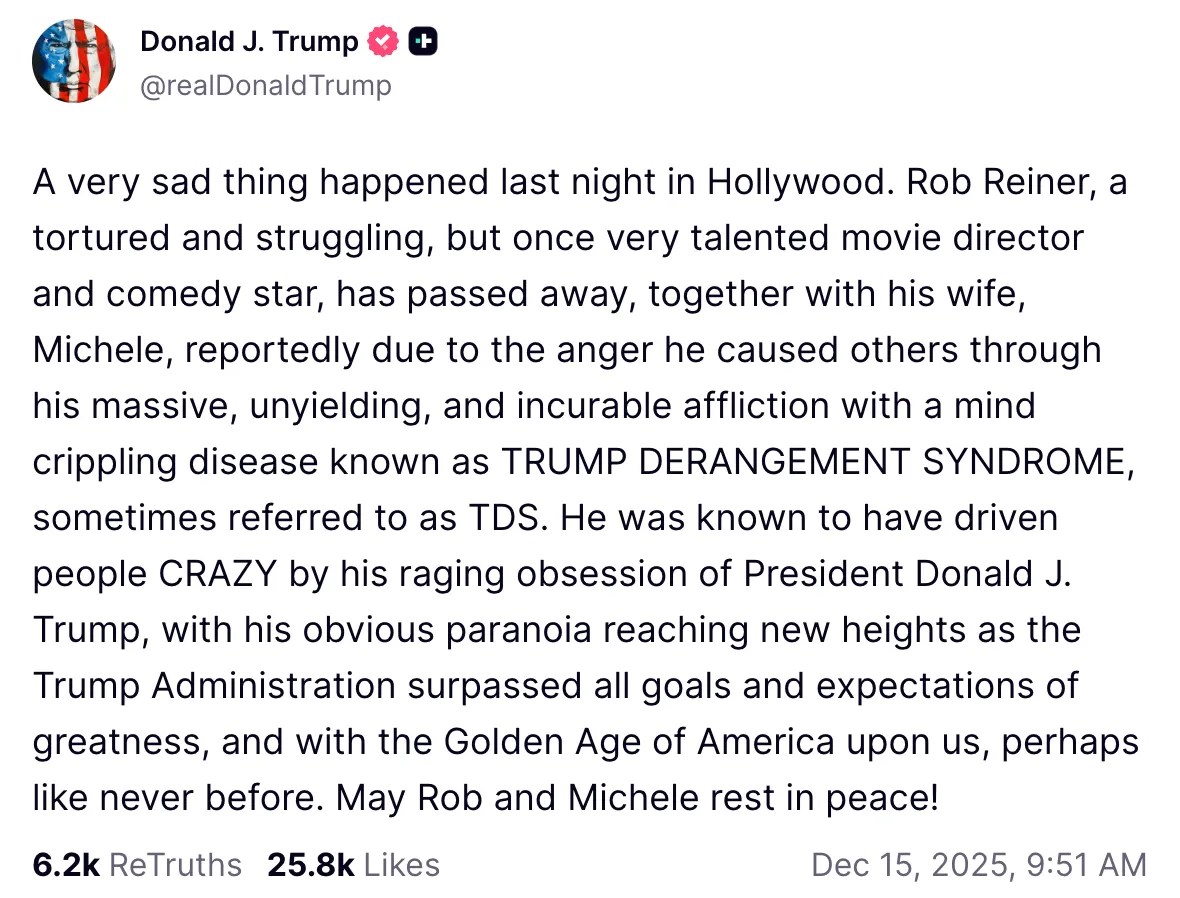
Unless you look at it the way the President did. Here’s his social media post in full:
Yep, the President marked the murder of this man and his wife — a murder for which their son has been arrested — by (1) ridiculing him the very next day for his politics, and (2) glorifying himself at their expense.
It should be noted that after Charlie Kirk was murdered, Reiner’s reaction was precisely the opposite of what we just saw from the President after Reiner himself was murdered. Reiner said the murder of Kirk was “horrible” and “unacceptable.” He went on to express admiration for the words of Kirk’s widow at his funeral.
I voted for Trump three times. To this day, I think the nation and the world are better off than we would have been with any of the three candidates he ran against. Witness the Joe Biden so-called Presidency.
Trump has improved America and the world, from the Mexican border to the Middle East, from his first term Supreme Court appointments to his second term war on wokeness. I applaud President Trump, and I’m proud of my votes for him.
But today, it appears the 79 years of Donald Trump may be catching up with him. Note that even the gold standard of senility – Joe Biden – was only 78 when he was elected.
Trump publicly ridiculed a man the day after he and his wife were murdered because he dislikes the man’s politics. He name-calls female reporters “Piggy” because he dislikes their questions.
His vainglory is clinical when it’s not comical. Think John Belushi with a samurai sword. He seems to be drifting into Nero and Caligula territory.
Some of his defenders contend he’s not ill, but just the biggest asshole to ever come near the White House (and that’s from his defenders).
OK, maybe the worst that can be said about Trump is that he’s just the world’s biggest asshole. But most Americans aren’t finding much comfort in that diagnosis, either.
You may say that he’s entitled to some anger after the way he’s been persecuted, and that I would be angry too. OK, I’ll buy that. But, unlike me, Trump has a country to run, a Presidency to fill, and an example to set.
Any way you slice it, in three years Trump will be gone. And in just one year, he’ll be a lame duck dealing with a hostile Democrat Congress.
It’s essential that the conservative cause – or MAGA if you prefer – survive. It’s a cause and a movement, not a person and a cult.
My loyalty is to that cause and that movement – to America – not to that man and his followers.
There’s a provision in the Constitution to deal with the incapacity of a President. It’s the 25th Amendment. At the request of the Vice President, a majority of the Cabinet certifies that the President is unable to perform his duties; Congress confirms it; and the Vice President assumes the Presidency.
That Vice President is JD Vance, not Kamala Harris. Thank God for that – and thank Trump.
Postscript: Condemn me if you wish. Name-call me if it makes you feel good. But consider this: If Trump is continuing to sink in the polls, and he is, and is losing three-time Trump voters like me, could it perhaps be time for a course correction before the GOP gets slaughtered in next year’s midterm elections? After all, your condemnation and name-calling won’t garner any more votes for our side – quite the opposite.
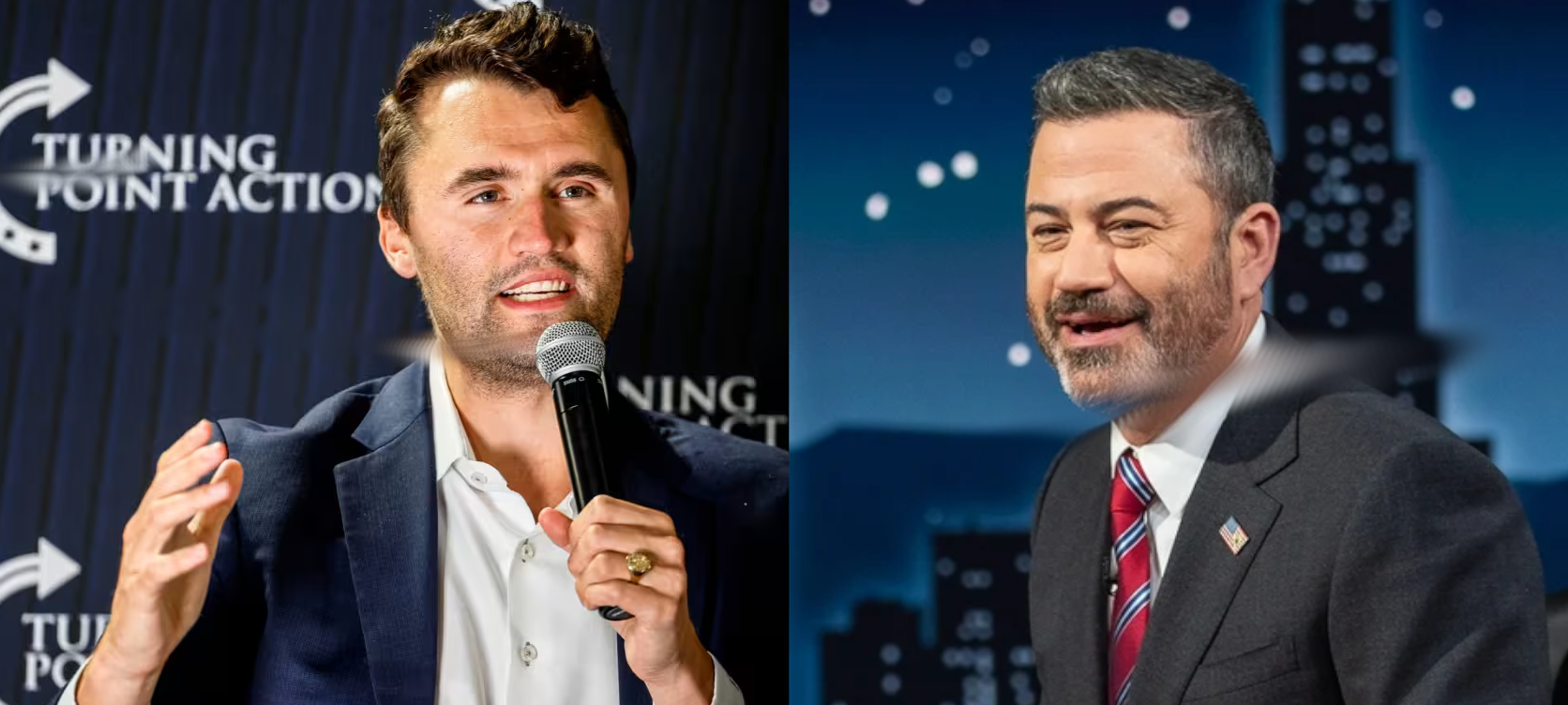
Note to readers: This is what ChatGPT came up with when I asked it to imagine a debate between Charlie Kirk and Jimmy Kimmel. Every word is from ChatGPT, except that one or two AI typos have been corrected.
_________________
Moderator: Welcome everyone to tonight’s debate on “Free Speech and Violence in America.” We’re honored to have Charlie Kirk and Jimmy Kimmel here to share their insights. Let’s begin with opening statements. Kirk, you have the floor.
Kirk: Thank you. Free speech is the foundation of democracy. It empowers individuals to voice their opinions, challenge authority, and push society forward. Throughout history, free speech has been instrumental in civil rights movements, political reform, and social progress. That said, with this freedom comes a responsibility. Words can incite violence, spread misinformation, and deepen divisions. Our goal should be to promote responsible speech—not censor it. Education, open dialogue, and adherence to social norms are the way forward. The core principle is that speech should thrive, but it should not be used as a weapon.
Kimmel: Thanks. I agree that free speech is vital, but let’s be clear. With the right comes the duty to prevent harm. In today’s world, inflammatory rhetoric, hate speech, and conspiracy theories are fueling real violence. We’ve seen many incidents where words have led to deadly actions — racial violence, terrorist attacks, online harassment turning into physical violence. Protecting free speech doesn’t mean tolerating speech that incites or promotes harm. Platforms — especially social media — must be held accountable. We need regulations and policies that draw the line where speech becomes dangerous. Society must defend freedom, but not allow it to devolve into chaos.
Moderator: An important discussion. Kirk, when you hear about hate speech, do you believe there should be limits?
Kirk: I believe in strong protections for free speech. Historically, censorship often suppresses dissent and can be used as a tool of oppression. The issue isn’t speech per se, but how we handle its consequences. Education is key — if people understood the impact of their words, they might moderate their tone voluntarily. Legal limits should be narrow– focused on directly inciting violence or spreading lies that cause harm. Broad restrictions risk infringing on fundamental rights and silencing constructive debate. The solution is fostering social responsibility, not censorship.
Kimmel: But history shows us that certain speech, especially hate speech, has led to violence and suffering. It dehumanizes people and can ignite mob actions or even genocide. Allowing unchecked harmful speech gives license to hate groups. That’s why platforms need clear policies– like removing hate speech and threats — and authorities should intervene when necessary. Sometimes, restrictions are essential for protecting vulnerable communities. We must recognize that the harm caused by hate speech is real, and it requires action.
Moderator: Let’s talk about where to draw the line. Kirk, do you think social media platforms should limit or regulate content more heavily?
Kirk: Platforms do have a role, but overregulation can suppress legitimate discourse. They should implement moderation tools and community standards, but these must be transparent and fair. Ultimately, the true solution lies in education — teaching people to critically evaluate content and behave responsibly online. Suppressing speech outright risks creating echo chambers and authoritarian control, which is dangerous for democracy.
Kimmel: I agree moderation is important, but the scale of social media makes it hard to control harmful content. Platforms often hesitate to act decisively due to fear of backlash or legal challenges. Meanwhile, harmful rhetoric continues to spread. Regulation can set standards that protect users without infringing on free speech. Additionally, social media companies must be held accountable for their role in amplifying dangerous content. We need collaborative efforts—government regulations, technological tools, and community initiatives—to create safer online spaces.
Moderator: Now let’s introduce a new topic — recent controversy surrounding Kimmel’s firing from a major network over comments related to political beliefs. Kimmel, would you like to comment on that?
Kimmel: Absolutely. The situation was very personal to me. I was fired after making some jokes that, depending on who you ask, were either funny or inappropriate, but what struck me was how quickly the culture shifted to silencing opinions and entertainment if they didn’t align perfectly with certain political narratives. It raises a fundamental question about free expression — should entertainers be penalized for their viewpoints or jokes? I believe that diversity of opinion, even offensive or controversial humor, is vital in a free society. Silencing voices due to pressure or fear undermines that principle.
Kirk: I agree with you. Freedom of speech includes the right to express unpopular opinions, including satire and humor. When society starts punishing individuals for expressing their views, it’s a step toward authoritarianism. The marketplace of ideas flourishes only when all voices can be heard, even if those voices are uncomfortable or controversial. I believe that silencing or punishing individuals—whether entertainers, journalists, or citizens — because of their opinions or jokes — undermines the very foundation of our democracy. Free speech is messy and can be uncomfortable, but it’s essential for progress. When we start policing humor or viewpoints out of fear, we risk creating a society where only certain approved voices can be heard, and that’s dangerous. We need to defend the right to express even unpopular or provocative ideas, because only then can real debate and growth occur. Censorship, whether by corporations or government, erodes liberty and sets a dangerous precedent.
Kimmel: Exactly. When individuals are silenced or penalized just for expressing their opinions, it sends a signal that certain ideas are unacceptable — no matter how silly or offensive. That’s not the path to a healthy democracy. We must stand firm in defending free expression, even when we disagree with what’s being said. Otherwise, we pave the way for authoritarian control and a stifling culture where conformity replaces free thought.
Moderator: Thank you, Kirk and Kimmel, for your insightful perspectives. To summarize, both of you agree that free speech is a fundamental pillar of democracy, but with important responsibilities. Kirk emphasizes the importance of education, responsible discourse, and cautious moderation to prevent censorship and authoritarianism. Kimmel highlights the need for accountability, especially on social media, and stresses that harmful speech can incite violence and must be regulated to protect vulnerable communities.
Regarding the recent controversy about Kimmel’s firing, both agree that silencing or punishing individuals for their opinions erodes free speech and opens the door to authoritarian control. The balance, as you both suggest, is in protecting the right to express unpopular ideas while ensuring public safety and social harmony. Ultimately, fostering open, respectful dialogue and safeguarding free expression are essential for a healthy society.
Thank you both for a compelling discussion.
_________________
I say bullshit. This sanitized, anodyne debate imagined by ChatGPT sounds like a love-fest.
Sure, it’s likely that both men would come down on the side of free speech, in the abstract, and both would caution against internet excesses.
But the debate imagined by ChatGPT completely ignores the overt calls for violence by such groups as Antifa and BLM and the barely-concealed calls for violence from Democrat leaders such as Senator Schumer’s threat against Supreme Court Justices.
It also ignores Kimmel’s false suggestion that the Kirk murderer was “one of” MAGA. Any legitimate discussion of Kimmel’s firing has to deal with that lie. Finally, it ignores the refusal by about half of the Democrats in Congress to join in a joint resolution condemning that violence.
So why did Chat GPT sidestep these issues?
I saw a piece a few months ago (if I could remember where, I would give credit to the author) suggesting that AI will not take bias out of the news. Rather, it will legitimize it. When you’re watching Rachel Maddow, you know she’s biased. When you’re inquiring with ChatGPT, you assume that the machine is not.
In addition, AI knows only what it reads on the internet. The old saw “the internet says . . .” is literally 100% of the basis for AI’s conclusions. Computer programmers would say garbage in, garbage out.
For the record, I think Kimmel’s bosses should fire him, or not, based on their sense of human decency and what he brings to their business. (My own sense of decency comes down in favor of the firing.) I think viewers should watch Kimmel, or not, based on their personal sense of human decency and what he brings to their entertainment life. I’m wary of the government getting involved in those decisions.
Also for the record, I occasionally use AI for research, but never for writing. I happen to think that, for now, I’m a better writer than the machine.
Political assassinations in America are usually committed by nutjobs. Lee Harvey Oswald was a communism-sympathizing loser. James Earl Ray was a career criminal who copped a guilty plea to avoid the death penalty and then falsely maintained his innocence until the day he died in prison.
This time feels different. This murderer looked normal. He earned college credits while in high school. He was a straight-A student. He had no criminal record.
He lived at home with his parents, two registered Republicans active in their Mormon church in conservative Utah. The family all talked ‘round the dinner table, as families used to.
One of those family dinner table talks early this week was about Charlie Kirk, who was due to visit the area on Thursday.
You know the rest of the story. As Charlie was talking in his trademark sort of way – not ranting, not raving, not cursing, but simply sitting and talking in a normal conversational way – the murderer shot him in the neck from a rooftop with a high-powered rifle. Charlie bled to death in seconds.
After video of the murder scene circulated, the murderer’s father turned him in with the help of a family friend who was retired from law enforcement.
Apart from the murder (but how was the play, Mrs. Lincoln?) the whole scene looks like a Norman Rockwell painting – a perfect glimpse of Americana.
Over a half a century ago, philosopher and writer Hannah Arendt wrote Eichmann in Jerusalem: A Report on the Banality of Evil. She was struck by the pedestrian personality of Eichmann in his trial and before his hanging in Jerusalem. He was not evil in the obvious ways. He had no horns, no cape, no devilish laugh, no foaming at the mouth, no apparent Hitlerisms.
Rather, Eichmann was a not-very-bright technocrat who’d dropped out of high school. He believed he was not just following orders (he was) but that he was following the law. He exhibited no hatred for the Jews, apart from his role in killing six million of them.
If Adolf Eichmann had been born into modern America, he might have become a mid-level manager in the EPA, the IRS or the Social Security Administration. He lacked both the credentials and ideology to be in the White House of either Joe Biden or Donald Trump, and he certainly lacked the passion.
Which brings me back to Charlie Kirk’s murderer. He was a devotee of the vapid echo chambers of online “discussion” but he exhibited little nuttiness or passion, until Thursday anyway.
Yes, he was a straight-A student, but in today’s schools that barely puts a kid in the top half of the class. Yes, he earned college credits while in high school, but then dropped out of a fourth-rate college. Yes, he participated in discussions at the family dinner table, but why was he living at home and eating his mother’s cooking at age 22?
The kid was a casual underachiever just going through the motions of an unlived life. He was the picture of banality.
The banal evil of Adolph Eichmann was six million times worse than the banal evil of Charlie Kirk’s murderer, but here’s what gives me pause: There are at least six million of these kids out there.

 the Aspen beat