
Rudolph was saved but all the other reindeer are mean girls

Do you recall the most famous reindeer of all? Here’s a hint:

Rudolph the red-nosed reindeer,

Had a very shiny nose,

And if you ever saw it,

You would even say it glows.

So, on top of an unusual name for a reindeer, Rudolph had a slight physical defect. But don’t we all?

You probably think nobody even noticed Rudolph’s defect. It’s like when your nose is just a teensy bit crooked but you need a ruler to figure it out. Or you happen to have no hair on top of your head but nobody even notices unless you take off your ski helmet and they see it shiny with sweat right after you ripped a double-black.

Wrong. The other reindeer did notice:

All of the other reindeer,

Used to laugh and call him names,

They never let poor Rudolph,

Join in any reindeer games.

OK, this pisses me off. It’s not like Rudolph surrendered to the Taliban or to the illegals. Just because the guy has a slight physical defect, the other reindeer gave him the FJB treatment.

I suppose Rudolph still found happiness of a sort, notwithstanding the ostracism. With those long strong legs, he probably did a lot of air hiking. Mostly alone.

Then the story takes a twist. The Big Guy shows up:

Then one foggy Christmas Eve,

Santa came to say,

‘Rudolph with your nose so bright,

Won’t you guide my sleigh tonight?’

This is presented as a purely utilitarian gesture by the Big Guy, but is it really? He surely knew of Rudolph’s plight. And he must have known that he’d get little guidance for his sleigh from a mere shiny nose. And there must have been other foggy Christmas Eves where he didn’t invite Rudolph to guide the sleigh. And there’s no predicate in the story for Rudolph having any experience in sleigh guidance. Yet, the Big Guy chose Rudolph for this important task.

Here’s my theory. The Big Guy saw a man . . . er, a reindeer, in need. He offered to help – not with charity but with an opportunity to prove himself by helping others.  

The last became the first, but only after the Big Guy offered Rudolph that place in line and Rudolph had the courage to accept it – along with all the daring demands and physical challenges and great responsibility that accompanied it. Had Rudolph guided the sleigh into a Starlink satellite, the story would not have ended happily ever after.

Rudolph accepted a hand but not a handout, He seized the opportunity, and flew with it. He had no experience but figured he’d learn on the fly.

And he did. Rudolph was possessed of a grace nothing short of amazing.

Then the story takes a mean girl twist, often not recognized as such by casual singers:

Then all the reindeer loved him,

As they shouted out with glee,

Rudolph the red-nosed reindeer,

You’ll go down in historeeeee.

Wait a minute! Now the other reindeer loved him? Now? Where were they before, when Rudy needed a friend? They were mocking and ostracizing him, that’s where.

I have a suggestion for Rudy. He and the Big Guy should invite Dasher and Dancer and Prancer and Vixen, Comet and Cupid and Donder and Blitzen, over for dinner. Main dish: venison.

I miss the TV dads – and my own too

You know them. They were in your living room and part of your family conversations every night, especially during those 60-second breaks. 

Before America was siloed into warring tribes by ratings-hungry cable TV and, later, by click-hungry internet sites, these men defined fatherhood for two generations. They were uncool before uncool was cool.

I’m aware this isn’t Fathers Day, other than in a specific religious sense. But Christmas always brings back family memories for me, particularly of my dad, which gets me thinking about the role of dads everywhere.

You’ll have your own favorite dads, but here are mine, in no particular order. Feel free to add and subtract.

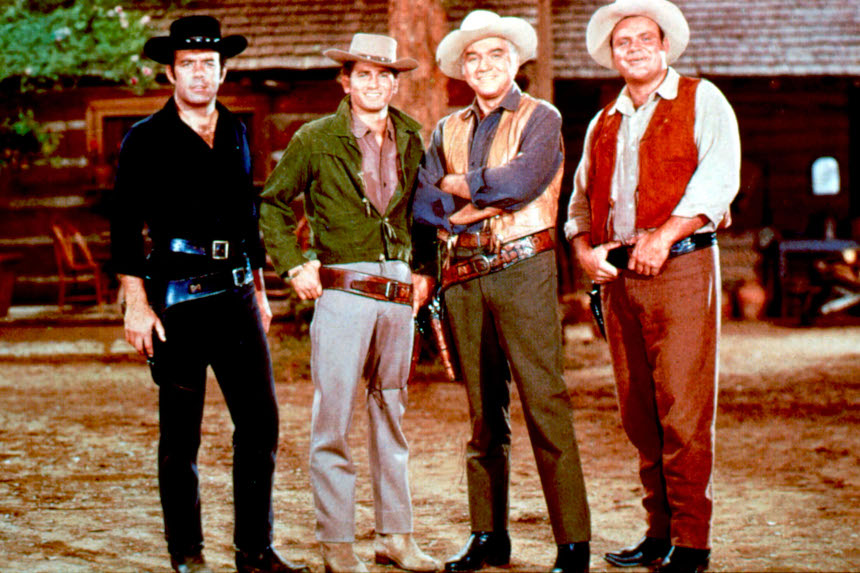
Ben Cartwright, of Bonanza

Ben came west, and founded the Ponderosa Ranch. He married and buried three women who gave him three sons. He was a strong and kind man back in the days when we thought that was a good thing.

Each episode of the show was a morality play, as much of television was back in the days when we had morality. A recurrent theme was the need for men to man-up. Ben taught that lesson many times, usually by example. And sometimes it meant something different than viewers initially assumed.

Frasier Crane, in Frasier

I suppose experts in comedy would say that a fussy, pretentious, good-hearted psychiatrist is easy material (Bob Newhart, anyone?) but Kelsey Grammer is so darned good as an over-actor (and also as a just-right actor on the Shakesperean stage) that he pulls it off. Best. TV Comedy. Ever.

Andy Taylor, of The Andy Griffith Show

I always wanted to dislike Sheriff Taylor (played by Andy Griffith) because the show was just so hokey. But Griffith was an accomplished actor, the writing was pretty good, and so I mostly failed.

I succeeded much better with Barney Fife. Bumbling incompetence with handguns does not amuse me.

Ward Cleaver, of Leave it to Beaver

Not really. Just seeing if you’re paying attention. I couldn’t – and still can’t – get past the fact that this dude calls his young son “The Beaver.” What’s up with that?

Tony Soprano, of The Sopranos

This show was pretty edgy. Tony led a life of crime, but, out of love, he desperately wanted to guide his family into something legitimate. He ever got a therapist!

If only Joe Biden had been watching. 

Jed Clampett, of The Beverly Hillbillies

The hat. This one is all about the hat. I wanted the hat. Well, the hat and the jalopy. Well, the hat, the jalopy and Elly May.

Ricki Ricardo, in I Love Lucy

I never liked Lucille Ball, but to this day it’s remarkable that her husband Ricki was presented as a charismatic Latin immigrant bandleader married to red-headed Lucille.

You couldn’t do that today, because Ricki was the bad kind of immigrant – legal, Cuban and probably Republican.   

Jim Anderson, in Father Knows Best

This is another one that could not be presented today. Maybe you could get away with “Birthing Parent Has a Truth That Works For Them.”

Atticus Finch, in To Kill a Mockingbird

OK, this was a movie, not a TV show. And, OK, I offer it up mainly to show off my movie chops. But Atticus Finch (played by Gregory Peck in his finest role) sets the standard for strength and courage in explaining and exemplifying the nuances of both to his young daughter. Ben Cartwright would be proud. The writing isn’t bad either.

That’s my list from the past. Today, I look for the next generation of fathers in the entertainment media. Two come to mind.

One is Joe Biden, who is not an entertainer strictly speaking but that’s about all he’s good for anymore.

Joe does not make my list of fathers I admire most.

Another is Deion Sanders. I don’t know Prime, and don’t pretend to understand him or relate to him. But one thing is clear: He holds his sons to very high standards of professional (yes, professional) achievement.

But where’s Ben Cartwright, for God’s sake? Where’s Sheriff Taylor? We can’t even get our hands on a good-father mobster like Tony Soprano.

When I was young, I had a father who was quirky (OK, that’s an understatement) but full of decency. Sure, there were things he simply was not capable of. But maybe that had something to do with his own father dying in the depths of the Great Depression when Dad was five. Maybe it had to do with flunking the 6th grade twice due to dyslexia (which went under the medical term “stupidity” at the time). Maybe it had to do with dropping out of school in the 8th grade to support his widowed mother, the turmoil of joining the army underaged, earning his GED, and somehow working his way into the middle class to support a family of six in an 800 square foot house.

I never heard the man say “I love you” to anyone, including my mother. But I was certain this unusual person did love me, just as Sheriff Taylor loved lovable Opie and Ben loved unlovable Adam. That’s how dads were. Television said so.

In today’s world, there isn’t enough of that certainty. The more our world of global information fragments, the less our moral compasses point in the same direction. 

Jesus is not our mom

Note: I first wrote and published this years ago. I occasionally revise and republish it.

Two thousand years ago, a carpenter lived a conventional life for 30 years in a tiny village in the Middle East. Then something got into him. He became, as they might say today, “radicalized” for the last three years of his short life.

Historians agree that Jesus did exist. There are reliable ancient records of him. But most of what we know are opaque and contradictory accounts written decades after his death in what we now call the Gospel of the New Testament.

In one sense, those Gospel accounts are profoundly simple. They say Jesus was the Messiah prophesized in the Hebrew Bible. As such, he performed miracles to save those needing saving. He came back from the dead. That’s the word.

But in a personal sense, the Gospels present a more complicated man than the one presented in Sunday School or even adult church services.

Continue reading

Ye of little science: Creation was created by a creator

Scientists generally agree that the universe – defined as everything in existence – has not always existed. It came into existence with a bang about 13 billion years ago. This bang was a big one, so they named it the “Big Bang.”

Before the Big Bang, there was no space, no energy and no time – not even empty space, zero energy or stopped time. There was nothing.

And then everything was created out of this nothing. We call this everything “creation.” It’s the tangible universe around us, seen and unseen. It’s the energy, the matter, and the progression of time.

As a matter of logic, creation must have been created. And also as a matter of logic, whatever caused creation to be created is, by definition, the creator of it.

How the creator created creation, we haven’t a clue. Oh sure, there are theories that our universe is one of many “parallel” universes, blah blah blah, but there’s zero evidence for any of those theories. Those theories are mainly semantics games. They really just beg the question: If our universe is a “parallel” universe to some other one – some other creation – then how was that one created if not by a creator?

In short, if you acknowledge that the universe – creation – exists, you cannot deny that it was created by a creator. The rest of organized religion is just puny humans quibbling about the nature of this creator, in the tribal, shallow ways they do. They’re not striving for understanding; they’re arguing that their creator is better than yours.

Whatever.

On the other hand, if you deny that the universe exists, you should stop reading and immediately check yourself into the hospital.

Here’s where it gets interesting. In order to create the universe – in order to create creation – the creator must have been around (but around what?) before the universe came into existence. The laws of cause-and-effect go only one direction in time.  Yesterday’s effect cannot be produced by today’s cause. The creation could not be caused by something occurring after it happened.

But the universe is defined to include everything, which includes a creator. And so, unless you deny the laws of cause-and-effect by contending that the creator was created in the creation and somehow cast a cause backward in time to create the effect of that creation, this creator must have existed before it existed. But how can something exist before it exists?

These violations, of not only physical laws but basic laws of logic and cause-and-effect, seem the very definition of a “miracle.”

Given that the creator created all of creation – and did so before the creator even existed, or, alternatively, the creator itself existed before it existed – I can only conclude that this creator is capable of anything. Virgin births, Red Sea partings, growing my hair back, you name it.

That the creator that created creation is omnipotent does not alone validate any particular religion – the mere fact that the creator is capable of something does not prove it did that something. It just says that, scientifically speaking, anything and everything is possible.

Remember all of that in this season of goodwill and at other times as well. Be merry – I have a hunch that our miraculous, puckish creator is. And humble.