
Why do Catholics still worship an old king in a palace?
I understand why they did in the old days. Everybody did. (Well, except Christ didn’t.) There was Henry VIII, Louis XIV, Charlemagne and, in folklore, King Arthur. There were also king-like rulers called emperors, such as Julius Caesar, Peter the Great, and Napoleon Bonaparte.
It was way back in the olden days that Catholics set up the papacy, their kingship. Their first Pope was said to be the Apostle named Peter, who used to be called Simon.
By the way, the names of the Apostles always have confused me. There was Paul, who was really Saul. There was Mark, who sometimes went by John. There was John, who always went by John even though Mark sometimes did, too. There was the aforementioned Simon whom Jesus called Peter even though that wasn’t his name and there was another Simon whom Jesus called Simon even though that was his name.
There were two James’s. One was James the Greater about whom we know a great deal of apocrypha and the other was James the Lesser about whom we know much less. James the Lesser went by Jim. (OK, that part is made up.)
Jesus must have had the patience of Job, considering how many times he had to say “No, the other one.”
As if Apostles are not complicated enough, let’s get back to popes. In case you encounter a pope, the proper form of address is not “Your Majesty.” That’s for kings and queens. Popes get addressed instead as “Your Holiness.” You see, kings and queens may be majestic, but popes are holy.
In fact, papal pronouncements on matters of Church doctrine are said to be “infallible.” Never mind that Church doctrine changes from time to time. The old doctrine was infallible when it was in effect, and the new, different one is infallible when it’s in effect.
As for all things, for infallibility there’s a season.
So, popes are holy. But there’s a bit of majesty in them, too. For a long time, infallible popes were also effectively the rulers of the Holy Roman Empire, an area that stretched from Rome to the Baltic Sea.
Wars and intrigue gradually chipped away at the Empire. The establishment of the nation of Italy in the 1800s cost the Vatican almost all of the little land they still held. The earthly territory of the Holy Roman Empire now comprises 0.2 square miles within the city limits of downtown Rome.
But that 0.2 square miles holds some good stuff, such as Michelangelo’s Sistine Chapel, priceless art works, and St Peter’s Basilica.
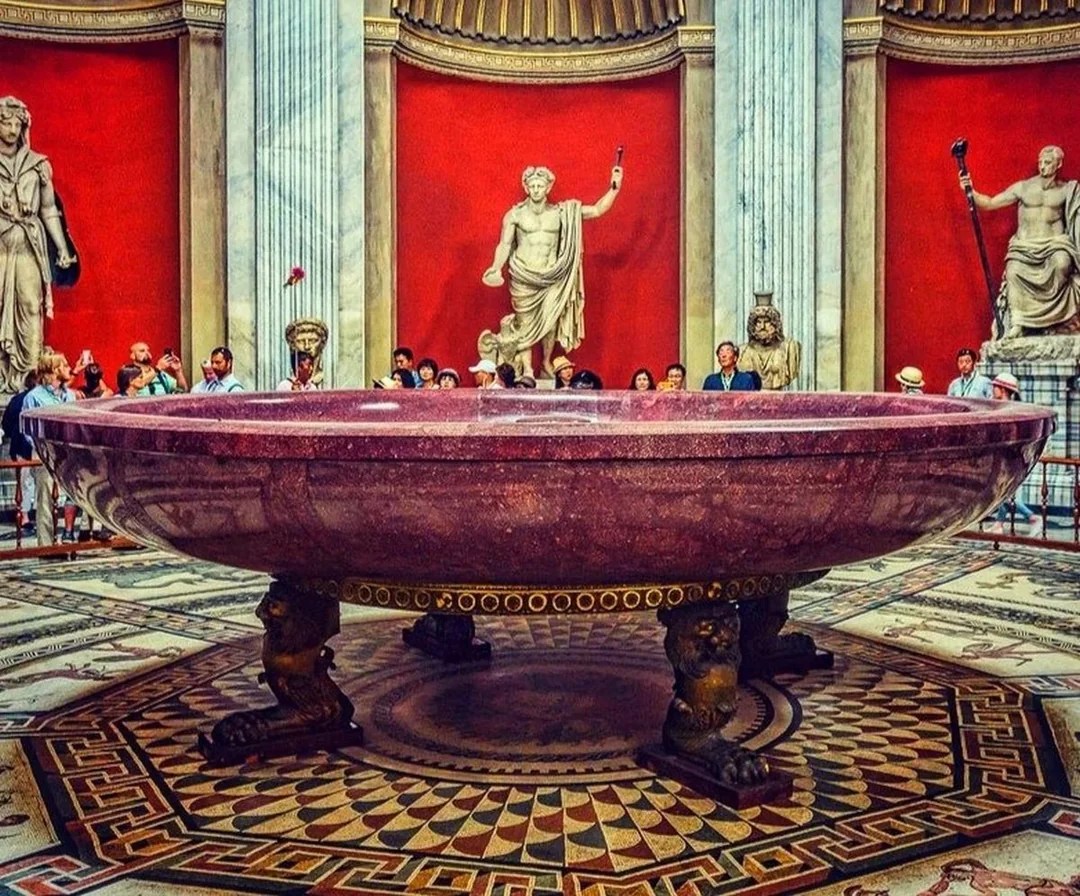
And Nero’s Bathtub. Nero’s Bathtub is a massive bathtub about 25’ long made of stone quarried in Egypt and brought to Rome for Emperor Nero. What better place to fiddle through a fire than in a bathtub? The value of Nero’s Bathtub is estimated at around two billion dollars. That’s $2,000,000,000. (I’m not making this part up.)
Altogether, the Vatican is the most valuable 0.2 square miles this side of Heaven. Don’t ask how they acquired all this treasure, and don’t ask how to reconcile such material acquisitiveness with their incorporeal mission. We’re talking infallible, remember?
These material riches of the Vatican’s balance sheet are oddly juxtaposed with the sorry condition of its income statement. They’re rich but they spend far more than they make. In fact, their finances have been in bad shape for many years. They have fallible finances.
In their defense, back in those olden days they had a lot of expenses such as wars to fight and bribes to pay. But now they don’t fight earthly wars, and bribes have not been reported for years. Even so, well into modern times they’ve still had sloppy finances, money-laundering allegations, and what might be called, um, corruption.
During the tenure of newly departed Pope Francis, the Vatican’s operating deficit tripled. Maybe ballooning budgets come with the territory from which he originated – Argentina.
Whatever the reason, finance types warn that this Latin American spendathon cannot continue unless the Vatican sells off assets, which will fix finances only for a while, or resumes selling indulgences – to a flock that is no longer accustomed to having to pay for them.
In contrast to the papacy, the aforementioned kingships and empires of Europe have evolved. They’ve been replaced by indirectly elected technocrat parliamentarians in such countries as Great Britain, Germany, France, Italy and most everywhere else. Only the throne of Peter the Great is still occupied by a despot.
So, what’s with the black smoke/white smoke ritual (“smoke-filled room” takes on a new meaning here) by a politburo of old men that are attired in plush red robes and lamp shade hats (let’s trust they’re not chomping cigars) to choose a new, infallible, male, old, dear leader in the richest corner of the globe even as that corner – and the globe – drift inexorably toward bankruptcy?
This is a heckuva way to save souls.
On the other hand . . .
The Catholic Church has probably been the greatest force for good in the history of the world. It has brought Good News to billions of people to enrich their lives if not save their souls.
The lucre and treasures the Church acquired along the way were from a different era, when that’s what powerful people did. It’s difficult for them to give it all away now, just because some Protestant blogger mocks Nero’s Bathtub.
And to whom would they give it? Secularist governments?
Sheesh, after the Notre Dame burned, the secular government of France proposed replacing it with a temple that would not offend (i.e., would pander to) the burgeoning Muslim population that seeks control of Europe. They backed down only when the remaining Catholic population of Paris (and France and the world) made a fuss.
My brother, a very smart guy with a Ph.D. in Physics, was a convert to Catholicism. I never really talked with him about his faith, but I respected his judgment. In that way, he reminds me of another very smart convert, JD Vance.
I confess that on my two long walks of the Camino de Santiago, there were times when I, too, considered converting to Catholicism. (There have been times when I’ve also thought about converting to Judaism, but that’s another column.) For now, I’m a die-hard Protestant.
So, the Church on balance has been a very good thing over the millennia.
Still, it has its quirks.
 the Aspen beat