
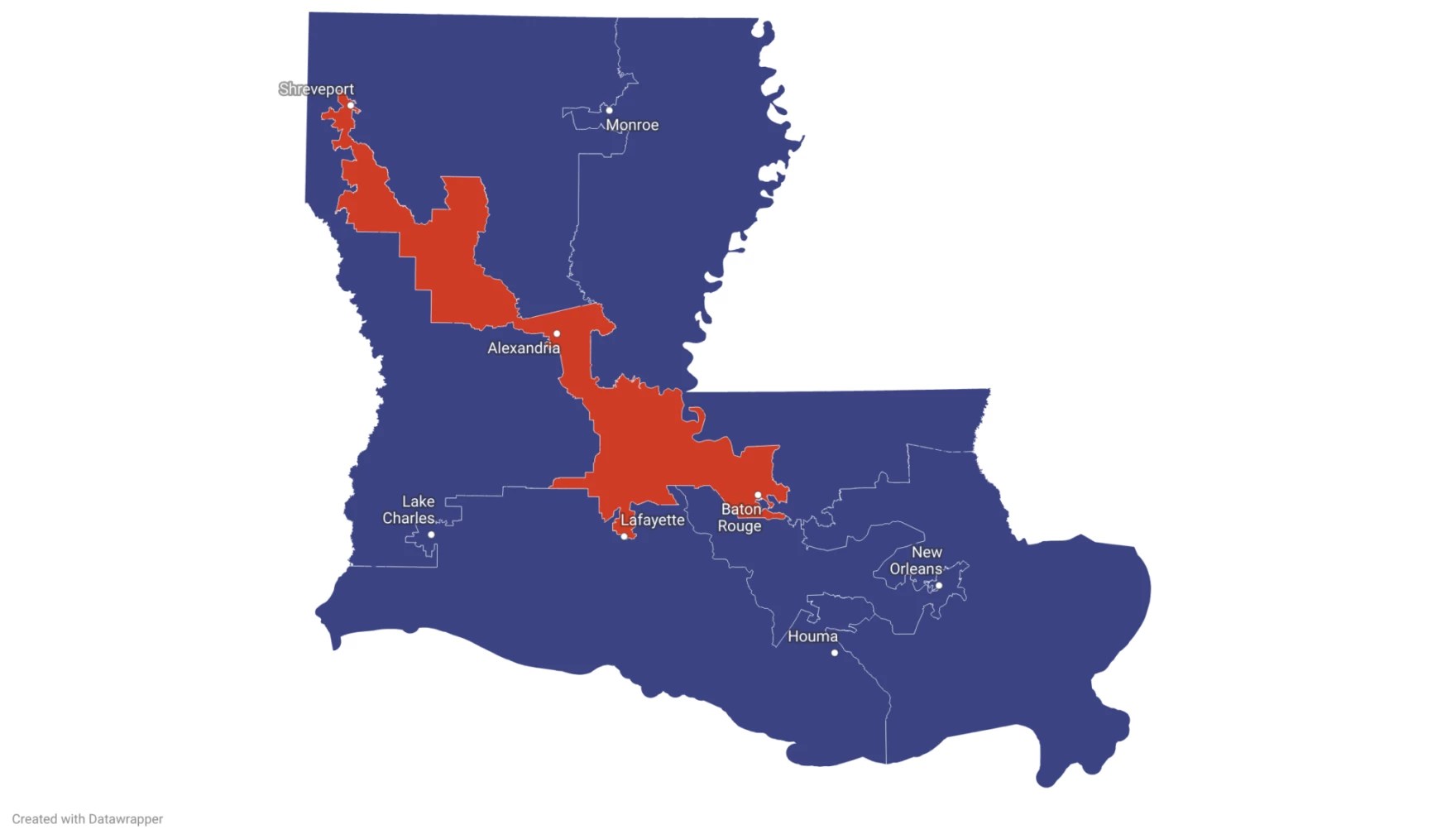
The map shows the contorted Congressional District in Louisiana that is at issue in the Supreme Court case that was argued yesterday.
You won’t see this map in most of the news reports on the case – not because it’s not newsworthy, but because it is. This picture speaks a thousand words about the absurdity at issue.
All parties to the case – and the Supreme Court Justices, as well – agree that this strange amalgamation was created for the express purpose of establishing a district that is supposedly Black* so that Blacks could be assured of electing Black representatives.
(I say “supposedly Black” because most Blacks in Louisiana, as in other American states, are actually of mixed race.)
There are several problems with this notion of Black Congressional Districts. First, it assumes that people identifying as Blacks can be represented in Congress only by other people identifying as Blacks. Why is that the case? I’m white and I’ve voted for Black candidates, and I’m sure many Blacks have voted for white candidates. In fact, Donald Trump got a substantial share of the Black vote last year.
Second, the flip side of concentrating Blacks into Black districts is to concentrate whites into white districts. If we’re to have separate Congressional Districts, should we also have separate schools? Separate drinking fountains?
In a region of the country with a sordid Jim Crow history of “separate but equal,” having separate Congressional Districts strikes me as a vile throwback.
Third, what happens if one of the white districts in Louisiana elects a Black? That would result in Blacks having too many seats, right? Conversely, what happens if a Black district elects a white? Does that mean we need to go back to the racial gerrymandering board to re-draw the districts again?
Fourth, this notion that Blacks are entitled to Congressional representation in exact proportion to their population (or more in the event a Black gets elected in a white district) would seem to apply equally to other races.
In Washington State, for example, about 10% of the population is of Asian descent. Many of their ancestors were exploited and discriminated against. Should we gerrymander the Congressional Districts in Washington to ensure that 10% of the representatives are Asian?
What do we do if the Asian voters don’t go along? What do we do if they “wrongly” vote for a white or Black or Hispanic rather than for the Asian candidate that they’re supposed to vote for? What if they vote for politicians on the basis of policy, not race? Or on the basis of the content of their character, not the color of their skin?
Gee, that’d be horrible, huh?
What about other minorities? In New York State, about 11% of the population is Jewish. Should we gerrymander some Jewish districts? Does it matter whether the Jews are observant or not?
What about transexuals? In California, about 97% of the population is transexual.
OK, I made that up, but you get the point.
The premise to this racial gerrymandering is that Blacks are unique among minorities, in (1) possessing “Black issues” that only they care about, and (2) lacking the ability to persuade non-Blacks to their side of those issues.
I disagree. I think Blacks are fully functional citizens who can vote their minds on all issues, side-by-side with the rest of us, and they have the ability to persuade the rest of us on those issues. They are not in need of child-like allowances any more than Asians or Jews or transexuals or Hispanics or Scots. It’s time to end the separate-but-equal Congressional Districts and end the soft bigotry of racial condescension.
*Although much of my tribe disagrees with me on this, I use “Black” rather than “black” when referring to American Blacks. That’s not because the AP Style Manual calls for it, but because I’m willing to call a race by the name that a majority of the race prefers. If a majority of whites start asking to be called “Whites,” or a majority of Scots start asking to be called “scots,” then I’ll go along with that, too.
 the Aspen beat