
Will the next Jewish diaspora to America help us win another world war?

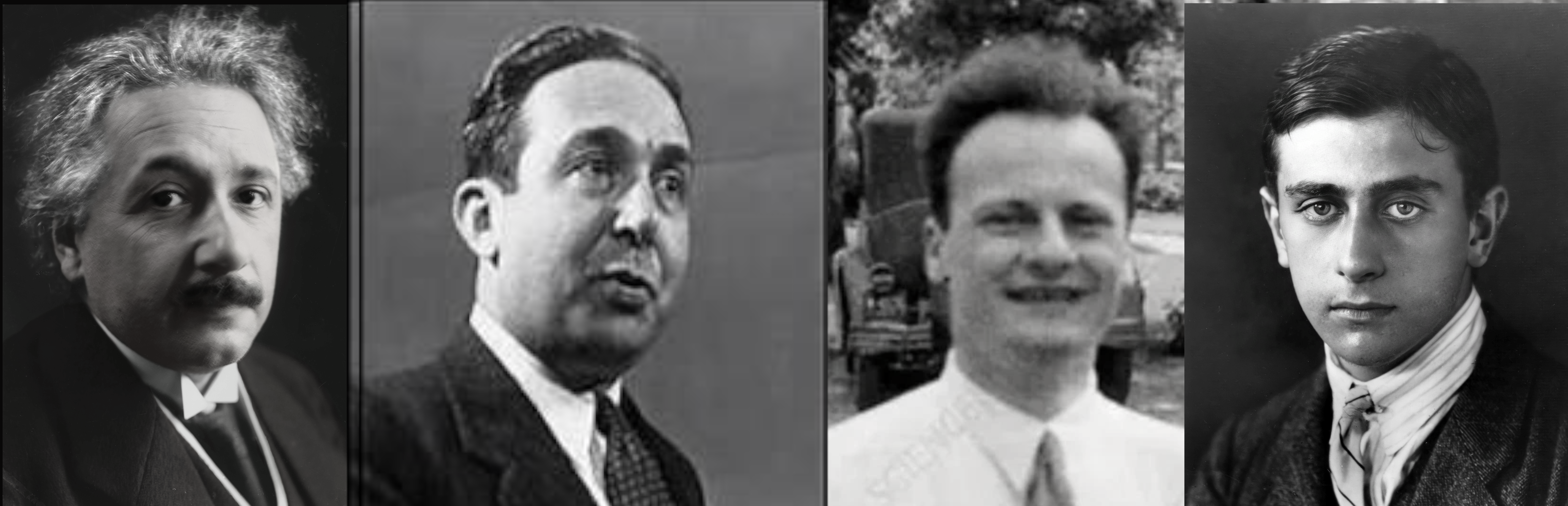
Guess what these men have in common: Albert Einstein, Leo Szilard, Hans Bethe, and Edward Teller.

Everyone knows about Einstein. He won a Nobel Prize for his work on the photoelectric effect, did revolutionary work on the relativity of time and space (all in his mind without a laboratory), fled Nazi Germany in 1933, had wild hair in his later years, and, most importantly, co-authored a letter to President Roosevelt explaining the potential for a nuclear bomb.

That letter is credited with persuading Roosevelt to launch the Manhattan Project. The ensuing nuking of Hiroshima and Nagasaki put an end to WWII. By avoiding a full-scale invasion, the bombs probably saved over a million Japanese, American, British, Australian and Chinese soldiers and civilians.

Einstein became a U.S. citizen in 1944, a year before the bomb was first tested at Los Alamos.

Leo Szilard was the other co-author of that letter. It was Szilard who conceptualized the notion in 1933 that incredible amounts of energy could be released in a nuclear chain reaction by splitting the uranium atom. It might have been the greatest Eureka! moment in science since the day Isaac Newton conceived of gravity when he was hit on the head with a falling apple. Szilard fled Europe in 1938 and became a U.S. citizen five years later.

Hans Bethe was a prominent physicist of the early 20th century. He fled Germany in 1935 at age 29 and became a U.S. citizen in 1941. Like Szilard, he worked on the Manhattan Project. He won the Nobel Prize in 1967 for his work on nuclear reactions over the course of a prolific career, and died in 2005 at age 98.

Edward Teller fled Germany in 1935 and became a U.S. citizen in 1941. He, too, worked on the Manhattan Project. He was later dubbed “the father of the hydrogen bomb.” (While the Hiroshima and Nagasaki bombs used nuclear fission, the hydrogen bomb uses fusion, which delivers much more bang for the buck. Hydrogen bombs have been successfully tested, but never used in warfare.)

OK, one thing these men obviously have in common is that they were all great physicists.

Here’s another thing, perhaps less obvious: They were all Jewish. Indeed, that’s the reason they fled pre-WWII Europe and came to the beacon of hope that is called America. (It should be noted that not all the physicists on the Manhattan project were Jewish. Project leader Robert Oppenheimer was raised in an American Jewish family but did not regard himself as Jewish. Enrico Fermi was an Italian immigrant raised in a Catholic family.)

The Nazis were pretty stupid, considering they fancied themselves clever and strategic. They drove away the greatest physicists of the day – right into the welcoming arms of their adversary.  

The result was poetic justice.

Germany’s persecution of the Jews deprived the Nazi war machine of their scientific talents. Imagine if Germany had kept the Jewish scientists at home in Germany to help them invent the bomb before America did. Those V-2 rockets they used to bombard London could have been loaded with nukes.

Fast forward a few generations. We now have some new Nazis to contend with, called radical Islam. Like the German Nazis, these neo-Nazi Islamicists fancy themselves pretty clever and pretty strategic, though at the moment the Trump-Netanyahu alliance has them on the ropes.

Here’s an interesting thought experiment. What if the radical Islamicists somehow manage to subdue what they call “the Little Satan” of Israel? Where will the Israeli physicists and other scientists go?

Not to Europe, which is a hotbed of antisemitism.

They’ll go where brilliant, hard-working people have always gone – they’ll go to America.

In America, we don’t care if they’re Jewish, Lutheran or Buddhists, and we don’t care if they’re Black, white, brown or yellow. We don’t care about who they are, we care only about what they can do.

What that next wave of Jewish immigrants can do is to help us – help humanity – win another world war, this one against radical Islam. In the meantime, they can help us cure cancer or generate limitless electricity or put a man on Mars.

Here’s the bigger point. It’s too simple to say that immigration is bad, or good. It all depends on the skill set of the immigrants. I’ll happily take another Einstein.
People who “believe in science” are willfully blind  

Remember the virtue-signaling yard signs a few years ago? In rainbow colors, they shouted self-congratulatory platitudes like:

HATE DOESN’T LIVE HERE”

Except that the residents of the house hated anyone who disagreed with them.

“NO HUMAN IS ILLEGAL”

As if the phrase “illegal immigrant” is synonymous with the phrase “illegal human.”

“BLACK LIVES MATTER”

In view of the colossal rip-offs committed by the organization of that name, this one didn’t age well.

“WATER IS LIFE”

Except it’s not; water is a simple molecule of two hydrogen atoms and one oxygen atom. Saying “water is life” is like saying “aluminum is an airplane.”

“SCIENCE IS REAL”

I’ll leave aside the irony of someone blathering something scientifically incorrect like “water is life” and in the next breath preaching “science is real.” It’s this last platitude that I want to focus on.

I have no objection to the phrase “science is real,” per se. “Science” is a methodology of observing, collecting data, developing theories to explain the data, testing the theories, and adopting the theories that pan out – while discarding or modifying the ones that don’t. That method is indeed real.

The problem with “science is real” as a slogan, as opposed to science as a methodology, is that the sloganeers don’t understand the methodology. Rather, they believe – very strongly, as believers are wont to do – that “science” is not a method but an authority. When people disagree with them, they cudgel them with “science” to shut down the debate.

Real scientists don’t do that. Real scientists instead talk about the theories that the methodology of science has developed. You would never hear a real scientist say “Science says . . .” 

Real scientists don’t have nonsensical yard signs shouting “SCIENCE IS REAL.”

Over thousands of years, the methodology of science has led to immense knowledge and enrichment for humanity. From that methodology, we’ve learned that the earth travels around the sun, that many diseases are caused by living pathogens that we can control, that water is a molecule of two hydrogen atoms and one oxygen atom (none of which are alive), that we can split other atoms to release tremendous energy that may someday supply endless electricity to run artificial intelligence machines that will enable us to forget everything we learned in those thousands of years.

But along the way, we’ve gone down many dead ends.

For millennia, scientists including Aristotle thought that life was created spontaneously in suitable settings. It was supposed that tadpoles were created by mudpuddles.

Scientists believed that the earth was a static place, and resisted the concept of continental drift and plate tectonics long into the last half of the 20th century, well after the proof became overwhelming.

Scientists thought that all the great problems of physics had been solved by the end of the 1800s, until an obscure dabbler in the Swiss Patent Office unveiled theories that changed everything. Albert Einstein had a brilliant and creative mind unimpeded by the rigors of running a laboratory or raising NIH grants. In fact, he had no laboratory and did no experiments.

Einstein’s successors in physics never disproved his theories, but their theories of quantum mechanics in the infinitesimal stand awkwardly alongside Einstein’s theories of the universe at large.

His successors accepted Einstein better than Einstein accepted them. He dismissed quantum mechanics theories of uncertainty with “God does not play dice with the universe.” Late in life, Einstein was one of the continental drift deniers.

But the continents do drift, and God does seem to play dice.

In geology, scientists thought the age of the earth was maybe a few million years. Not until the middle of the last century did they theorize correctly (we currently think) that it’s more like 4,500 million years – or 4.5 billion.

At the time scientists came up with the 4.5 billion figure for the age of the earth, that figure was older than the widely accepted age of the universe. It was as if you were determined to be older than your mother. Talk about awkward.

The “science is real” crowd of non-scientists have even more reckoning ahead. Here’s a brief punch list of what the methodology of science has still left unanswered:

We don’t know why things fall. We have a name for it – gravity – and we can predict how things react to this gravity stuff (though our predictions get squirrely when we take them to a large scale and start moving things fast) but we don’t know what it is. It behaves like a force by drawing things toward one another, but we cannot isolate or identify that force. We’re left with the unsatisfying conclusion that it’s just an artifact of the shape of the universe. Hmm.

About 90% of the universe is unaccounted for. We call it “Dark Matter,” which is not to be confused with Darth Vader. Our observations say it has to be there, but we can’t find it or even describe it. Given that it’s 90% of the universe, it’s not like looking for a needle in a haystack. It’s more like looking for hay in a haystack. Here we are, deep in the haystack, and we can’t find the hay.

The universe began with a bang, says our best theory. Before this big bang, there was nothing – no time, no things, not even empty space. Then everything came out of nothing. We don’t know why and we don’t know how.

Back to quantum mechanics. Scientists have experimentally proven that there can be “action at a distance.” If two protons (or other objects) are “entangled,” then a change to one simultaneously effectuates a change to the other even if it’s a million miles away.

This simultaneous action-at-a-distance would seem to violate Einstein’s settled conclusion that nothing can travel faster than the speed of light – including information. But physicists have ideas as to why it doesn’t violate Einstein.  They call those ideas “theories.” Those theories will be tested, validated, invalidated, modified, remodified and, if appropriate, discarded.

I suspect that some of the great unanswered questions will never be answered because the applicable theories cannot be tested. How everything – the universe – came into existence from nothing, is one of those unanswerable questions. The nothingness before the big bang was empty of both time and events, and so it left no tracks. All we know and ever will know about the time before time and the nothing before everything, is nothing.

Which brings us back to that dice player.

The best we can say is this. Creation was created and, perforce, it was by a creator, the nature of which or whom is a question best left to philosophers and theologians.

Next time someone tries to win an argument by invoking “science,” have a little fun with them. Start with “Do you think water is life?” and go on from there.