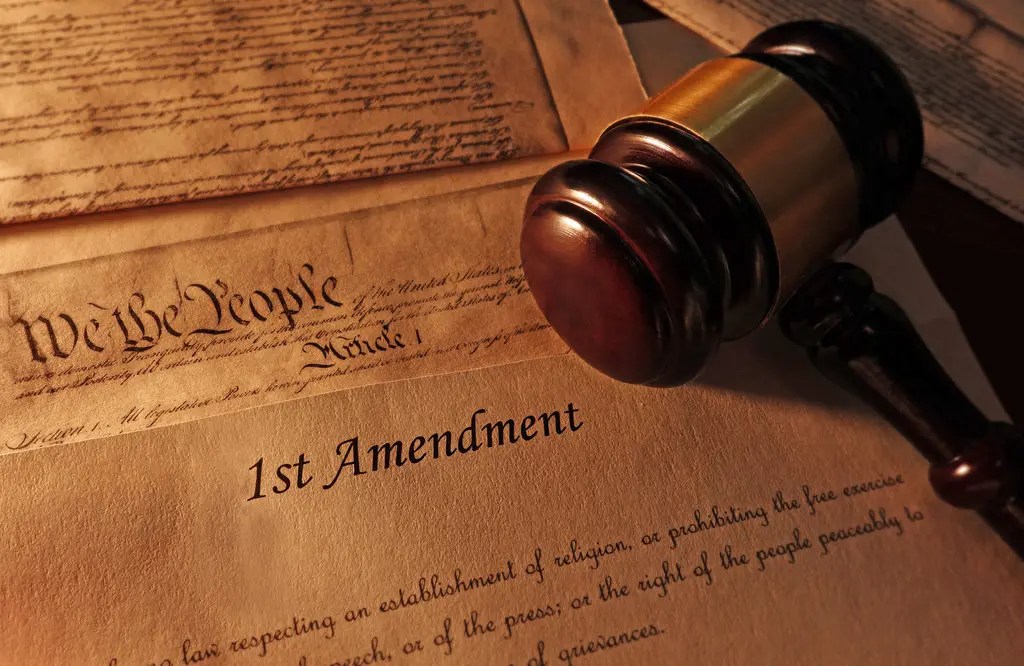

“Disinformation” is not the same as falsely shouting FIRE in a crowded theater

Here’s how the First Amendment debate over governmental prohibitions on free speech has been framed:

  • The Democrats want the government to prohibit people from spreading “disinformation” that they don’t like.
  • The Republicans correctly point out that the First Amendment, in general, prohibits such a prohibition.
  • The Democrats then respond that the First Amendment does not apply because disinformation is like falsely shouting FIRE in a crowded theater – people’s safety is at risk.
  • Republicans then point out that the analogy between political speech and falsely “shouting FIRE in a crowded theater” is rooted in a Supreme Court case dating back to WWI. In that case, the Court upheld a restriction on speech in opposition to the wartime draft. The Court decided that political speech opposing the draft was like falsely shouting FIRE in a crowded theater, in that it could cause America to lose the war. It was a stretch, but that was the Court’s analogy.
  • But, say the Republicans, that Supreme Court case was later rejected during the Vietnam War in 1969 (a much less popular war than WWI) and was essentially overruled. Political speech today clearly is protected by the First Amendment – even if it’s highly unpopular or even untrue.

So far, so good. But many Republicans have gone on to imply that the Supreme Court’s overruling of the “shouting fire in a crowded theater” analogy means that the First Amendment gives people the right to falsely shout FIRE in a crowded theater.

This was a mistake for two reasons. The first is strategic and the second is legal.

The strategic reason is that contending the First Amendment gives people the right to say things to cause an immediate, panicked mayhem violates common sense and tends to discredit the First Amendment. Casual thinkers start to casually think, “Gee, if the First Amendment gives people the right to cause dozens of trampling deaths in minutes, just to watch people get trampled, then maybe the First Amendment is not such a good thing.”

The legal reason it’s a mistake to imply that the Supreme Court ultimately decided falsely shouting FIRE in a crowded theater is protected by the First Amendment, is that the Supreme Court never did.  

Rather, what the Court held in that later case was that political speech is simply not the same as falsely shouting FIRE in a crowded theater. The latter is false and may produce immediate maiming and death, while the former is a political statement which might be false (or might not be) but is not likely to produce immediate maiming and death.

If the Supreme Court is ever confronted with a case where someone is prosecuted for causing immediate maiming and death by falsely shouting FIRE in a crowded theater, I am confident that the Supreme Court will not decide that his grotesque mischief is protected by the First Amendment.

But, you say, isn’t the First Amendment absolute?

No, it is not. For example, there is no First Amendment right to tell material lies in the sale of a product – to engage in false advertising. The First Amendment does not give a business the right to falsely state that their snake oil has cured cancer in 29,385 people if it hasn’t, or falsely state that customers can return goods for a cash refund if they can’t.

There is no First Amendment right to state falsehoods on your tax return. You can’t tell the IRS that you earned X dollars when you really earned X + Y dollars, as Hunter Biden has learned to his dismay (along with thousands of other citizens over the years, notoriously including Al Capone).

There is no First Amendment right to lie under oath. That’s perjury, and it’s a crime – and it’s not protected by the First Amendment.

There is no First Amendment right to defame a person, as several media outlets learned when they falsely characterized a teenager as racist because it suited their narrative. 

There is no First Amendment right to make or distribute child pornography.

But most other speech is indeed protected by the First Amendment, particularly political speech. Saying that Donald Trump colluded with the Russians, or that Barack Obama or Vladimir Putin is running the White House, or that the 9/11 attack was orchestrated by the CIA or by aliens, or that your uncle was eaten by cannibals, is all generally protected as political speech – whether it’s true or not.

Such political speech is not the same as shouting FIRE in a crowded theater to cause an immediate mob scene of trampled human bodies.

Whether there’s a political price to be paid for false speech is, of course, a separate issue. Sometimes there is, and oftentimes there’s not. Either way, that’s not a legal matter, but a political matter.

Our nation stands nearly alone in the protections of the First Amendment. In most of Europe, you can be sent to jail for “hate speech” that a judge finds offensive. And many people have been. That is not the law in America, yet.

The Republicans have by far the better of this First Amendment debate, but they’ve expressed their argument poorly by implying that you can indeed shout FIRE in a crowded theater.

The proper argument is: Granted, you can’t falsely shout FIRE in a crowded theater, but political speech is nothing of the sort.

Glenn K. Beaton practiced law in the federal courts, including the Supreme Court.

Colorado’s Civil Rights Commission gets schooled on the First Amendment in the wedding website case

Remember the wedding website case that came out of Colorado and went all the way to the Supreme Court? It’s finally over, and it ended beautifully. Bigly beautifully.

I’ll let the district court describe the facts:

“Plaintiff Lorie Smith . . . offers a variety of creative services, including website design, to the public. Ms. Smith intends to expand the scope of [her] services to include the design, creation, and publication of wedding websites. However, [Smith] will decline any request to design, create, or promote content that promotes any conception of marriage other than marriage between one man and one woman. [Smith has] designed an addition to [her] website that includes a statement that [she] will not create websites “celebrating same sex marriages or any other marriage that contradicts God’s design for marriage.”

The Colorado Civil Rights Commission decided that Smith’s exercise of her First Amendment right to decline to perform services in violation of her religious beliefs, and that her words so stating, were, ironically, in violation of the First Amendment. The Commission said (1) Smith was required to design websites celebrating marriages other than between a man and a woman, and (2) she was prohibited from stating that she wouldn’t.

Smith sued the Commission in Federal Court. It was a smart move to go to Federal Court because state court would have ensnarled her for years in the swamp of the Democrat-controlled Colorado state judiciary – the one where the state supreme court tossed Donald Trump from the 2024 ballot only to be unanimously overturned by the Supreme Court last winter.

The district court dismissed her case on procedural grounds. She appealed to the federal appellate court. They overturned the dismissal on procedural grounds, but, worse, dismissed her case on substantive grounds.

She appealed to the Supreme Court. The Supreme Court held 6-3 last year that both dismissals were wrong. They held that the Commission’s insistence that she perform services in violation of her religious beliefs, and insistence that she refrain from stating that she wouldn’t, were in violation of her First Amendment rights.

In short, she won.

The case was then remanded back to the lower courts to work out the details. It came back to a different district court judge. (The first judge, a former bankruptcy judge, had taken “Senior” status while the case was on appeal. That’s a gravy train for federal judges where they get full pay, the same plush courtrooms and chambers, a full complement of law clerks to kiss the back of their robes, and invitations to the right (er, left) cocktail parties. But they work just part-time by taking on only the particular cases they want. No, this “job” is not available for you.)

The details remaining to be worked out on remand to the district court were the exact language of the court’s order, and the payment of attorney fees. The Commission wanted a cramped order with little precedential significance and minimal further embarrassment to them. Smith of course wanted a broader order protecting her against infringements on her First Amendment right to exercise and state her religious beliefs.

This week, the new judge sided with Smith. The court’s order states:

“ORDERED that the First Amendment’s Free Speech Clause prohibits Colorado from [compelling Smith] to create custom websites celebrating or depicting same-sex weddings or otherwise create or depict original, expressive, graphic or website designs inconsistent with her beliefs regarding same sex marriage.”

Then there was the attorney fees issue. The civil rights laws provide for an award of attorney fees and costs to a prevailing plaintiff. Smith was the prevailing plaintiff, though she had to go all the way to the Supreme Court to become one.

The Commission argued that she was actually only a partially prevailing plaintiff because she didn’t win on every single claim she made. Accordingly, the Commission contended, attorney fees should be prorated.

The district court rejected the Commission’s argument, and instead correctly held that “prevailing” in this context simply means the side that basically won, even if they didn’t win on every single claim. Attorney’s typically throw in lots of claims of dubious merit in a lawsuit. The fact that some get thrown out along the way doesn’t mean their client isn’t the prevailing party at the end of the day when they are awarded the remedy they seek.

The judge concluded with an invitation to Smith’s attorneys to file a motion for their costs and attorney fees.

Those costs and fees are likely to be into seven figures, since they include the original district court proceedings, the appeal to the appellate court, the appeal to the Supreme Court, and the current remand to the district court.

That is all good news. Smith is now playing with the house’s money. The bad news is that the “house” is, at the end of the day, the taxpayers of the State of Colorado.

Mind you, my objection here is not to gays getting married. I’m OK with that, though it took me a few years to get there. My objection is to the government telling everyone that they’re required to think it’s OK. Many people have sincere religious or other beliefs objecting to gay marriage. It’s wrong — and a violation of the First Amendment — to force them to abandon their beliefs.

As a matter of strategy, I also think it’s a grave mistake for gays to force this issue. People tend to get entrenched when their religion is attacked. But very often, when the left can choose between effective persuasion and ineffective coercion, they choose the latter. Because, at heart, they want to boss people around. They’re totalitarians.

I wish there were a way to hold these totalitarian bureaucrats personally liable in cases like this. A million-dollar judgment against them personally, and a seizure or their residences, might make them think twice next time. How about an $83 million judgment and $92 million bond? Better yet, how about a $464 million judgment secured with a $175 million bond?

Glenn Beaton practiced law in the Federal Courts, including the Supreme Court.

Fascist officials of Aspen threaten to cancel a newspaper because its new owners are unwoke

The Aspen Times months ago published a thinly supported story suggesting that one of the local billionaires was in league with Vladimir Putin. The billionaire filed suit against the newspaper for defamation. The newspaper wanted to settle the case.

Meanwhile, the newspaper was recently bought by a family-owned group of several dozen small newspapers. Much of the family are Republicans, which may be the determinative fact in this story.

The new owners asked that the newspaper staff refrain from commenting on the pending litigation while settlement talks were ongoing. That’s standard and prudent in legal proceedings. You don’t want employees saying things that might become evidence at trial or disrupt the settlement negotiations.

Continue reading