Don’t it always seem to go
Joni Mitchell
That you don’t know what you’ve got ’til it’s gone
They paved paradise, put up a parking lot
Ooh, bop-bop-bop-bop, ooh, bop-bop-bop-bop
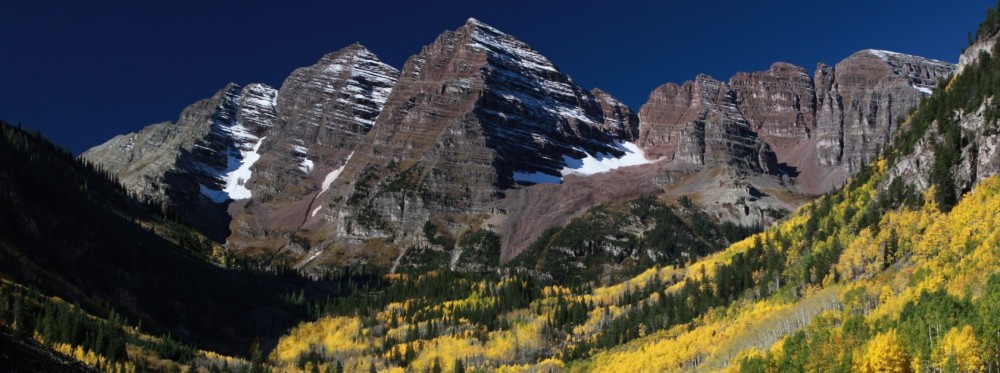
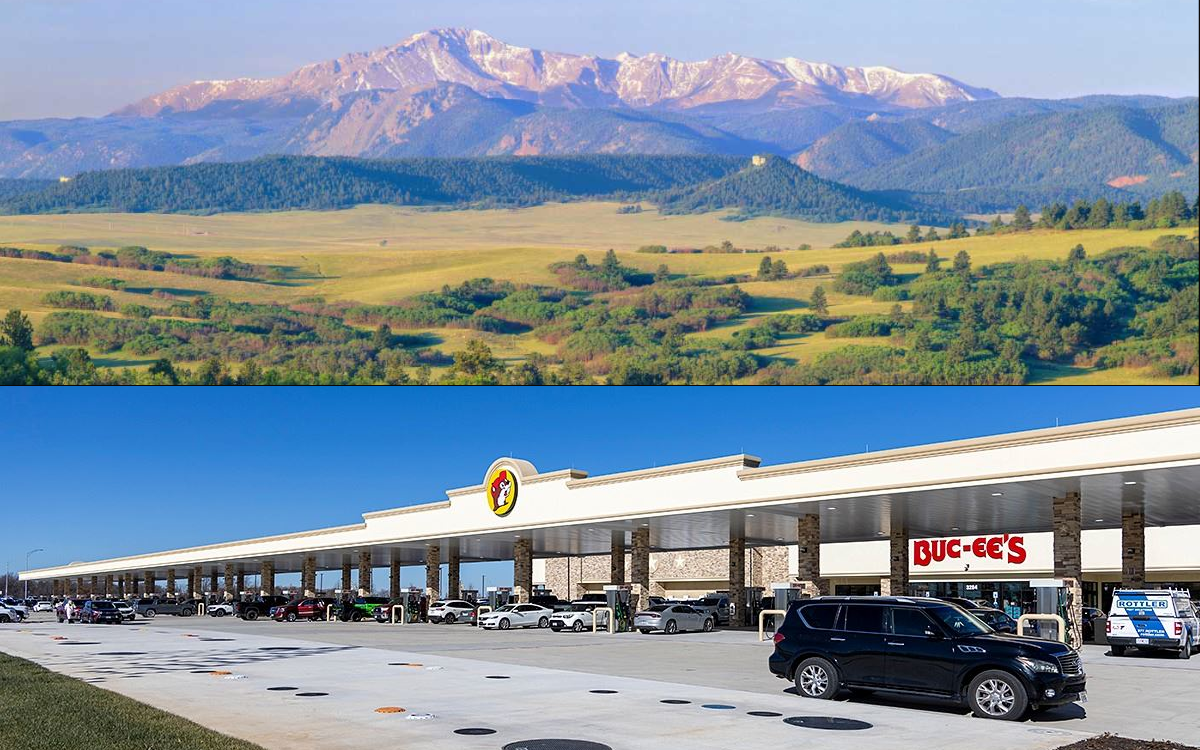
The “Front Range” of the Colorado Rocky Mountains stretches a few hundred miles from Wyoming to New Mexico. It’s where the plains meet the mountains. It’s high plateaus of grasslands, gnarly ponderosa pines and sandstone bluffs.
It’s anchored by 14,107-foot Pikes Peak, named in honor of the 1806 expedition to the region led by explorer Zebulon Pike.
“Pikes Peak or Bust” was the slogan of intrepid gold rush pioneers making their way across the Great Plains to Cripple Creek and other gold camps west of Colorado Springs. Those early gold rushers traveling on foot, horses and wagons were able to see Pikes Peak from the Kansas border 160 miles to the east, where they were still a week away from it.
I grew up a few miles from Pikes Peak, in the shadow of nearby Cheyenne Mountain. After traveling the world and summiting some of the great mountains, I still admire the majesty of what locals and former locals like myself call “The Peak.”
Today, the Front Range is rapidly turning into an extended suburbia. Metropolitan Denver to the north is growing at double the national average. Colorado Springs, 60 miles to the south, is growing even faster. The entire Front Ranch threatens to become a strip city. Call it Denver Dings.
Roughly in the middle of the sprawl is a large, preserved, open space that looks much like it did when Zeb Pike rode through, called Greenland Ranch. It once stretched from the Front Range all the way to the Kansas border. What remains today is about 17,000 acres – about 26 square miles. This fantastic landscape is home to coyotes, elk, deer, bear, mountain lions and prairie dogs.
Greenland Ranch was bought by cable television entrepreneur John Malone five years ago. He has invested tens of millions in the Ranch, but not to develop it. Rather, he spent his money to ensure the opposite. He granted a permanent conservation easement to preserve it forever.
Malone happens to be politically conservative. He donated $250,000 to Donald Trump’s campaign. Like many conservatives, he’s no environmentalist but he does believe in conservation. He therefore worked in conjunction with local governments which bought thousands of adjacent acres for permanent conservation.
As a result of the efforts of John Malone, there will always be Greenland Ranch to remind us of the Old West, whatever bad things happen to the rest of the Front Range.
Like Buc-ee’s.
I’m not intimately familiar with Buc-ee’s. It’s apparently a chain of gas station/convenience superstores. Think of a monster truck stop, but without the charm or grace.
Buc-ee’s wants to put up one of its superstores adjacent the Greenland Ranch and open space. They’ve sold the politicians running the nearby local town of Palmer Lake on the idea with the promise that their superstore would generate a million dollars a year in tax revenue.
Politicians like tax revenue.
The locals who are not politicians are less enthused. The issue has sharply divided Palmer Lake between the politicos who want tax revenue and the people who want the semi-wild landscape they came for.
Buc-ee’s proposal is to build and pave about 41 acres. They anticipate 11,000 cars a day and 60 gas pumps.
A recent article in the Wall Street Journal described the imbroglio. It was a decent piece, better than some of the pap that has appeared lately in the Journal.
As interesting as the piece itself, were the comments to it. The commenters were as sharply divided as the town of Palmer Lake, but for a different reason. The reason for division between the commenters was pure tribal politics.
The commenters saw Buc-ee’s as a political statement. To them it’s a symbol of truck stops, gasoline (and gas), fast food, big RVs, and American pie (or at least pie).
And so, the commenters favored or disfavored the Buc-ee’s proposal based on whether they were conservatives or liberals. A sampling:
Buc-ee’s brings much more joy to people than John Malone
Is it that Buc-ee’s is just “too American” for these people?
If you live in a town with either a Buc-ees or a Wawa [convenience store] you are blessed.
The usual Colorado leftist hypocrisy.
Buc-ee’s is awesome and a welcome stop anytime you do a road trip.
Ten dollars says that the Buc-ee’s opponents are card carrying Democrats.
This cult following around a business really shows Americans are starved for culture in these parts of the country.
The WSJ doesn’t have a clue what the spirit of the west is, just a bunch or rich spoiled elitists who think they know better how to live our lives than we do.
You can’t have a Buc-ee’s because it would make the elk sad is about the dumbest argument I have ever heard.
I love Buc-ee’s.
I love the Beaver Nuggets
Anybody who opposes a Buc-ee’s has never been to a Buc-ee’s
For me, the question is not whether Buc-ee’s is an appealing place or not (though I happen to think it’s probably not, to me anyway). Rather, the question is a land use question: Is this the right use for this land?
We frequently make decisions about how to use land. That’s why we have zoning laws.
Unfortunately, the debate over this Buc-ee’s at this particular location has devolved into a tribal fight. Conservatives favor Buc-ee’s because liberals oppose it, and liberals oppose it because conservatives favor it.
It’s today’s American politics in a microcosm. Whether you like Buc-ee’s or not, and whether you favor this particular Buc-ee’s location or not, this much is true: The American political system has become tribalized to the point of dysfunction.
 the Aspen beat