
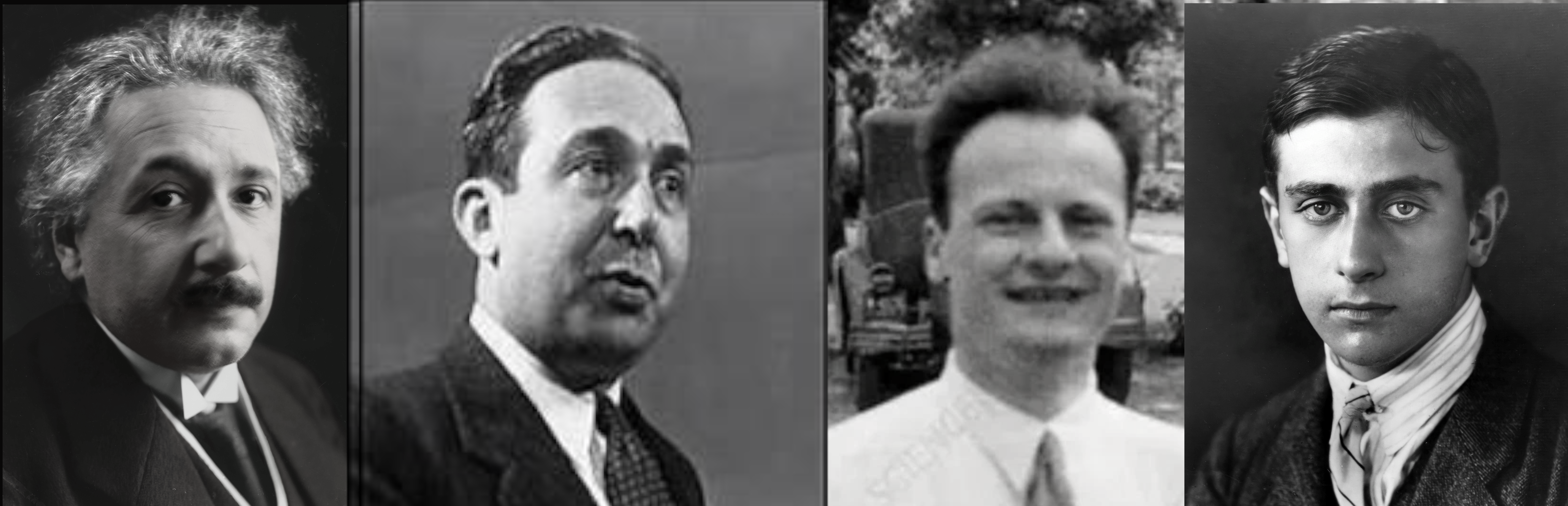
Guess what these men have in common: Albert Einstein, Leo Szilard, Hans Bethe, and Edward Teller.
Everyone knows about Einstein. He won a Nobel Prize for his work on the photoelectric effect, did revolutionary work on the relativity of time and space (all in his mind without a laboratory), fled Nazi Germany in 1933, had wild hair in his later years, and, most importantly, co-authored a letter to President Roosevelt explaining the potential for a nuclear bomb.
That letter is credited with persuading Roosevelt to launch the Manhattan Project. The ensuing nuking of Hiroshima and Nagasaki put an end to WWII. By avoiding a full-scale invasion, the bombs probably saved over a million Japanese, American, British, Australian and Chinese soldiers and civilians.
Einstein became a U.S. citizen in 1944, a year before the bomb was first tested at Los Alamos.
Leo Szilard was the other co-author of that letter. It was Szilard who conceptualized the notion in 1933 that incredible amounts of energy could be released in a nuclear chain reaction by splitting the uranium atom. It might have been the greatest Eureka! moment in science since the day Isaac Newton conceived of gravity when he was hit on the head with a falling apple. Szilard fled Europe in 1938 and became a U.S. citizen five years later.
Hans Bethe was a prominent physicist of the early 20th century. He fled Germany in 1935 at age 29 and became a U.S. citizen in 1941. Like Szilard, he worked on the Manhattan Project. He won the Nobel Prize in 1967 for his work on nuclear reactions over the course of a prolific career, and died in 2005 at age 98.
Edward Teller fled Germany in 1935 and became a U.S. citizen in 1941. He, too, worked on the Manhattan Project. He was later dubbed “the father of the hydrogen bomb.” (While the Hiroshima and Nagasaki bombs used nuclear fission, the hydrogen bomb uses fusion, which delivers much more bang for the buck. Hydrogen bombs have been successfully tested, but never used in warfare.)
OK, one thing these men obviously have in common is that they were all great physicists.
Here’s another thing, perhaps less obvious: They were all Jewish. Indeed, that’s the reason they fled pre-WWII Europe and came to the beacon of hope that is called America. (It should be noted that not all the physicists on the Manhattan project were Jewish. Project leader Robert Oppenheimer was raised in an American Jewish family but did not regard himself as Jewish. Enrico Fermi was an Italian immigrant raised in a Catholic family.)
The Nazis were pretty stupid, considering they fancied themselves clever and strategic. They drove away the greatest physicists of the day – right into the welcoming arms of their adversary.
The result was poetic justice.
Germany’s persecution of the Jews deprived the Nazi war machine of their scientific talents. Imagine if Germany had kept the Jewish scientists at home in Germany to help them invent the bomb before America did. Those V-2 rockets they used to bombard London could have been loaded with nukes.
Fast forward a few generations. We now have some new Nazis to contend with, called radical Islam. Like the German Nazis, these neo-Nazi Islamicists fancy themselves pretty clever and pretty strategic, though at the moment the Trump-Netanyahu alliance has them on the ropes.
Here’s an interesting thought experiment. What if the radical Islamicists somehow manage to subdue what they call “the Little Satan” of Israel? Where will the Israeli physicists and other scientists go?
Not to Europe, which is a hotbed of antisemitism.
They’ll go where brilliant, hard-working people have always gone – they’ll go to America.
In America, we don’t care if they’re Jewish, Lutheran or Buddhists, and we don’t care if they’re Black, white, brown or yellow. We don’t care about who they are, we care only about what they can do.
What that next wave of Jewish immigrants can do is to help us – help humanity – win another world war, this one against radical Islam. In the meantime, they can help us cure cancer or generate limitless electricity or put a man on Mars.
Here’s the bigger point. It’s too simple to say that immigration is bad, or good. It all depends on the skill set of the immigrants. I’ll happily take another Einstein.

 the Aspen beat