
David Brooks holds himself out as a moderate Republican. I suspect, however, that the last Republican he voted for was George H.W. Bush – the senior Bush who was elected 38 years ago.
Disgracefully but predictably, PBS pairs Brooks with Jonathan Capehart in a point-counterpoint format. PBS pretends that this little tête-à-tête constitutes balance – an avowed far-left gay Black man versus a faux Republican moderate who, in reality, hasn’t voted for a Republican in decades.
But Brooks made a good point in a recent piece on the shooting in Minneapolis. First, Capehart performed his predictable over-the-top song and dance about murder-murder-MURDER!!!
Then Brooks quietly observed that, in a better day, principled people would believe what they see on videotape. Today, however, it’s the opposite. Rather than believing what they see, people are seeing what they believe.
People watching exactly the same videotape believe they watched a murder, or believe they watched a cop shoot someone in self-defense, based on their pre-existing political persuasion.
Today’s political partisans are like sports fans. When two people are watching the same game but rooting for opposite teams, they typically both believe their team is getting cheated by the refs.
Of course, that can’t be true. On balance, the refs are either fair, or biased one way, or biased the other way. But people’s emotions cloud their judgment. It’s especially pernicious that they’re unaware of this phenomenon. That’s bad enough in sports; it’s tragic and often unjust in law enforcement.
Of course, after making this good point, Brooks went on to bash President Trump. There’s a reason, after all, that Brooks has a forum at PBS and The New York Times.
As of today, a few more facts have come it. I don’t know what Brooks is thinking right now, but I’ll tell you what I’m thinking.
First, a couple of background facts. Context matters.
The cop (I’ll call him a “cop” for convenience, though I know he’s not a policeman, and I do so without derogation) was the victim of another car incident last year. His arm got tangled up inside the car of a person he was apprehending as the person drove off. The cop was dragged 300 feet down the paved road by the accelerating car. He was lucky to survive.
Does that matter? Maybe not in a legal sense. After all, it was a completely different incident that occurred many months ago. But it suggests that the man was probably sensitive to the danger in such a circumstance. I sure would be.
Here’s another background fact. The left has made a studied show of resistance to enforcement of the immigration laws. They’ve flung names at ICE cops such as Nazis, fascists and worse. They’ve physically obstructed them, and occasionally physically attacked them with rocks and bottles. That’s criminal behavior, even though it does not justify a lethal response.
They’ve also used their cars to obstruct the cops and, as I’ve just reported above, on at least one occasion they dragged a cop 300 feet with their car.
Their objective has been to provoke the cops into victimizing them. Lefty influencers have explicitly urged protesters to put their bodies on the line.
If they can provoke the cops into violence in their enforcement of the immigration laws, goes the thinking on the left, people will come to believe that the laws being enforced are bad.
It’s a very old strategy. It often works, especially when the news media is sympathetic to the cause.
A final background fact. The Administration has taken a confrontational approach to immigration enforcement. That’s not necessarily a bad thing, and it may be warranted in view of the lackadaisical approach taken for many years. But confrontational approaches do have a tendency to produce, well, confrontations.
Whatever approach is utilized, it might be useful to combine it with an employee card-check system where employers are required to check the immigration status of their employees. Substantial fines could be imposed on companies who hire illegals. Such a system has been talked about for years and partially utilized, but politicians too often bow to business lobbies who want to hire illegals for cheap labor.
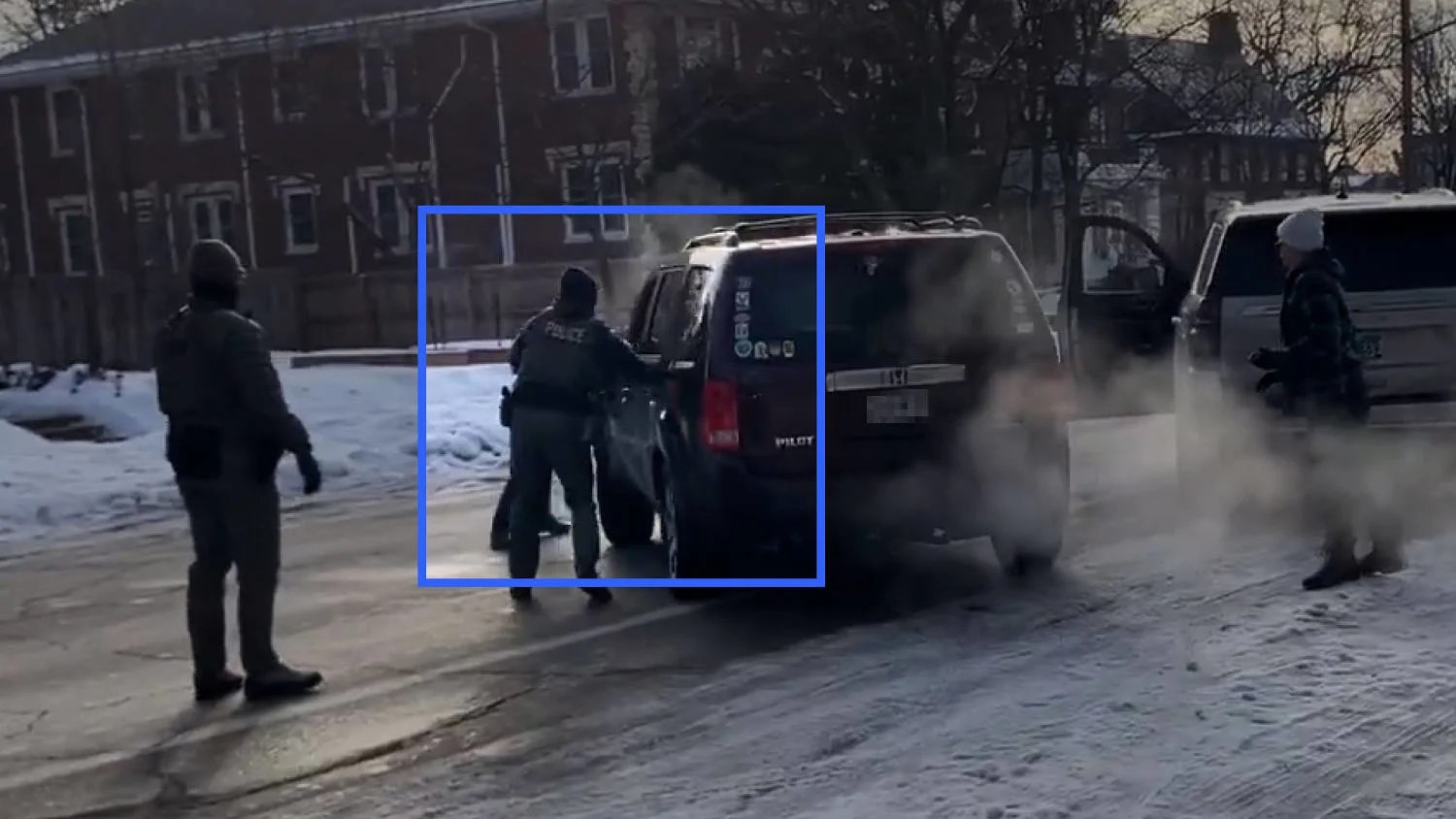
On to the incident itself. At least two videotapes are available. One was taken by a bystander, and the other is the body cam that was being worn by the cop who fired the shots.
The bystander’s video is taken from a stationary position. It shows a cop approaching the car, putting his hand on the driver’s door handle, and ordering her:
“Get the fuck out of the car.”
The car moves backward a few inches. The front wheels turn hard right and it juts forward. Only then, you can see another cop at the left front of the car. He shoots three times. We later learn that his shots leave one bullet hole through the windshield. At least one shot went in through the driver’s open side window as the car moved past him.
The shot through the driver’s side window suggests that, whatever danger the cop was in at the time he shot through the windshield, the cop by then had gotten out of the way, for he was then alongside the car.
The video taken by the cop’s body cam provides more context as the cop circles the car. The woman’s wife was at the scene and had gotten out of the car. Smirking, the wife taunted the cop repeatedly:
“Come at us! You want to come at us?”
A refection of the cop is visible in the shiny finish of the car, and he appears to be a sizable man. The wife taunts him again:
“Go get yourself some lunch, big boy!”
As the cop circles to the front of the car, the shots come quite suddenly. The situation was tense but exploded unexpectedly, to me as the viewer anyway, with (1) the wife starting to open the passenger side door and shouting “drive, baby, drive,” (2) the car lurching forward, and (3) three shots ringing out quickly.
I cannot tell whether the cop legitimately feared for his life when he fired the first shot. I can say, however, that he was very ready to pull his gun and shoot, because he did so very fast. As for the second and third shots, see my discussion above.
It’s still early, and not all the facts are in. Maybe they never will be.
But here’s my tentative assessment. Two lefty troublemakers went looking for trouble. They used their car to block armed cops on an icy street from doing their jobs, and they taunted the cops with personal insults. One cop reacted with a profanity. Another cop – who’d been dragged 300 feet by a car in such a situation – reacted with his gun when the car lurched toward him as he was circling it and he heard “Drive, baby, drive!”
Is this tragic? Yes. Was it preventable? Yes. Is it murder? No.
 the Aspen beat