Glenn K. Beaton is a writer and columnist living in Colorado. He has been a contributor to The Wall Street Journal, RealClearPolitics, Powerline, Instapundit, Citizen Free Press, American Thinker, Fox News, The Federalist, and numerous other print, radio and television outlets. His most recent book is "High Attitude — How Woke Liberals Ruined Aspen"
We went to bed on Sunday and there was vague talk of a shutdown workaround. We wake up on Monday, and the Democrats have caved.
Analogies, anyone? If this were a boxing match, the Democrats didn’t come out of their corner for the 8th round. If it were a softball game, the ten-run rule got applied. If it were a war, they flew the white flag and laid down their arms. If it were wrestling, they tapped out.
If it were poker, they folded, though the time to fold ‘em was a month ago. They didn’t know when to walk away, and so now they have to run.
Feel free to add your own analogies. That’s what the comment section is for!
This all transpired because Democrats are the minority party in Congress at the moment. They consequently got outvoted on the tax bill last winter. Getting outvoted often happens to the minority party.
The Democrats’ solution to being outvoted as the minority party was to demand to be treated like the majority party, else they would shut down the government. They demanded a re-do of the tax bill, specifically the part that let expire the Obamacare insurance subsidies enacted as a temporary measure during COVID.
The Republicans’ reaction was, “Huh? Do you think that Democrats get to act like the majority party when they are, and also get to act like the majority party when they aren’t?”
It wasn’t hard for the Republicans to call that bluff.
After the biblical 40 days and 40 nights, give or take, and over a dozen votes blocked by the Democrats, eight of the 43 Democrat Senators finally broke ranks Sunday evening and voted to re-open the government.
The stock market cheered. Food stamp recipients rejoiced. Federal workers felt relieved. Holiday travelers were glad.
Democrats fumed.
Now there’s a civil war in the Democratic party. By the media reports, it sounds like the biggest one since Democrats quit America a century and a half ago to continue holding in chains some of the men God created equal.
In the resolution to both civil wars, the Democrats got hardly anything in the bargain.
At least this time, Atlanta didn’t get torched.
But Chuck Schumer did. Imagine Schumer stark naked with only a fig leaf, surrounded by ravenous dog-like Democrats looking for someone to blame. Now take away the fig leaf and let loose the dogs.
That’s the Democrat Party right now. It ain’t pretty.
Remember the virtue-signaling yard signs a few years ago? In rainbow colors, they shouted self-congratulatory platitudes like:
“HATE DOESN’T LIVE HERE”
Except that the residents of the house hated anyone who disagreed with them.
“NO HUMAN IS ILLEGAL”
As if the phrase “illegal immigrant” is synonymous with the phrase “illegal human.”
“BLACK LIVES MATTER”
In view of the colossal rip-offs committed by the organization of that name, this one didn’t age well.
“WATER IS LIFE”
Except it’s not; water is a simple molecule of two hydrogen atoms and one oxygen atom. Saying “water is life” is like saying “aluminum is an airplane.”
“SCIENCE IS REAL”
I’ll leave aside the irony of someone blathering something scientifically incorrect like “water is life” and in the next breath preaching “science is real.” It’s this last platitude that I want to focus on.
I have no objection to the phrase “science is real,” per se. “Science” is a methodology of observing, collecting data, developing theories to explain the data, testing the theories, and adopting the theories that pan out – while discarding or modifying the ones that don’t. That method is indeed real.
The problem with “science is real” as a slogan, as opposed to science as a methodology, is that the sloganeers don’t understand the methodology. Rather, they believe – very strongly, as believers are wont to do – that “science” is not a method but an authority. When people disagree with them, they cudgel them with “science” to shut down the debate.
Real scientists don’t do that. Real scientists instead talk about the theories that the methodology of science has developed. You would never hear a real scientist say “Science says . . .”
Real scientists don’t have nonsensical yard signs shouting “SCIENCE IS REAL.”
Over thousands of years, the methodology of science has led to immense knowledge and enrichment for humanity. From that methodology, we’ve learned that the earth travels around the sun, that many diseases are caused by living pathogens that we can control, that water is a molecule of two hydrogen atoms and one oxygen atom (none of which are alive), that we can split other atoms to release tremendous energy that may someday supply endless electricity to run artificial intelligence machines that will enable us to forget everything we learned in those thousands of years.
But along the way, we’ve gone down many dead ends.
For millennia, scientists including Aristotle thought that life was created spontaneously in suitable settings. It was supposed that tadpoles were created by mudpuddles.
Scientists believed that the earth was a static place, and resisted the concept of continental drift and plate tectonics long into the last half of the 20th century, well after the proof became overwhelming.
Scientists thought that all the great problems of physics had been solved by the end of the 1800s, until an obscure dabbler in the Swiss Patent Office unveiled theories that changed everything. Albert Einstein had a brilliant and creative mind unimpeded by the rigors of running a laboratory or raising NIH grants. In fact, he had no laboratory and did no experiments.
Einstein’s successors in physics never disproved his theories, but their theories of quantum mechanics in the infinitesimal stand awkwardly alongside Einstein’s theories of the universe at large.
His successors accepted Einstein better than Einstein accepted them. He dismissed quantum mechanics theories of uncertainty with “God does not play dice with the universe.” Late in life, Einstein was one of the continental drift deniers.
But the continents do drift, and God does seem to play dice.
In geology, scientists thought the age of the earth was maybe a few million years. Not until the middle of the last century did they theorize correctly (we currently think) that it’s more like 4,500 million years – or 4.5 billion.
At the time scientists came up with the 4.5 billion figure for the age of the earth, that figure was older than the widely accepted age of the universe. It was as if you were determined to be older than your mother. Talk about awkward.
The “science is real” crowd of non-scientists have even more reckoning ahead. Here’s a brief punch list of what the methodology of science has still left unanswered:
We don’t know why things fall. We have a name for it – gravity – and we can predict how things react to this gravity stuff (though our predictions get squirrely when we take them to a large scale and start moving things fast) but we don’t know what it is. It behaves like a force by drawing things toward one another, but we cannot isolate or identify that force. We’re left with the unsatisfying conclusion that it’s just an artifact of the shape of the universe. Hmm.
About 90% of the universe is unaccounted for. We call it “Dark Matter,” which is not to be confused with Darth Vader. Our observations say it has to be there, but we can’t find it or even describe it. Given that it’s 90% of the universe, it’s not like looking for a needle in a haystack. It’s more like looking for hay in a haystack. Here we are, deep in the haystack, and we can’t find the hay.
The universe began with a bang, says our best theory. Before this big bang, there was nothing – no time, no things, not even empty space. Then everything came out of nothing. We don’t know why and we don’t know how.
Back to quantum mechanics. Scientists have experimentally proven that there can be “action at a distance.” If two protons (or other objects) are “entangled,” then a change to one simultaneously effectuates a change to the other even if it’s a million miles away.
This simultaneous action-at-a-distance would seem to violate Einstein’s settled conclusion that nothing can travel faster than the speed of light – including information. But physicists have ideas as to why it doesn’t violate Einstein. They call those ideas “theories.” Those theories will be tested, validated, invalidated, modified, remodified and, if appropriate, discarded.
I suspect that some of the great unanswered questions will never be answered because the applicable theories cannot be tested. How everything – the universe – came into existence from nothing, is one of those unanswerable questions. The nothingness before the big bang was empty of both time and events, and so it left no tracks. All we know and ever will know about the time before time and the nothing before everything, is nothing.
Which brings us back to that dice player.
The best we can say is this. Creation was created and, perforce, it was by a creator, the nature of which or whom is a question best left to philosophers and theologians.
Next time someone tries to win an argument by invoking “science,” have a little fun with them. Start with “Do you think water is life?” and go on from there.
Democrats have gone full Islam. On the surface, that’s a bit peculiar. When you dig deeper, it’s downright weird. But as always, there’s a cause for this particular effect.
Let’s start with the peculiar part. Islamists tend to be religious, much as Christians, Buddhists and Hindus (and, for that matter, atheists, who often disbelieve with a blind religious fervor).
In contrast, Democrats tend not to be religious. They’re simple vanilla agnostics. Go down to Starbucks. Ask one whether he believes in God. His response would be along the lines of, “Umm, I’m kinda in-between . . . it all depends . . . what I do know is I don’t believe in America . . .” And then he’d drift back to his double latte sprinkled with fresh pumpkin seeds.
Now, try to imagine that wishy-washy but unwashed and wish-less agnosticating procrastinating prognosticator with the man-bun sipping a double latte sprinkled with pumpkin seeds . . . embracing Islam.
Well, not exactly embracing Islam, with which there’s not necessarily anything wrong, but embracing Islamists, with whom there is.
You see, I distinguish between Islam and Islamists. About Islam, I know very little. I do know that, like most religions, it was invented by barbarians and so there’s undoubtedly some rough spots in its scriptures. I’m sure there’s eye-for-an-eye stuff, animal sacrifice rituals, and cruel tests of torment.
In most religions, the barbaric stuff got watered down over time. As people advanced, the believers shifted their focus toward the kinder, gentler aspects of their religion. They shifted toward loving thy neighbor, and away from goat sacrifices.
That could have been the path of Islam, if only we’d had different Islamists. The Islamists we do have seem stuck in the 9th century – which was not a particularly enlightened time.
That brings us to the weird part. The beliefs of these Islamists stuck in the 9th century are, by today’s mostly-civilized standards, downright weird.
They believe shoplifters should have their hands cut off. They believe adulterous women should be stoned to death. They believe gays should be thrown off rooftops. They believe infidels (meaning non-Muslims) should be beheaded, raped, tortured, burned alive, murdered and taken hostage to use as currency to free terrorists.
They believe it is right, joyful and heroic to fly airplanes into tall buildings.
I know Democrats have fallen far in the last generation but they still didn’t have those things in their party platform, even in 2024 when they ran a half-baked, half-assed, half-wit.
That’s why it’s downright weird that the Democrats have embraced not Islam, about which they know nothing, but Islamists, about which they know quite a lot – and none of it is good.
But it all makes sense. Despite the peculiarity and weirdness of this outcome, it all makes sense in a perverted sort of way.
Democrats perceive, correctly, that Islamists see America as their enemy. Indeed, Islamists see all of Western culture as their enemy.
And so do Democrats.
If America is the enemy of Islamists, and is also the enemy of Democrats, that makes Islamists the friends of Democrats – or at least the allies.
Of course, Islamists and Democrats hate America for entirely different reasons. Islamists hate America because it’s not an Islamist theocracy, while Democrats hate America because it’s not a communist dictatorship.
But that’s just a detail, say the Democrats. They’ll figure out how to share the spoils of this war against America once they win it.
That’s the part where Democrats might not have thought things through. Islamists will be in no mood for sharing.
AI knows, or will soon know, practically everything. The most knowledgeable people in the world readily admit that AI knows more than they do – about their own specialties.
How could it be otherwise? AI has access to all the information on the internet. In today’s world, that’s tantamount to saying it has access to all information, period, with the possible exception of personal information like what you ate for breakfast this morning and classified information like the underwater location of America’s nuclear submarines at any given instant.
Apart from those narrow exceptions, AI already knows – or will soon know – more about quantum mechanics than the leading physicists. More about tax law than the best tax lawyers. More about biology than the brightest biologists.
It’s not just me saying this. Business technology thinkers like Elon Musk and Sam Altman, who know a lot more about AI and a lot more about business than I do, say the same. (Interestingly, most of those deep thinkers are conservative/libertarian in their politics.)
Here are the implications. We are fast approaching the day when people with knowledge will not be able to command a premium for their services. Employers needing knowledge will not pay someone for it; they’ll simply ask AI for it. The knowledge they get from AI will not only be less expensive, but also more accurate.
Granted, we aren’t at that point yet – today’s AI makes too many mistakes – but we soon will be.
This phenomenon is likely to accelerate. AI will acquire more human knowledge and will also start to interpret that knowledge to produce knowledge that humans themselves don’t have.
In some cases, AI will produce knowledge that humans cannot even comprehend. When AI figures out how the universe began, don’t expect to understand its explanation.
That’s the fate of knowledge. Factual knowledge will be the province of machines, not humans.
Now let’s look at another quality that employers currently pay for: Hard work.
In the past, hard workers were paid more, just as knowledgeable ones were. That’s because hard workers produced more for the company. Other things being equal, someone who put in 46-hour weeks got paid more than someone who put in 29-hour weeks.
Take an analytical problem that is difficult but susceptible to resolution. Imagine that a team of humans would require, say, 1000 manhours to solve it. The employee working 46-hour weeks will contribute much more to that solution than the one working 29-hour weeks.
In the future, however, the hard work of the AI machine will dwarf both those workers. AI could solve that 1000-hour problem in seconds – and without the drama, sex harassment lawsuits, maternity leaves, labor strikes, water cooler gossip about the boss and expensive office space associated with the team of humans.
To the accuracy of a tiny rounding error, those two workers – the 46-hour worker and the 29-hour worker – become equally valuable or, more accurately, equally valueless.
Human hard work will thus go the way of human knowledge. Just as backbreaking work in the mines and the fields became obsolete with the advent of tunnel digging machines and farm equipment, hard work of other kinds including office work will become obsolete with the advent of AI machines.
This presents a dilemma. If employees are not differentiated by their knowledge or their hard work, then how will they be differentiated in their salaries? How will the market decide to pay Jane a million a year, and pay Charlie only a few hundred thousand? (Yes, workers’ compensation will increase dramatically due to the incredible efficiencies that AI brings to bear.)
We already see this problem in schools. How do you differentiate students when they’re all using AI to take the test for them and all the answers are right?
Stated another way, if AI can answer questions and perform work assignments unimaginably fast, what can AI not do? What’s left for us humans?
Here’s what. AI cannot weigh human values.
A character in an Oscar Wilde play complained about people who “know the price of everything and the value of nothing.” That character might have been anticipating AI by a century and a half.
Oh sure, AI is fully capable of determining value in a cost-per-pound or other quantifiable way. But it is incapable of possessing or assigning “values” in a human sense. It is consequently incapable of weighing those human values in its analysis.
Here’s an example, back to Elon Musk. He has about a million children at last count (actually, the figure is ten, officially, according to AI) born to sundry mothers. And he has something like a half-trillion dollars.
AI can figure out how to distribute his billions to his children over time in a way that minimizes the tax consequences. (Don’t worry, the taxes will still be astronomical.)
But here’s a question that AI is incapable of figuring out. Is it a “good” thing for Musk’s kids to receive a multi-billion-dollar inheritance? More specifically, will such a windfall enhance the values that we humans call “happiness” and “fulfilment”? Relatedly, are such inheritances “good” for society?
My human instinct is that the answer depends on lots of circumstances, including especially the nature of each kid. For some kids, such an inheritance would be a “good” thing for them, and perhaps for humanity, too, though there might also be some bad aspects to it. For other kids, maybe not.
To answer this question, you need to understand human nature, you need to understand kids, and you need to understand that people change as they grow up, sometimes in unpredictable ways.
AI will always have a poor grasp of such things. Such things are and will remain the province of humans. They entail something AI will never have, no matter how fast or knowledgeable it becomes. They entail wisdom.
Will society find a way to compensate people for wisdom after AI renders human knowledge and hard work obsolete? I don’t know, and neither does AI. Maybe the compensation for wisdom is just the joy and the pain of having it.
U.S. Senate Minority Leader Charles Schumer (D-NY)
The Senate filibuster is an odd rule. It says 60 votes out of the 100 Senators are necessary to end debate on a piece of proposed legislation.
Absent those 60 votes, the legislation never gets put to a vote. The effect is that it takes not just a majority of the Senate – 51 votes out of 100 – to pass legislation. It takes a supra-majority of 60.
The filibuster rule is not in the Constitution. In fact, it’s not even in a statute. It’s simply a rule dreamed up by the Senate. In various forms, it goes back to the 19th century, and has been tweaked many times since then.
The original idea behind the filibuster was this: If Senators want to keep debating some proposed legislation, then – politicians being politicians – they should. Talk is not just cheap, but good, and so more talk is better.
But – politicians being politicians again – they soon abused their right to talk. Filibusters became not a way to keep talking about legislation, but a way to kill it. Legislation supported by 59 Senators, which typically meant Senators from both parties, could be killed by just 41 senators opposing it.
The result has been the occasional paralysis of the Senate. Controversial legislation cannot get passed unless it falls within one of the limited exceptions to the filibuster rule.
This outcome frustrated Democrats a few years ago, because it enabled the Republicans to stop the confirmation of a few of the controversial federal judges nominated by Barack Obama. Republicans didn’t stop all confirmations, mind you, but only the ones they especially disliked. Obama still got the great majority of his judges confirmed, and we still see them in action.
This filibustering of judicial nominations did not start with the Republicans, of course. Democrats were at least as adept at the practice and, arguably, were the ones to start the practice.
For example, a brilliant and highly qualified nominee by George W. Bush name Miguel Estrada was filibuster by the Democrats. And then again. And again, and again. And again, and again. and again.
Seven times, the Democrats filibustered Miguel Estrada.
When the Republicans repaid the filibustering favor, it didn’t sit well with the Democrats. The Democrat Senate leader was a sleazy old battle ax named Harry Reid who served in, or at least enjoyed, the Senate for 30 years and mysteriously amassed a fortune doing so. He threatened to, and did, abolish the filibuster for ordinary judicial nominations. From that time forward, it took only 51 Senators to break a filibuster on ordinary judicial nominations.
You might reasonably ask how he got the 60 votes to abolish the filibuster rule requiring 60 votes to overcome a filibuster.
Here’s where it gets curious. It takes 60 Senators to overcome a filibuster on proposed legislation, but it takes only 51 to change the Senate rules allowing for filibusters. And so, with a simple majority, Senator Reid jammed through his change to the rule requiring a supra-majority to confirm a judicial nominee, to require only a simple majority.
The Republicans warned Senator Reid and his Democrat colleagues that they would regret abolishing the filibuster. They warned that someday the tables would be turned, and it would be the Republicans who would take advantage of the power to confirm judicial nominations with a bare majority of 51 Senators, rather than the traditional 60 Senators.
That’s what happened, in spades. Senator Reid abolished the filibuster for judicial nominations with the exception of Supreme Court nominations. In 2017, the Republicans saw his bid and raised him.
President Trump had the opportunity to nominate three Supreme Court Justices in his first term to replace conservative and liberal Justices who died in office, and a moderate Justice who retired.
Unsurprisingly, President Trump nominated three conservatives. Unsurprisingly, the Democrats went ballistic and promised to filibuster. Unsurprisingly, the Republicans took the natural step of abolishing the filibuster for Supreme Court nominations, just as the Democrats had for lower court nominations. Unsurprisingly, all three were confirmed by Republican Senate majorities (even though the Democrats shamelessly defamed Justice Kavanaugh).
Unsurprisingly, the Supreme Court is now 6-3 conservative, and will remain conservative for the foreseeable future.
This 6-3 conservative Supreme Court has been a key component to President Trump’s power. On political cases, the outcome is generally (not always) five or six conservatives to four or three liberals.
Which brings us to the government “shutdown.” Of course, the government is not shut down, but the word “shutdown” generates clicks for click-baiting whores that comprise today’s media, and so that’s the term they use – together with the suggestion that it’s all the fault of the Republicans because they refuse to un-do the tax bill that was passed last spring.
But that’s just an excuse. The real reason for the “shutdown” is that the Democrat leader, Now York’s Charles Schumer, is panicking that a loony Democrat woman with initials for a name will challenge him in a primary and defeat his ambition to stay in the Senate well into his 80s. He’s in need of loony lib cred in a state that prizes such stuff. (See, e.g. Zohran Mamdani.)
And so, the Democrats have filibustered the legislation to keep the government open a dozen times.
In ordinary times, the rank-and-file Democrats would go along with Schumer’s selfish shutdown scheme, for about as long as they can say those four words fast.
But in today’s political climate, even rank-and-file Democrats oppose practically everything Trump proposes, just because it’s Trump who proposes it. When the leftist base of the Democrats demand brave “resistance” to Trump, the rest of the Democrats willing grovel in compliance to show their bravery.
The Republicans could thwart the Democrats and end the shutdown in hours by taking a simple majority vote, a la Harry Reid, to suspend the filibuster. They wouldn’t even have to abolish it. They could do a one-time suspension of it. With 53 of the 100 Senators being Republican, that one-time suspension should pass.
By the way, if the Republicans were to abolish the filibuster for everything, not just as a one-time exercise, then they could run roughshod over the Democrats for at least the next year until the 2026 mid-term elections.
I like the idea of running roughshod over Democrats who are “bravely” groveling to their crazy leftist base.
Ah, you say, but then the Democrats would turn the tables against the Republicans next time the Democrats have a majority of the Senate.
Yes, they will.
But they will do that whether the Republicans suspend the filibuster now or not. These are Democrats, by golly. Do you expect them to abide by the filibuster later just because the Republicans do now? Do you expect them to play fair?
Back when Sleepy Joe Biden was “President” and someone with a Tourette’s laugh named KAMala or KaMALa or something, was his trustless assistant, we had a fashion fest.
You know, sort of like hula hoops, or streaking, or socialism, or The Twist.
First it was COVID, the disease that was not leaked from a Chinese bioweapons lab, except that it was. The Chinese and their allies in the teachers’ unions successfully produced a generation of illiterate Americans. (But those Americans would have been illiterate anyway because, after all, their teachers are in the teachers’ unions.)
Then came Russian collusion – the fact that Donald Trump colluded with the Russians, somehow, to get himself elected back in the Dark Ages of Trump 1. That fact was not factual but it was still a good fad. Call it a fadt.
Hot on the heels of that came the false fact that Sleepy Joe’s drug-addicted, deadbeat, foreign-favors-receiving criminal son left his incriminating laptop at a repair shop. That false fact, however, turned out to be a true fact, but it was fashionable to sneer that it wasn’t – that it was just something planted by the Russians. (Those Russians were everywhere!)
Believe you me, it was a crazy time.
But the craziest craziness was when attention-starved boys decided to pretend to be girls.
It worked. They got lots of attention and even cheers – from parents, classmates, teachers (in the teachers’ unions, naturally), and women’s athletic teams who didn’t like the little pervs in the women’s locker room, which not only garnered attention for them but also made them victims.
Being a victim at the center of attention was about the highest achievement in the land. And if you were a pervert to boot, well, that’s god-like (lower case “g” for this crowd).
Here’s where we need to be careful about our terminology. There are transvestites and there are transexuals. Transvestites are men who like to dress up as women.
Disclosure: I confess that in college I once dressed up like a woman on a Halloween about three hundred years ago. We all thought it was funny, but I can’t say I particularly enjoyed my costume.
Some men do enjoy that costume. They really enjoy that costume, if you know what I mean. Scientists say that men who enjoy dressing up as women, not just on Halloween and not just every three hundred years, are “transvestites.”
Importantly, a transvestite man doesn’t think he’s a woman, and has no desire to become one. He’s simply (if I can use the word “simply” here) a man who for sexual pleasure likes to dress up as a woman.
Transvestites in history are not unheard-of, but they’re usually unheard from. They get their jollies in a private sort of way. They’ve generally been pretty harmless.
Rumor is that J. Edgar Hoover was a transvestite. That rumor has been mostly debunked, and historians now say he was merely gay, with a close aid as his long-time lover.
Interestingly, as Director of the FBI, Hoover liked to keep files on the sexploits of politicians, with a special emphasis on possible homosexuality for the purpose of blackmailing them if necessary, and, perhaps, because he just liked gathering and keeping those files.
Transsexualism is something different. A man who is transexual wants to be a woman. Some have surgeons surgically remove their genitals and carve a vagina into the bottom of their torso. Such a man wants not just female clothing but also female parts and female pronouns. He wants to be a she.
Unlike transvestites who typically do their thing in private, transexuals seem to crave the limelight. It’s not enough to pretend to be a woman, it’s not enough to dress like a woman, and it’s not even enough to surgically mutilate themselves to look like a woman when they’re naked.
They want you to know they are transexuals. They want you to know that they’re men who “have become” women. And they want you to acknowledge that they actually are women.
That last thing – demanding that you acknowledge that a man pretending to be a woman actually is one – is their sure-fire attention-getter. Demanding that you sign onto something that is patently untrue is sure to get your attention.
Transexuals are very rare. Scientist estimate that far fewer that 1% of men are transexuals. It’s safe to say that evolution has not favored men who go around pretending to be women, mutilating their genitals, and demanding that you admit that they really are women.
But in the fashion-fest of a few years ago, young people were signing up to be transexuals like crazy. The numbers reached something like 5-7%.
Ah, but fads fade, and this one did too. In the latest surveys, the number is something like half that, and dropping fast.
Odd, that, since we were told that transexuals were “born that way.” These folks “born that way” seem to be about half in number that they were a year ago.
Maybe the fade in this fashion has something to do with the association between transsexualism and cold-blooded murder. And maybe not, since cold-blooded murder seems rather fashionable too these days.
More likely, it’s just a fad that ran its course. Fads are that way.
I can imagine a fashion-conscious tranny today. “Now where do I go to get my penis back?”
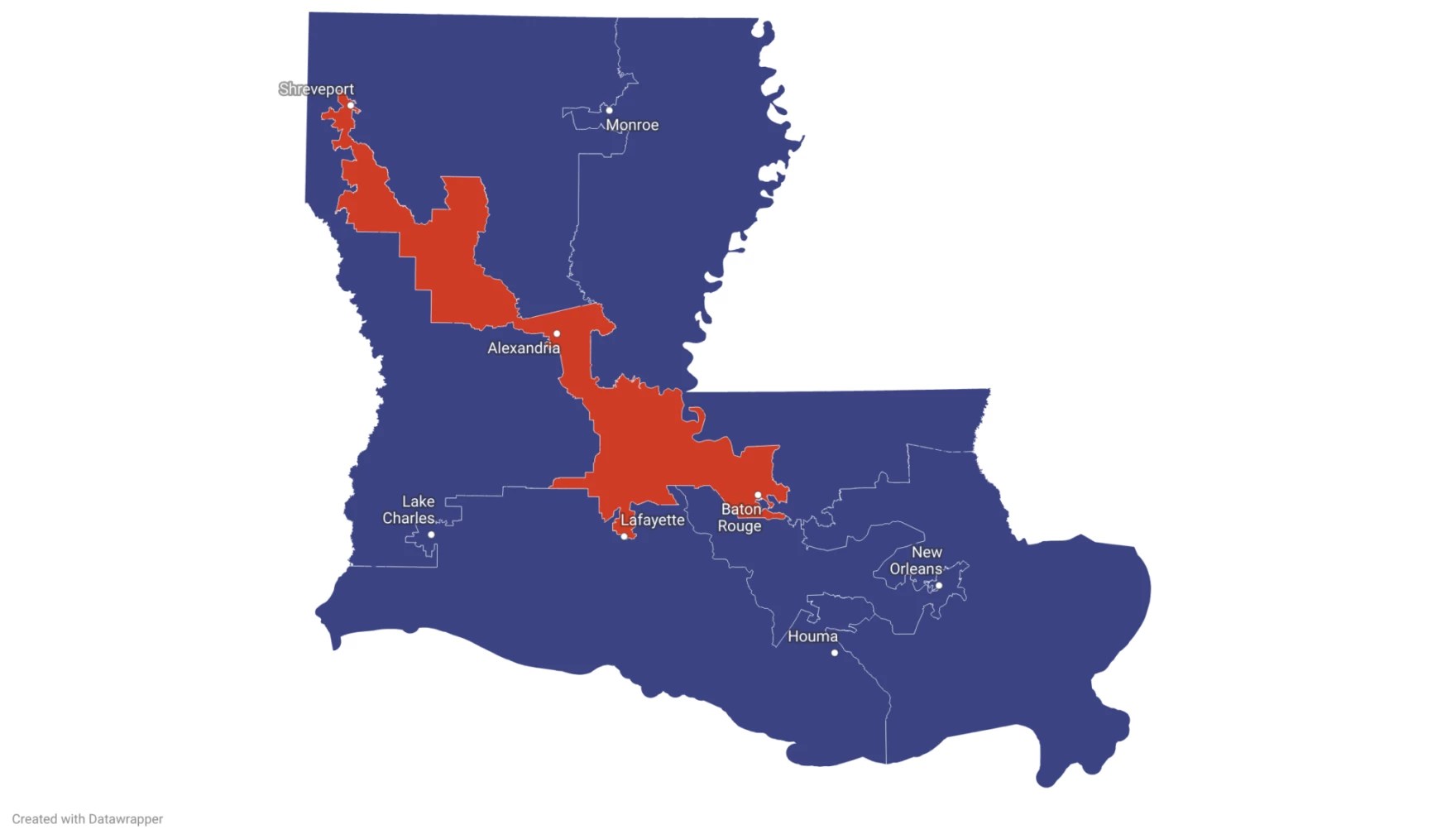
The map shows the contorted Congressional District in Louisiana that is at issue in the Supreme Court case that was argued yesterday.
You won’t see this map in most of the news reports on the case – not because it’s not newsworthy, but because it is. This picture speaks a thousand words about the absurdity at issue.
All parties to the case – and the Supreme Court Justices, as well – agree that this strange amalgamation was created for the express purpose of establishing a district that is supposedly Black* so that Blacks could be assured of electing Black representatives.
(I say “supposedly Black” because most Blacks in Louisiana, as in other American states, are actually of mixed race.)
There are several problems with this notion of Black Congressional Districts. First, it assumes that people identifying as Blacks can be represented in Congress only by other people identifying as Blacks. Why is that the case? I’m white and I’ve voted for Black candidates, and I’m sure many Blacks have voted for white candidates. In fact, Donald Trump got a substantial share of the Black vote last year.
Second, the flip side of concentrating Blacks into Black districts is to concentrate whites into white districts. If we’re to have separate Congressional Districts, should we also have separate schools? Separate drinking fountains?
In a region of the country with a sordid Jim Crow history of “separate but equal,” having separate Congressional Districts strikes me as a vile throwback.
Third, what happens if one of the white districts in Louisiana elects a Black? That would result in Blacks having too many seats, right? Conversely, what happens if a Black district elects a white? Does that mean we need to go back to the racial gerrymandering board to re-draw the districts again?
Fourth, this notion that Blacks are entitled to Congressional representation in exact proportion to their population (or more in the event a Black gets elected in a white district) would seem to apply equally to other races.
In Washington State, for example, about 10% of the population is of Asian descent. Many of their ancestors were exploited and discriminated against. Should we gerrymander the Congressional Districts in Washington to ensure that 10% of the representatives are Asian?
What do we do if the Asian voters don’t go along? What do we do if they “wrongly” vote for a white or Black or Hispanic rather than for the Asian candidate that they’re supposed to vote for? What if they vote for politicians on the basis of policy, not race? Or on the basis of the content of their character, not the color of their skin?
Gee, that’d be horrible, huh?
What about other minorities? In New York State, about 11% of the population is Jewish. Should we gerrymander some Jewish districts? Does it matter whether the Jews are observant or not?
What about transexuals? In California, about 97% of the population is transexual.
OK, I made that up, but you get the point.
The premise to this racial gerrymandering is that Blacks are unique among minorities, in (1) possessing “Black issues” that only they care about, and (2) lacking the ability to persuade non-Blacks to their side of those issues.
I disagree. I think Blacks are fully functional citizens who can vote their minds on all issues, side-by-side with the rest of us, and they have the ability to persuade the rest of us on those issues. They are not in need of child-like allowances any more than Asians or Jews or transexuals or Hispanics or Scots. It’s time to end the separate-but-equal Congressional Districts and end the soft bigotry of racial condescension.
*Although much of my tribe disagrees with me on this, I use “Black” rather than “black” when referring to American Blacks. That’s not because the AP Style Manual calls for it, but because I’m willing to call a race by the name that a majority of the race prefers. If a majority of whites start asking to be called “Whites,” or a majority of Scots start asking to be called “scots,” then I’ll go along with that, too.
After Hamas invaded Israel two years ago to behead babies, rape women, torture men, burn people alive, and take hostages, they gleefully promised to do so repeatedly.
Israel sought to prevent that. They went into Gaza to root out the barbarians from their underground tunnels. In the process, some people got killed.
Sometimes that was because Hamas put civilians in harm’s way. Sometimes they did so for the purpose of hiding behind them, as when they set up their military headquarters in civilian hospitals. Sometimes they did so for the very purpose of getting the civilians killed in order to increase the overall body count.
Israelis often went out of their way to avoid civilian casualties. Sometimes they issued warnings to civilians about an upcoming military mission, even though they thereby lost the element of surprise and also endangered their own soldiers. Israel literally tried to protect the enemy’s people more than the enemy themselves did.
Tragically, civilians did die, despite the efforts of the Israelis and due in part to the counter-efforts of Hamas. Hamas sees civilians as expendable propaganda tools in their war on the Jews.
As Hamas intended, the worldwide Left took this Hamas propaganda and ran with it. They seized on the casualty figures to claim that Israel was conducting a “genocide” against the Gaza residents.
Let’s apply some simple math to that claim.
Hamas reports that Israel killed over 60,000 Gazans out of a population of over 2,000,000. (That figure from Hamas is clearly overstated, but even if it’s a fraction of that, it’s a tragedy.) Let’s accept Hamas’ overstated figure for purposes of this discussion.
To judge this purported “genocide,” we need to know the net reduction in population. In the gold standard of genocides, the population of Jews in Europe was reduced by two-thirds in the Holocaust – about six million people were murdered. To this day, the Jewish population in Europe is less than half what it was in 1939, while the overall population of Europe has nearly doubled.
Back to Gaza. The birthrate in Gaza is very high, about 3.9. That means women in Gaza have an average of 3.9 children over their lifetimes. That produces a doubling of the population about every 20 years. (For comparison, the birthrate in the United States and most of Europe is less than 2.0 – which results in an ever-declining population.)
Given this birthrate of 3.9, how many births occurred in this Gazan population of 2,000,000 over the two-year period since Hamas started this war?
You can do the math (exponential equations, anyone?) or you can ask AI to do it. The answer is around 140,000.
In summary, even if you accept Hamas’ exaggerated figure of 60,000 deaths, the 140,000 births in Gaza more than offsets that. In fact, it means that the population of Gaza increased by a net of about 80,000 over the last two years.
As genocides go, the Israelis’ “genocide” of the Gazans was conducted ineptly and failed miserably. It’s almost like the Israelis didn’t even intend a genocide.
In contrast, the Gazans and their Leftist colleagues on American college campuses and elsewhere are fond of chanting “From the River to the Sea, Palestine will be free.” (Chants have always been a specialty of the Left.)
That river is of course the Jordan River east of Israel, and that sea is the Mediterranean west of Israel. If the Israelis were expelled from the River to the Sea, they would be exterminated.
It’s the Left that is seeking a genocide – the second in less than a century.
The indefatigable Trump team looks to have achieved the impossible. They secured the support of a diverse and conflicted world for a peace plan in Gaza, they persuaded the parties who mutually hate one another to accept it, and they got it signed.
All remaining hostages are being released by Hamas, the Israelis are freeing over 1,000 terrorists and prisoners of war, and Israel has commenced a cease fire and partial withdrawal from Gaza.
People are jubilant – in both Israel and Gaza. How many wars end with jubilation on both sides?
In Tel Aviv, they’re chanting “Donald Trump!” In Gaza City, they’re chanting . . . well . . . “Donald Trump!”
Even CNN and MSNBC have admitted that this is a diplomatic triumph – by a person who is not known for being particularly diplomatic. If diplomacy was to succeed here, it would require a different kind.
Trump was exactly the right person at the right time to deliver this different kind of diplomacy. Diplomatic niceties are not effective with baby-beheading Hamas, and probably not very effective with Israel’s hard-bitten, former Special Forces member, Benjamin Netanyahu.
Hamas, especially, understands only force. Trump permitted the Israelis to deliver that force. The result is peace, at last, at least for a while.
Ah, but not everyone is celebrating.
There’s no celebration in Russia or China or North Korea or . . . among American Democrat protestors.
The Democrat leaders have of course said what they are obligated to say. But the thousands of anti-Israel and antisemitic protestors on college campuses and elsewhere have said nothing. No celebrations, no statements, no candle lighting, no congratulations to the people of Gaza or the people of Israel or the people of the world.
They’re literally dancing in the streets of Tel Aviv and Gaza City to celebrate the peace, while the protestors on American college campuses who purportedly protested for peace, sometimes violently, are, for once, silent.
I’m left wondering, if it wasn’t peace that they were protesting for, then what was it?
There’s an odd little side show that caught my attention in the vaudeville act of “Dr.” Ian Roberts, the illegal immigrant from Guyana whom the Des Moines School District hired, heroized, and paid $300,000/year. (None of those particular things caught my attention in themselves, since they’re all par for the illegal immigrant course, these days.)
What caught my attention is that he’s registered to vote in Maryland, which was one of his waypoints on his grand and illegal tour through America. How, I wondered, did he manage to register to vote in Maryland?
It’s easy. In fact, it’s automatic.
Like about 18 other states, Maryland allows illegals to get driver’s licenses. Yes, it’s illegal for an illegal to be in America but, no, it’s not illegal in those states for them to get a driver’s license to drive around. Their presence is illegal, but their driving is not.
Okay, fair enough. On second thought, that’s not fair at all to the rest of us who wind up dodging illegals whose driving “skills” are the product of the roads and customs of such places as Guadalajara while we see our insurance premiums skyrocket.
But, anyway, there’s more.
In about 24 states, when the state issues a driver’s license, it automatically registers the person to vote – completely and willfully ignorant of whether the person is an American citizen.
Re-read that last paragraph. Yes, you got it right.
This scheme has a name. (The Democrats are great at branding things. See, e.g., “Affordable Housing,” “Reproductive Rights,” and “Me Too.”) They call this one “Automatic Voter Registration” or “AVR.” Democrats boast that AVR makes it easier to vote.
About that, they’re right.
Back to the erstwhile “Dr.” Ian Roberts. He got a driver’s license in Maryland while he happened to be on-the-lam there. Under their AVR system, Maryland automatically registered him to vote, as other states with AVR would have done.
Voila! He was in the country illegally, but had a valid driver’s license to drive around and was duly registered to vote.
Nothing odd or extraordinary took place. What happened undoubtedly happens thousands of times every day. It’s supposed to happen that way. There was no breakdown in the system. His voting registration was not a mistake.
The mistake was a bigger one. The mistake was a failure of American government. One political party has hijacked the levers, arms and dials of American government to produce deliberate and systematic voting fraud.






 the Aspen beat