Glenn K. Beaton is a writer and columnist living in Colorado. He has been a contributor to The Wall Street Journal, RealClearPolitics, Powerline, Instapundit, Citizen Free Press, American Thinker, Fox News, The Federalist, and numerous other print, radio and television outlets. His most recent book is "High Attitude — How Woke Liberals Ruined Aspen"
I went walking on Christmas Day and crossed paths with others doing the same. Unprompted, most wished me a “Merry Christmas.” Some simply said “hi” or gave me a nod. Only a few said nothing at all.
None wished me “Happy Holidays.” And there were no Kwanzaa carols in the air.
Yes indeed, “Merry Christmas” survived the invention of both “Happy Holidays” (a misguided attempt to avoid offending Jews by greeting them with a wish for merriment when they were not merrily profiting from the writing of most of our modern Christmas carols) and Kwanzaa, a late-20th century invention that was something like DEI for religious holidays to pander to people who think Christ is a dead white European who preached that camels could pass through the eye of a needle easier than poor Black people could get to heaven.
Christmas also survived the climate-change lobby. It survived the Gaia worshippers.
It survived the nihilistic, faithless Millennials (and has been embraced by their successors, the faith-seeking Gen Z), it survived the Godless Democrats, it survived the proselytizing atheists.
It survived 9/11, it survived October 7.
It survived the faith-mockers, it survived “Pope” Francis, it survived the Episcopalians, it survived yard signs of the self-devout self-proclaiming their virtue.
And not only did Christmas survive us, we survived it.
We survived electronic Christmas cards. We survived ghosts of fruitcakes from Christmases past (they never go bad, you know, or at least they never go worse). We survived aluminum Christmas trees, we survived plastic Christmas trees, and we survived dead Christmas trees.
We survived LED candles, we survived the mall.
We survived the still-unfilled promise of joy to the world and we survived Joy to the World. We survived a noisy night and we survived Silent Night. We survived Come All Ye Faithful and we survived Santa Claus is Coming to Town.
We survived We Three Kings even amid the chants of “no kings!”
We survived the cancelation of Baby it’s Cold Outside.
Speaking of which, your correspondent became a grandfather a couple of weeks ago, which is not to be confused with a grand father or even a mediocre father.
I came through it all fine, and I’m mostly happy and healthy, thank you for asking.
But it’s not all just about me, there are also other people involved. They’re happy and healthy as well.
I have a feeling that the silent nights in their home will be few and far between in the upcoming few months, but I’m starting to understand joy to the world. You see, it happens one little world at a time.
Now, if I can just get through New Years Eve unscathed . . . Isn’t that when they do the mistletoe thing?
Note to Readers: This is the final installment of a three-part series. Part One is HERE and Part Two is HERE. I call this final installment “Choose Your Destructor.”
Part One of this series discussed the rise of Western Civilization from the Greeks and Romans. Part Two concluded with the sad realization that this Western Civilization is falling. The question for this final Part Three is, what will replace it?
It won’t be Russia, “a gas station masquerading as a country,” as John McCain famously put it. McCain died before he could witness Russia proving him right by flailing and failing to conquer it’s eastern neighbor for nearly four years now, a conquering that any competent conqueror could have performed in four weeks.
Of course, by “eastern neighbor,” I’m not talking about the NATO alliance, or even Finland or Sweden. I’m talking about . . . drum roll . . . Ukraine. That’s right. Russia cannot even take over a country most people had never heard of before Russia made heroes of them, and still couldn’t place on a map even if the map were limited to Eastern Europe.
That leaves two powerful forces as candidates for the Destructor of Western Civilization – the nation of China and the imperialist religion of Islam.
China is an ancient civilization going back to the time of the pharaohs. They built their civilization the old-fashioned way — by hard work, merit and an inquisitive culture, much as the Greeks and Romans later built theirs.
The ancient Chinese differed from the Greeks and Romans in an important way, due to geography. The Chinese weren’t located on the friendly pond of the Mediterranean Sea, but rather on the shores of the vast and ferocious Pacific Ocean, and so they never developed an advanced seafaring technology. That limited their ability to expand, since the land to the immediate west of them was high and dry. Eventually, they traded with the West over the Silk Road, but that came late and entailed an arduous journey.
As a result, Chinese culture has always been insular. Until the 20th century, they didn’t give a fig about the West. They were quite sure their system and their people were superior to whatever the West had to offer.
They still often think that way, though now they see that the West – or at least America – does have some things to offer. Such as advanced AI microchips.
With or without the West, Chinese culture is successful by most measures, as one would expect of a bright and numerous people utilizing merit-based approaches to management.
To be sure, communism has corrupted Chinese culture, as it corrupts all cultures it infects. But Chinese communism is a little different. It’s not just an extreme form of socialism. They don’t practice “from each according to his ability and to each according to his needs.” Karl Marx was not Chinese.
The communism practiced by the Chinese is more like a state-regulated capitalism. Small businesses flourish independently in a free market economy. Large ones are often controlled or even owned by the government, but with the goal of maximizing wealth, not redistributing it. Foreign investment in China is encouraged. They emphasize manufacturing and exporting manufactured goods, something no communist country ever achieved during the Cold War.
The political system, too, is pragmatic in a way seldom seen in Marxist communism. People join the Party, they advance by showing ability and alliances, and the most-accomplished become part of an oligarchy or “politburo,” which chooses leaders.
The leaders they choose these days are not dictators in the sense of having absolute power. There’s always the oligarchy/politburo to deal with.
This should sound familiar. The Founders of the United States of America were an oligarchy. They were not elected. Rather, they knew and respected one another and built alliances among themselves to arrive at most decisions by consensus.
Oligarchies are not so bad. I sometimes wish we were now being ruled by the oligarchy of Madison, Jefferson, Hamilton, Monroe, Franklin, Adams and the other Founders, rather than by warring mobs, conspiracy theorists and a lying media.
Chinese culture is generally not imperial. That’s in part due to their geographical isolation and consequent wariness of outsiders and in part, relatedly, because they always thought their culture was too good to share. Whatever the reasons, they don’t have a tradition of subjugating and enslaving their neighbors. The Chinese could own most of Russia and all of Southeast Asia, at a minimum, but they don’t. (Yes, I know about their designs on Tibet and Taiwan.)
Nor are the Chinese a theocracy or regime of ideologues. They’re a pragmatic and patient people. The billion-plus of them will eventually dominate the world, but probably not by brute force. (Yes, I know about the brutality of Tiananmen Square.)
Their strategy in trade is an example. Their days of slave labor and child labor are largely over. With vast numbers of skilled workers, they manufacture huge quantities of goods at high efficiency and sell them at a small margin. The manufacturing skills and trading networks they’re developing will serve them over the long term.
It’s the long term they’re interested in. The Chinese were a civilization in the time of the Egyptians, and well before the Greeks and Romans.
Our assimilation by the Chinese will probably be gradual and not destructive. They’re not interested in killing their customers. They think of Americans the way we think of cattle – big and clumsy, but very useful once you domesticate them.
Don’t get me wrong. I don’t think the Chinese are nice people. They will exploit us, and they already are. Like cattle, we will be milked.
But we won’t be slaughtered.
There are things China admires about us, such as our inventiveness, our technological sophistication, and even our entrepreneurialism (despite or perhaps because of the fact that they themselves are, putatively, anti-capitalist communists).
With any luck, the Greco-Roman-Western culture that still dominates the world but is falling fast will not be extinguished, but will instead live on and be subsumed by China. Who knows, they might even improve on it, just as the Romans improved on the Greeks in some ways and we improved on them both in some ways.
They might even boot the Muslims out of Europe – something that European leaders lack the backbone to do even as the European people demand it.
Which brings us to the other possible group that could be our Destructor. It’s that old nemesis of the Greeks – the Persians. Or, more broadly, the Muslims. Of course, the ancient Persians were not Muslims, since Muhammad was still a millennium in the future, but there’s a straight line between the culture of Persia and the culture of Islam.
I will state some hard truths about the Muslims. Rather than grappling with those hard truths, some will simply dismiss the message by labelling me as the messenger “Islamophobic.”
If “Islamophobic” means fearing people who glorify the beheading of babies, the torturing of hostages, the defenestration of gays, and the raping of women, then I plead guilty. I am indeed Islamophobic.
One of those hard truths about the Muslims is that they have a nasty habit of conquering and converting infidels at the point of the sword – the ones they don’t kill outright, that is. To that end, they’ve invaded Europe multiple times, the most recent being the “mostly peaceful” invasion of the last generation.
They’re like strangers who crashed a house party. The kind hosts reluctantly let them stay. Then they repaid the hosts’ kindness by trashing their house. Now, the hosts are afraid to ask them to leave. Next, they’ll be sleeping in the hosts’ bed, with his wife along with the young girls they brought.
It won’t continue to be mostly peaceful. The party crashers see the hosts as infidels. They contend the hosts have no rightful authority over this house. They must submit and convert and then submit some more, and some more, or be put to death.
In fairness to Muslims, two qualifications should be mentioned. First, violence can be found not only in Muslim writings but also in Judeo-Christian writings. But violence in old Judeo-Christian texts is mostly ignored or viewed as allegorical now. When’s the last time you heard a Christian talk about literal jihad? Or globalizing an intifada? No mainstream Christian theologian preaches that we should invade Saudi Arabia and kill or convert them.
Many mainstream Muslim theologians, on the other hand, do preach that they should invade Europe and America, kill or convert us, and steal our stuff. Their leaders publicly label us Satanic. The great cathedrals of Europe will be converted into Muslim mosques in the next 50 years. Bet on it.
The second qualification is, not all Muslims believe in violence. In fact, the great majority of them do not. But – and this is a big but – when someone commits an atrocity in the name of his religion, others of that religion are obligated to condemn the atrocity and disown the criminal who committed it. Muslims seldom do.
I realize I’m asking for more from good Muslims than I’ve ever asked of myself. I’m asking them to risk everything by standing against religious atrocities, while all I’ve ever risked is losing a few tribal readers by standing against stupid tweets.
But if you don’t stand up to wrongs committed in the name of your religion or tribe, then you forfeit that religion or tribe to the wrong. So far, most Muslims have elected not to bravely stand up to wrongs committed in the name of their religion. They’ve elected to risk their religion rather than risk themselves.
It’s ironic that, once you scratch the surface, this religion cloaked in machismo seems to be 10% barbarians and 90% chickens.
Back to those plodding Chinese. The difference between Chinese and Muslim culture can be seen in a microcosm in their respective immigrants to America. Which do you prefer?
I prefer the Chinese. Given the choice, I choose to be assimilated by pragmatic, exploitative, profit-seeking Chinese rather than being conquered and converted, or worse, by violent, macho, chicken-shit Muslims.
I wish I didn’t have to choose – I wish there were still reason for optimism about the West – but there’s not. Being assimilated into China is our only hope for some semblance of our culture to survive.
Note to readers: This is the second of a three-part series. I call this second installment “The Fall of Western Civilization.” The first installment, called “The Rise of Western Civilization,” is HERE.
Religious animal sacrifices may soon be conducted by your neighbor in his backyard on the other side of the little fence you share, or perhaps in the condo down the hall from yours. Try not to let the animal’s screams bother you — that would be racist.
You see, there’s a small town in Michigan called Hamtramck. For generations, it has been an enclave of Polish immigrants and their descendants. They danced to polka music, ate pierogi, and so on. They were Polish-Americans. They blended right in — as well as our Irish-Americans and Italian-Americans and Chinese-Americans.
Then the town was taken over by Muslim immigrants. The Muslims wanted to sacrifice animals in their backyards as part of their religious rituals. They do that by slitting their throats and watching them scream and convulse as they bleed to death while they (the Muslims, that is) shout Allah Akbar!
These Muslims not exactly trying to blend in.
These backyard spectacles were against local ordinances in Hamtramck. But the city council this week voted 3-2 (you can guess the ethnicity of the majority of 3) to change the ordinance, despite objections that such backyard animal sacrifices are inhumane, unsanitary, unsightly and noisy.
The slitting of the animals’ throats will usually be done by a butcher, they say, but the residents are also allowed to perform the task themselves because some of them complain that they are too poor to hire a butcher.
Apart from the grotesqueness of this, I have several practical questions.
What sort of butcher makes house calls? And how does that change anything — does the butcher bring along an anesthesiologist? And if the residents are too poor to afford a house-calling butcher to sacrifice the animal, how are they supposed to afford the animal itself? Is it possible that they will just “find” the animal somewhere in the neighborhood?
Ah, but I’ve gotten ahead of myself.
The point of Part 1 of this series was that, just as large parts of Roman culture derived from Greek culture, large parts of our own culture derive from Greco-Roman culture. We’re still living in the Greco-Roman age.
Unfortunately, we’ve expanded on some of those Greco-Roman values. That sounds like a good thing, but it’s not. In fact, it’s the reason for our demise. Here’s how it happened.
If a little democracy is good, as Athens taught us, then we foolishly thought a lot must be even better, right?
If picking up some menu tips from the barbarians and learning to wear funny scarves are good, then inviting them all in – to trash and replace our philosophy and religions – must be even better, right?
If showing compassion for people lacking merit is good, then we should abolish merit altogether, right?
Wrong, wrong, and wrong.
Let’s take these in order. Democracy is like medicine. A little might be a good thing, but a lot can poison you. Right now, the biggest illness of the West is an overdose of democracy. Stated simply, too many people vote, they’re the wrong people, and they vote for the wrong people.
There’s a reason that the Left always seeks to expand the voter rolls, and it’s not to improve democracy. It’s because the Left hates the West, and they know that the fools they will newly enfranchise with voting rights are easily manipulated into sharing that hate.
Voting rights for 18-year-olds? C’mon. Today’s 12th graders have the education of 10th graders from 30 years ago, and typically have never held a job. That’s a good reason to raise the voting age by at least two years, but instead we lowered it by three, from 21 to 18.
The net result is that today’s first-time voters have five years less education than the first-time voters of their parents’ generation. (Don’t try to explain this to those youngsters. You’ll lose them on the 3 + 2 = 5 part.)
As for philosophy and religion, no religion has been as successful or made its adherents as successful as the Judeo-Christian religions. Those religions teach a combination of merit-based achievement and forgiveness for failure, which opens the door to endless opportunity. (I’m not talking about the opportunity for eternal salvation, but that too.) You can try, and try again. If you develop merit and learn from your failures, you will be forgiven and you will succeed.
You will. It’s right there in the Bible, from Job to Jesus.
The idea of earned second chances sounds obvious today, but it’s not obvious at all in most of the world outside Judeo-Christian cultures. In most places at most times, it was one-strike-and-you’re-out. And often, you weren’t even allowed that one strike – you didn’t even get to bat.
As for foreigners – the barbarians – the Greeks were not especially welcoming. The Romans were a bit more cosmopolitan. They sometimes used native administrators for controlling local matters. But when they did, the local administrators always answered to Rome on important matters.
More often, the local administrators were Romans, even in far-flung provinces. (Pontius Pilate is the most famous today. He did defer to the locals on the decision he is best known for, but that decision was a minor one, he thought.)
The notion that they should abolish their borders and invite the barbarians into Rome, or Greece, on the Panglossian notion that “diversity makes us stronger,” would be utterly foreign – barbaric in both senses of the word – to Romans and Greeks.
Abolishing merit? We did that because merit is “inequitable.” Fools and barbarians are ill-equipped for it. In today’s math:
ill-equipped = inequitable
The abolition of merit certainly did produce more equality among people. Ill-equipped people lacking merit are deemed “equal” to the ones possessing it because we stopped trying to measure it.
But in a system that does not measure or reward merit, people will not strive to be meritorious. And so, the culture as a whole will have less of it.
Principles or merit, liberty, limited democracy and common values served Greco-Roman culture for a long time – about 2,500 years, if you include the subsequent Western culture that grew out of it.
But alas, we’ve abandoned those tested principles that got us here. Some of that abandonment was well-intentioned; we wanted to help people we deemed “less fortunate” (but who often were really less worthy).
Some of that abandonment was intentional – a deliberate attempt to undermine our culture by people who hate it (and would probably hate whatever culture they were born into).
Now, we’re past the tipping point. The West has not only welcomed fools and barbarians, but under DEI we’ve favored them. Many of them vote, and they demand a share of what our culture has earned over the course of 2,500 years while simultaneously demanding that we forsake that culture.
So, the West is lost. America is well on its way, and Europe is already there.
That leaves a question. Lost to whom or what? Who or what will take our place?
Note to readers: The third and final installment of this three-part series will come in a few days. Stay tuned!
Note to readers: This is the first of a three-part series. I’ve given this first installment the modest title “The Rise of Western Civilization.”
Western Civilization and its political systems are rooted in the Greek culture of about 2,500 years ago. Athens was famously a “democracy” (a Greek word) in its heyday, though only free men born of two Athenian parents were allowed to vote.
Most other Greek city-states, though not democracies, used political systems that recognized a role for the people and had a basic concept of individual rights and ethics.
Greek culture was similar to our own in other ways as well. The Greeks loved live entertainment. Actors, readers, musicians, singers and elaborate physical sets presented multimedia extravaganzas.
This passion for engagement extended to debating issues of the day, not unlike our online debates. They had a concept that speech was not exactly free, but somewhat protected. The death of Socrates for corrupting the youth with his orations might be an exception proving the rule.
Greek gods were depicted as having human forms. This was unusual for the time. In Egypt and Crete, for example, their gods were typically animals or part-animal/part-human.
What defined Greek geopolitics were their long wars with the Persians. Hundreds of rival Greek city-states sometimes came together for alliances against Persia. Nothing establishes an identity for a group quite as well as a common adversary who threatens to enslave or exterminate them.
Those Persians were barbarians in both the Greek sense and the modern sense. In Greek, the word “barbaros” merely means “foreigners.” The Persians were certainly foreigners. They came from what is now Iran, which is across the Aegean Sea and nearly 2,000 miles from Athens.
In the modern sense, too, the Persians were barbarians. They subjected their defeated foes to a degree of cruelty and punishment that generally exceeded what the Greeks meted out.
In that regard, however, it should be mentioned that the first rule of history is not that it is written by the winners. The first rule is that it is written by the writers. Greek writing was sufficiently advanced to record history, while Persian writing was comparatively primitive. We thus have no Persian accounts of the Persian wars, only the Greek accounts.
The Greeks’ recordation of the Persian wars was only a small part of their writings. Better known today are their epic poems embodying much of their culture and beliefs, primarily the Iliad and the Odyssey.
The epic poems, originally oral traditions but reduced to writing early in Greek culture, are still considered some of the best literature in Western Civilization. They’ve influenced Western thought for over two millennia.
The Greeks were never conquered and exterminated. Rather, they were subsumed into the Roman empire.
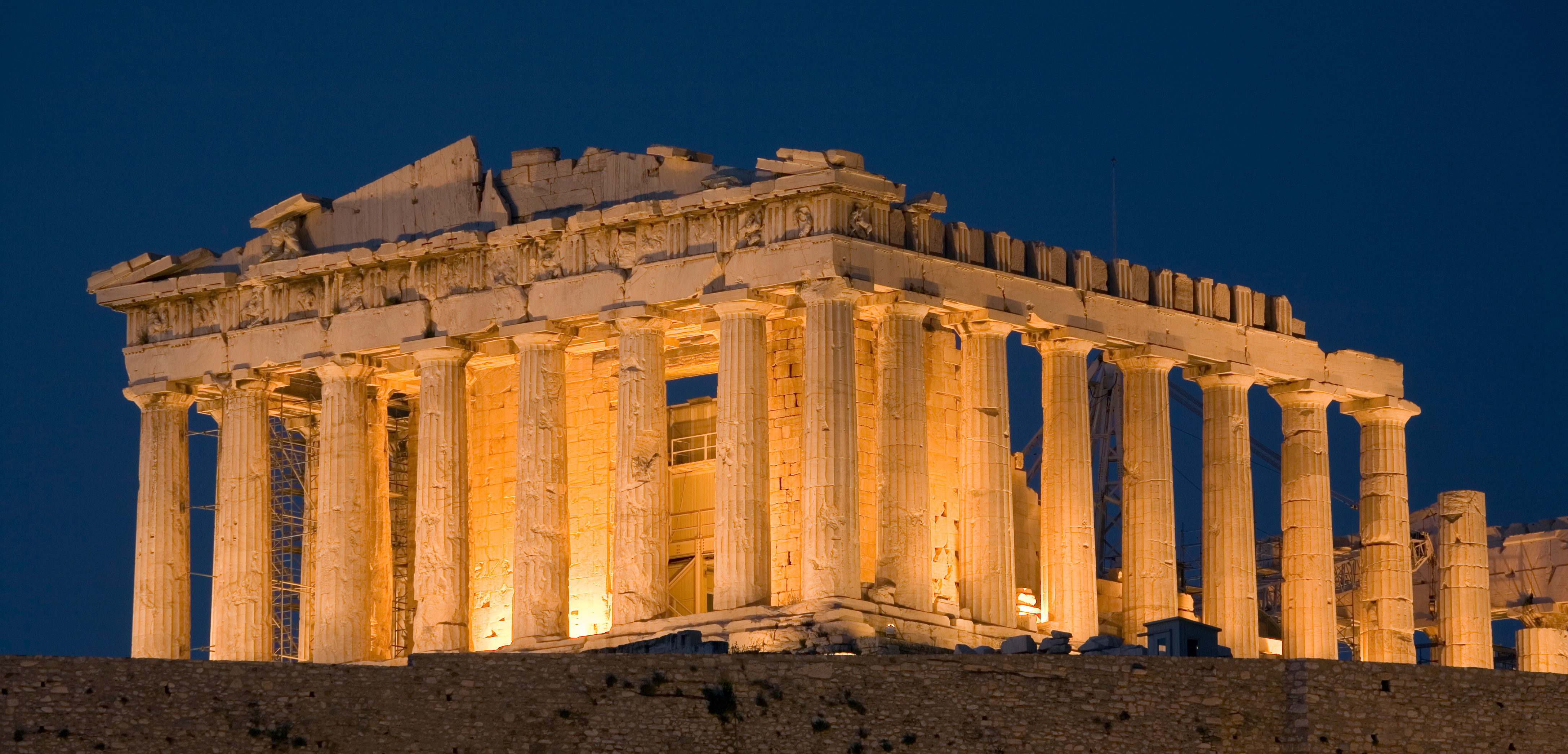
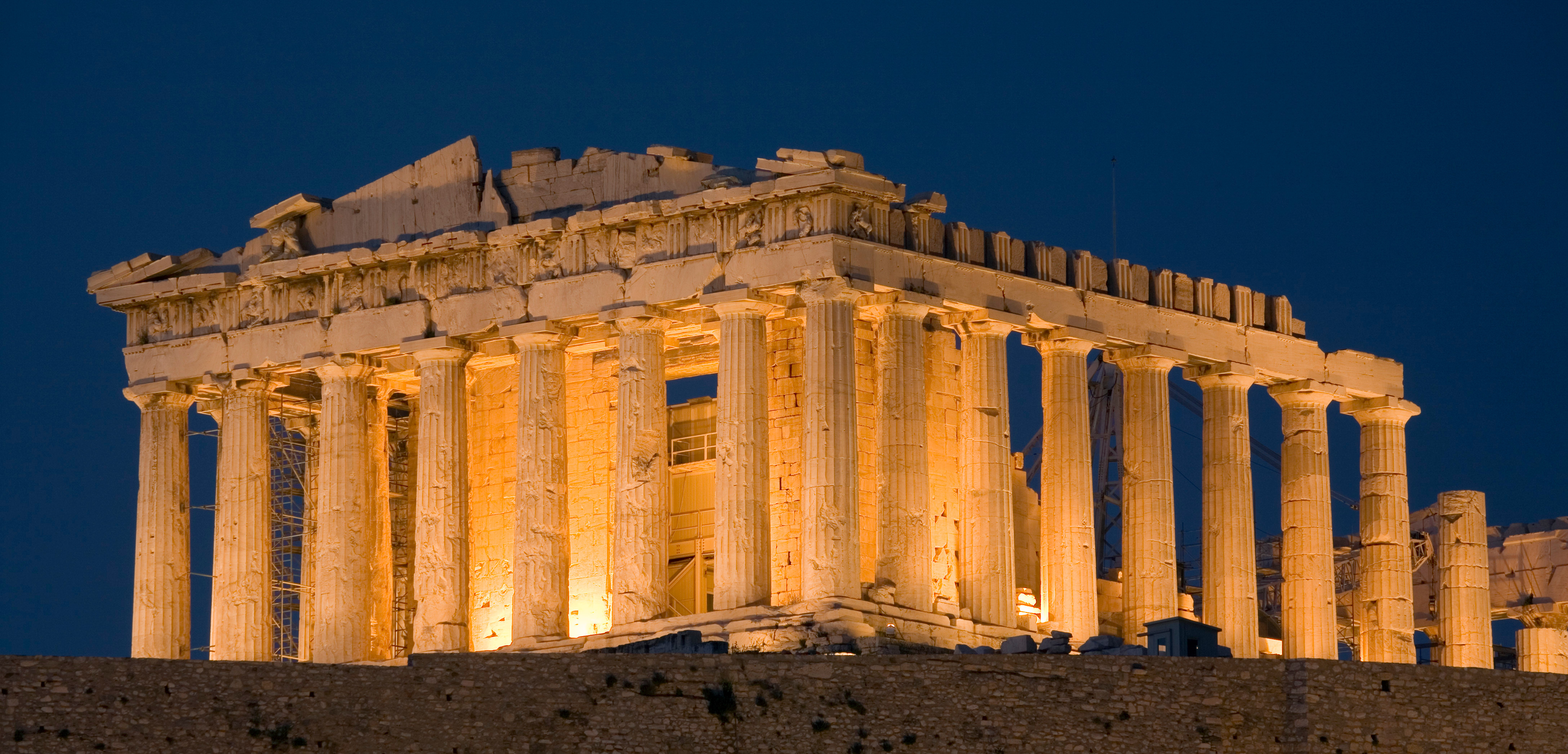
Technologically, the Romans far surpassed the Greeks. In architecture and engineering, they invented the arch and its three-dimensional equivalent, the dome, which allow for loads to be suspended over a void using materials that are high in compressive strength but low in tensile strength, such as stone. They improved concrete with the use of aggregates and ash to build huge structures that still survive and in some cases are still used such as the Roman Pantheon. Their advances in metallurgy were applied effectively in weaponry, building materials, coins and tools.
They nearly conquered the world – or at least the part they could reach, from England to the Middle East.
When it came to art, however, the Romans never quite overcame their inferiority complex. They adopted much of Greek art, sometimes by slavishly copying it. Roman reproductions of Greek statues were common.
To some degree, the Romans adopted Greek ideas of government, as well. Rome never adopted the direct democracy of Athens but did use the representative democracy of a republic.
Yes, both the Greeks and Romans used slaves, but so did practically every other society in the ancient world, including the societies from which the Greeks and Romans sourced their slaves.
Even after the Roman republic gave way to an empire after Julius Caesar, the Romans retained ideas of individual rights and ethics inherited largely from the Greeks.
In Roman culture, Greek culture thus lived on.
The Romans, like the Greeks, were never really conquered and exterminated. Their culture and language were instead assimilated into the rest of Europe.
The Enlightenment, the Renaissance, the scientific method, and Western notions of ethics and individual rights are all rooted in Roman culture, which is, in turn, rooted in Greek culture.
In America in particular, this was very conscious. Just glance at the neoclassical architecture of the government buildings of Washington, D.C.
Let’s pause. What you’ve just read used to be common knowledge taught in high schools throughout America. You’re probably well aware of it all. Forgive me for boring you with my amateur synopsis.
But I suspect it’s no longer taught to youngsters. In today’s curriculum, Maya Angelou has replaced Homer, Richard Pryor has replaced Ovid, and climate change zealots have replaced Aristotle.
So, humor me – and yourselves. Inflict this synopsis onto some young unsuspecting victim of today’s bastardized school curriculum. Be a hit at Christmas dinner with a dramatic reading!
Note to readers: Watch for the second in this three-part series in a few days, called “The Fall of Western Civilization.”
I always disliked Rob Reiner as a liberal activist, though I’ve admired his work including When Harry Met Sally and A few Good Men.
His work and his politics, however, don’t matter today. What matters is that he and his wife were murdered in their home. Their troubled son has been arrested.
It’s a horrible, violent tragedy, any way you look at it.
Unless you look at it the way the President did. Here’s his social media post in full:
Yep, the President marked the murder of this man and his wife — a murder for which their son has been arrested — by (1) ridiculing him the very next day for his politics, and (2) glorifying himself at their expense.
It should be noted that after Charlie Kirk was murdered, Reiner’s reaction was precisely the opposite of what we just saw from the President after Reiner himself was murdered. Reiner said the murder of Kirk was “horrible” and “unacceptable.” He went on to express admiration for the words of Kirk’s widow at his funeral.
I voted for Trump three times. To this day, I think the nation and the world are better off than we would have been with any of the three candidates he ran against. Witness the Joe Biden so-called Presidency.
Trump has improved America and the world, from the Mexican border to the Middle East, from his first term Supreme Court appointments to his second term war on wokeness. I applaud President Trump, and I’m proud of my votes for him.
But today, it appears the 79 years of Donald Trump may be catching up with him. Note that even the gold standard of senility – Joe Biden – was only 78 when he was elected.
Trump publicly ridiculed a man the day after he and his wife were murdered because he dislikes the man’s politics. He name-calls female reporters “Piggy” because he dislikes their questions.
His vainglory is clinical when it’s not comical. Think John Belushi with a samurai sword. He seems to be drifting into Nero and Caligula territory.
Some of his defenders contend he’s not ill, but just the biggest asshole to ever come near the White House (and that’s from his defenders).
OK, maybe the worst that can be said about Trump is that he’s just the world’s biggest asshole. But most Americans aren’t finding much comfort in that diagnosis, either.
You may say that he’s entitled to some anger after the way he’s been persecuted, and that I would be angry too. OK, I’ll buy that. But, unlike me, Trump has a country to run, a Presidency to fill, and an example to set.
Any way you slice it, in three years Trump will be gone. And in just one year, he’ll be a lame duck dealing with a hostile Democrat Congress.
It’s essential that the conservative cause – or MAGA if you prefer – survive. It’s a cause and a movement, not a person and a cult.
My loyalty is to that cause and that movement – to America – not to that man and his followers.
There’s a provision in the Constitution to deal with the incapacity of a President. It’s the 25th Amendment. At the request of the Vice President, a majority of the Cabinet certifies that the President is unable to perform his duties; Congress confirms it; and the Vice President assumes the Presidency.
That Vice President is JD Vance, not Kamala Harris. Thank God for that – and thank Trump.
Postscript: Condemn me if you wish. Name-call me if it makes you feel good. But consider this: If Trump is continuing to sink in the polls, and he is, and is losing three-time Trump voters like me, could it perhaps be time for a course correction before the GOP gets slaughtered in next year’s midterm elections? After all, your condemnation and name-calling won’t garner any more votes for our side – quite the opposite.
It’s a story right out of pre-woke Hollywood. Her country has been taken over by a series of corrupt socialist dictators (ah, but I repeat myself) who’ve seized the natural resources for their own personal enrichment. They’ve suspended or disregarded elections.
Not satisfied with stealing the country’s riches, the looters have also entered the drug business to support their palatial lives.
The regime operates in league with Russia, China, Iran and North Korea – not exactly upstanding citizens of the international community – whose main interests are in simply disrupting South America, along with sharing in the natural resource spoils.
All this is at the expense of the people. The country has gone from the richest in South America to one of the poorest in two generations. People are fleeing the country by the millions.
A brave, charismatic woman – a truly wise Latina – has stood up to the looting fascists. Risking her life, she demanded the ouster of the criminal dictator. She demanded fair elections. She’s been living in hiding, because the regime would surely imprison her, or worse, if they could find her.
Her name is Maria Machado. Her country is Venezuela. The Norwegian Nobel Committee this fall recognized her heroic work to free her country, and awarded her the Nobel Peace Prize.
President Trump has supported Machado and her efforts from the outset. He congratulated her for the prize, for her courage, and for her goals. She in turn said:
“This Nobel Prize is symbolic of that fight for freedom and is dedicated to the Venezuelan people and to President Trump for showing what strong leadership looks like in the moments that matter most.”
Speaking of strong leadership, the Administration assisted private American forces in extricating Machado from Venezuela for a harrowing journey to Oslo for the Nobel Prize. She arrived just hours too late to accept the prize in person, but her daughter accepted for her and read her stirring speech.
It’s an amazing story, still being spun. The Venezuelan dictator will fall – it’s just a matter of time (probably just weeks or months). Maria Machado will return to Venezuela. Socialist despotism in the Americas will be dealt a blow.
Stories in the American media (there isn’t really one in Venezuela anymore) including the New York Times and the Wall Street Journal have lauded Machado’s incredible efforts and harrowing journey. Give credit to the reporters and editors of both the Journal and the Times.
But the comments sections to those stories are chock full of hostility – not hostile to the Venezuelan regime, but hostile to Machado and Trump.
They’re hostile to Trump for the usual reason: Orange Man Bad! And they’re hostile to Machado for failing to scream “Orange Man Bad!”
The American left’s anger at Machado is heightened by the socialist dictator overlay to the story. They wonder, gee, what’s next? Will Trump go after our socialist friends in Cuba?
The American left reluctantly admit that murderous terrorism is an “unfortunate accident” and narco-state kleptocracies are unseemly, but what’s really horrible are Western civilization, American capitalism and, most of all, Donald J. Trump.
How dare this woman thank and applaud Trump – in public, no less! – they grouse. In their eyes, she’s a freakin’ woman with freakin’ dark-ish skin. Doesn’t she know her place? When it comes to relations between white Yanquis and darkish Latinas, her place is to defer to us American liberals. What we say, goes. And what we say is:
“Orange Man Bad. We don’t care if you think he helps your so-called cause of fighting-for-freedom. Nothing done by Orange Man is good. Nothing. Especially when he undermines socialism.”
Ah, socialism. It invariably deteriorates quickly into corruption, graft, waste and cronyism, and then fascism, totalitarianism, torture and terrorism.
But the American left never stops trying it. They now argue that the proof it works is in the fact that Bad Orange Man thinks it doesn’t, and he’s always wrong.
But, in fact, socialism doesn’t work – even if Trump thinks it doesn’t. It never has, and it never will. In the matter of Venezuela, the left will wind up on the wrong side of history, once again.
In a Supreme Court term with several important cases on executive power, two stand out. Both will be decided this Spring.
One is the tariffs case, argued a few weeks ago. The three liberal Justices will go against Trump, of course, because Orange Man Bad. But even the conservative Justices – especially the three appointed by Trump – appeared skeptical that the President could unilaterally impose broad tariffs.
Tariffs are much like a tax. The taxing power is generally held by Congress, not the President.
Yes, there is a loophole allowing for emergency actions by the President, but the Justices were not buying the argument that there was an emergency requiring tariffs on coffee from South America, wine from France, machines from Germany, pharmaceuticals from Switzerland, cars from Japan, etc. etc. etc.
(Apart from the legal issue, I’ve written that the tariffs are somewhat defensible from an economic perspective.)
You may argue that the “emergency” is the overall trade deficit. That trade deficit emergency, goes the argument, requires sweeping action.
I won’t argue the point. I’m just telling you that the Supreme Court is not buying it. Expect a 7-2 decision against Trump, or maybe even a 9-0 decision.
Already, companies that have paid the tariffs (including some that we assume are on the righthand side of the political spectrum, such as Costco) have filed lawsuits against the government for a refund of the tariffs they’ve paid.
Confusion will ensue. The decision is likely to be fractured with multiple opinions expressing different reasoning, and will also be complicated since the tariff scheme itself is complicated.
The other case at the Supreme Court concerns whether the President has the power to fire the leaders of so-called “independent agencies.” Trump will win this one.
Independent agencies are curious creatures. Scour the Constitution, and you’ll never find a mention of them. They are largely the creation of New Deal legislation from the 1930s. Over the ensuing century, they took on a life of their own in the fertile and fecund federal bureaucracy, like slimy salamanders spontaneously generated from warm mudpuddles.
There’s no doubt the President can fire ordinary agency leaders, but these independent agency leaders seem to have a special status in the minds of Washington politicians.
They clearly are part of the executive branch, since they’re not part of the judicial or legislative branch, but purportedly cannot be fired by the chief executive – the President – because they’re “independent.” They effectively make policy and enact legislation without oversight from Congress or the President.
This raises two questions. First, how can Congress delegate away its legislative power under the Constitution to entities never mentioned in the Constitution?
Could Congress also delegate away their legislative power to private foundations like the Gates Foundation and foreign entities like the United Nations? (Congress thinks the answer is yes, and to some extent they already have.)
In any event, it’s quite ironic that the defenders of these independent agencies accuse Trump of violating the law by firing the agency leaders, when the very existence of the agencies is in violation of the Constitution.
The second question is, if the President cannot fire the leader of an independent agency, then who can?
Not Congress, since Congress wields no hiring and firing power beyond its own internal staffing. Outside that, its power to hire people is non-existent and its power to fire people is limited to the draconian and rarely-used power to impeach.
And not the judiciary, either. Judges have no power to hire or fire members of the executive branch. They can barely hire and fire their clerks and secretaries.
So, if the President has no power to fire these independent agency leaders, then they are virtually untouchable.
Presidents and Congressmen come and go, but bureaucracies go on and on – especially if their leaders cannot be replaced. The deep state lives forever.
But it’s also the outcome desired by a certain cohort of never-Trump Republicans. It’s amusing to see their pseudo-scholarly rhetoric decrying the administrative state – until it’s Trump (gasp!) who proposes modest control over it. Then, and only then, reining in the unaccountable, unconstitutional administrative state run by unelected bureaucrats is . . . you know what’s coming . . . a threat to democracy.
The Supreme Court decision on this will likely be less hypocritical than those pseudo-scholar never-Trumpers. All nine Justices know that the administrative state of Democrats spawned by independent agencies is an unconstitutional cancer on democracy, and that the only means to rein it in is through the President.
Based on that common understanding, the six conservative Justices will side with the President and the three liberals will side against him.
Do you recall the most famous reindeer of all? Here’s a hint:
Rudolph the red-nosed reindeer,
Had a very shiny nose,
And if you ever saw it,
You would even say it glows.
So, on top of an unusual name for a reindeer, Rudolph had a slight physical defect. But don’t we all?
You probably think nobody even noticed Rudolph’s defect. It’s like when your nose is just a teensy bit crooked but you need a ruler to figure it out. Or you happen to have no hair on top of your head but nobody even notices unless you take off your ski helmet and they see it shiny with sweat right after you ripped a double-black.
Wrong. The other reindeer did notice:
All of the other reindeer,
Used to laugh and call him names,
They never let poor Rudolph,
Join in any reindeer games.
OK, this pisses me off. It’s not like Rudolph surrendered to the Taliban or to the illegals. Just because the guy has a slight physical defect, the other reindeer gave him the FJB treatment.
I suppose Rudolph still found happiness of a sort, notwithstanding the ostracism. With those long strong legs, he probably did a lot of air hiking. Mostly alone.
Then the story takes a twist. The Big Guy shows up:
Then one foggy Christmas Eve,
Santa came to say,
‘Rudolph with your nose so bright,
Won’t you guide my sleigh tonight?’
This is presented as a purely utilitarian gesture by the Big Guy, but is it really? He surely knew of Rudolph’s plight. And he must have known that he’d get little guidance for his sleigh from a mere shiny nose. And there must have been other foggy Christmas Eves where he didn’t invite Rudolph to guide the sleigh. And there’s no predicate in the story for Rudolph having any experience in sleigh guidance. Yet, the Big Guy chose Rudolph for this important task.
Here’s my theory. The Big Guy saw a man . . . er, a reindeer, in need. He offered to help – not with charity but with an opportunity to prove himself by helping others.
The last became the first, but only after the Big Guy offered Rudolph that place in line and Rudolph had the courage to accept it – along with all the daring demands and physical challenges and great responsibility that accompanied it. Had Rudolph guided the sleigh into a Starlink satellite, the story would not have ended happily ever after.
Rudolph accepted a hand but not a handout, He seized the opportunity, and flew with it. He had no experience but figured he’d learn on the fly.
And he did. Rudolph was possessed of a grace nothing short of amazing.
Then the story takes a mean girl twist, often not recognized as such by casual singers:
Then all the reindeer loved him,
As they shouted out with glee,
Rudolph the red-nosed reindeer,
You’ll go down in historeeeee.
Wait a minute! Now the other reindeer loved him? Now? Where were they before, when Rudy needed a friend? They were mocking and ostracizing him, that’s where.
I have a suggestion for Rudy. He and the Big Guy should invite Dasher and Dancer and Prancer and Vixen, Comet and Cupid and Donder and Blitzen, over for dinner. Main dish: venison.
A good part of a person’s success in the game of life is a product of nature and nurture – his genes and the parenting he received. People who were unlucky enough to receive bad genes, or bad parenting, or both, tend to be unsuccessful.
Tragically for America, these people who are unsuccessful at life are the very people who are disproportionately successful at having babies. Those babies tend to inherit their parents’ bad genes and learn their bad parenting.
When those babies grow up (or, often, just partially grow up) they, like their parents, are unsuccessful at life but disproportionately successful at having babies. Those babies, in turn, wind up short-changed by both nature and nurturing.
What I’ve just described already takes us through three generations. In the end, there’s no end. We’ve set up a vicious and expanding cascade of poverty and failure.
The effect is a policy of survival – and propagation – of the un-fittest. Charles Darwin would predict adverse consequences for our species.
Before you take offense, I hasten to add that general rules often are riddled with exceptions. I grew up in in a family of six with modest means. We all turned out OK. But the fact that it sometimes rains in the desert doesn’t disprove the general rule that deserts are dry.
The welfare state makes it all the worse. This was recognized as early as 1965 by intellectuals such as Daniel Patrick Moynihan, the future Democrat Senator from New York back when the Democratic Party sometimes produced rigorous thinking rather than identity politics. Moynihan’s work focused on poor Black families but it’s not a Black issue per se; it’s a poverty issue.
Moynihan criticized social welfare policies where we pay unsuccessful people to have unsuccessful babies to propagate their failure at life, thereby amplifying this vicious cascade of poverty.
The more babies they have, the more money we pay them. Then their babies have babies, and we’re off to the races.
Perhaps our policy should be exactly the opposite. Perhaps we should discourage unsuccessful people from having unsuccessful babies.
A smart start to getting out of this hole would be to stop digging. We should stop paying unsuccessful people to propagate. To that end, eliminate the $3,000 child tax credit.
Then go a step further. Pay people not to have babies. A simple way to accomplish that would be to pay them to undergo sterilization.
That sounds cruel, but is it really? If “my body my choice” justifies people aborting unborn babies because they’re inconvenient, then surely it justifies people accepting money to prevent the babies’ conception. For gosh sakes, the manufacturers of condoms accept money to prevent the conception of babies.
Moreover, many if not most of the babies these people have are utterly unplanned. If it’s cruel to prevent unwanted pregnancies, then why haven’t we outlawed those condoms – along with birth control pills, the rhythm method, premature withdrawal, abstinence and chastity?
I recognize that courts are wary of government measures that produce sterilization. Courts might view a system where the government pays people taxpayer money conditioned on them being sterilized as tantamount to the government sterilizing them involuntarily.
So don’t do it through the government. Let foundations and philanthropists administer the system with private funds. A foundation or a rich guy (Elon, do you hear me?) could say, “Here’s $3,000 for anyone under 50 who wants to get sterilized. And we’ll pay the medical bills, too.”
The people that we want not to have babies would find that offer tempting, because $3,000 is a lot of money to those people. But the people we want to have babies would not find that offer tempting, because that’s not a lot of money to them.
Over time, we just might reduce the population of undesirables (not to be confused with deplorables).
You might ask, what about America’s fertility crisis? Yes, it’s a fact that American (and European) birthrates are less than what’s required to maintain the current populations. And so, the argument goes, we should provide incentives for people to procreate.
That argument is premised on the notion that when it comes to people, the more the better. I question that notion, especially when I’m forced to endure crowded freeways, crowded hiking trails, and crowded crowds.
We have eight billion of us. Is that not enough? I don’t know about you, but I rarely think, “Gee, I wish there were more people here.”
From a pure financial perspective, it’s true that an ever-increasing population is necessary to continue our Ponzi scheme called Social Security, where we need more and more workers to support more and more retirees who live longer and longer (though the effects of rationed medical care – which seems inevitable and already encroaching upon us – will partially solve that problem).
I submit that the way to fix the Ponzi scheme of Social Security is not to produce infinitely expanded pools of young suckers to support it, but to phase out the scheme. Like all Ponzi schemes, it’s unsustainable. We cannot increase our population forever to produce an ever-increasing pool of hard-working suckers to support an ever-increasing number of long-lived retirees. At some point, we run out of space, resources and suckers.
Even if the number of suckers we breed to support the burgeoning population of retirees is sufficient in quantity, they are apt to be insufficient in quality. How many generations of bad nature and nurture can a society withstand?
The Babylon Bee – America’s unofficial newspaper of record – said they are indeed, but it turns out to be satire.
I think.
The Bee’s piece was in the heavy wake of a story that Somalis in Minnesota bilked the government out of something like a billion dollars. I say “billion” not in the way I say “gazillion.” The figure is actually, literally – and by “literally” I don’t mean figuratively – something like . . . a billion dollars.
Their scheme was to send bills to the Minnesota state government for providing various forms of welfare relief to the public. It took off during Covid when the government all but legalized fraud because the best way to defeat a pandemic is to close the schools, print money, and drop it from helicopters.
Somali groups would set up phony organizations pretending to provide whatnot, from affordable housing to food for children, and send the government fake invoices for it.
Which the government happily paid.
There were lots of clues for a long time that the whole thing was a scam. The Wall Street Journal reports “The massive fraud was an open secret. Merrick Garland, who served as U.S. attorney general under Joe Biden, called it the largest pandemic-relief hustle in the nation” (emphasis added).
But this was Minnesota, full of “nice” Minnesotans and especially full of a governor who was very full of himself and fulsome aspirations. His name was Tim Walz, aka the 2024 Democratic Vice-Presidential candidate.
Rather than pursuing the abundant clues and whispers – nay, the smoking guns and shouts – of fraud, Walz waltzed on, out of deference to a key Democrat constituency – Somalis.
Today’s Somalis in America, you see, are the descendants of Somalians who were enslaved in America three hundred years ago and discriminated against ever since and so they deserve special favors like legalized fraud.
Well, no, that’s not quite right. Today’s Somalis in America arrived in just the last decade or two. They fled a bloody war-torn Somalia to come to American in order to earn a piece of the American Dream.
Well, no, that’s not quite right either. They fled a bloody war-torn Somalia, alright, but they came to America to be beneficiaries of the modern American welfare state which flowers in nice Minnesota.
Well, no, even that’s not quite right. They fled a bloody war-torn Somalia and came to America to rip us off – while accusing us of racism all the while.
Two lessons can be learned from this. The obvious one is that the modern welfare state is out of control. It all but begs to be ripped off. The people paying for the rip-off are you and me, and it’s not pennies – it’s billions.
The second lesson is more controversial. Here’s a good summary of it:
[R]adical Islam has shown that their desire is not simply to occupy one part of the world and be happy with their own little caliphate; they want to expand. It is a – it’s revolutionary in its nature. It seeks to expand and control more territories and more people.
And radical Islam has designs, openly, on the West – on the United States, on Europe. We’ve seen that progress there as well. And they are prepared to conduct acts of terrorism – in the case of Iran, nation-state actions, assassinations, murders, you name it. Whatever it takes for them to gain their influence and ultimately their domination of different cultures and societies.
That’s a clear and imminent threat to the world and to the broader West, but especially to the United States, who they identify as the chief source of evil on the planet.
That statement was by Secretary of State Marco Rubio (whose parents were legal Cuban immigrants) in a recent interview.
Americans like to think that their diversity is a strength, and, up to a point, it is. But that strong diversity consists of groups such as Protestants from England, Catholics from Italy, Huguenots from France, Amish from Switzerland, and Jews from Poland. It even consists of Buddhists from China and Hindus from India.
Something that all those groups have in common is tolerance for other religions and, mostly, tolerance for other cultures. The concept of “infidel” is foreign to these groups.
Muslims are often different. The concept of “infidel” is alive and strong in Islam. They’ve sought to conquer Europe since the seventh century, and nearly succeeded several times. Even now – maybe especially now – many publicly name-call America “the Great Satan.”
Even Nazi Germany, imperial Japan, the Soviet Union and today’s communist China never called us “the Great Satan.” We Americans are semi-amused by that moniker, but the Muslims flinging it are dead serious.
They see the indigenous religions and culture of their adopted nation as evil. That’s a clever feat since, after all, their culture and religion failed in the place they fled, they came here voluntarily, and we welcomed them – complete with their religion and culture that looks down on us. But that’s how they see our cultures, our religions, and us.
Maybe part of the reason for their contempt for us is that they see us as suckers.
Muslims therefore tend not to seek assimilation into American culture, a culture they despise. They seek, more than the Irish, more than the Asians, more than the Jews, to maintain their particular identity and distinct culture.
And to impose it on us.
We’ve already seen what happens when Islam reaches a critical mass in a Western nation, as it has in France and is nearing in England. Within our lifetimes, it is likely that the Notre Dame and St. Paul’s will be converted into mosques.
You think that’s ridiculous? Bear in mind that the first great Christian cathedral was in Constantinople – the incredible Hagia Sophia. When Constantinople fell to the Muslims, they eventually changed the name of the city to Istanbul but they immediately mutilated the Hagia Sophia into a mosque by ripping out the altar and burning the Christian crosses and all other Christian symbols and art. The Hagia Sophia remains a mosque to this day. (BTW, where’s the Pope on this?)
Muslims conquer and they convert, at the point of a sword if necessary, and sometimes even if not.
Like most Americans, it goes against my grain to think we should discriminate against a particular religion and particular regions of the world in deciding who can immigrate into our nation. But this is an exception, and a very important one.










 the Aspen beat