Glenn K. Beaton is a writer and columnist living in Colorado. He has been a contributor to The Wall Street Journal, RealClearPolitics, Powerline, Instapundit, Citizen Free Press, American Thinker, Fox News, The Federalist, and numerous other print, radio and television outlets. His most recent book is "High Attitude — How Woke Liberals Ruined Aspen"
You say you want a revolution, well, you know, we all wanna change the world – John Lennon/Paul McCartney
Three-quarters of a million people were killed in the American Civil War, and another half million were wounded – many grievously.
That was in a country with a population of less than a tenth of today’s America. The equivalent deaths in today’s America would be about eight million. That’s something like 20x the American deaths in WWII.
Much of Atlanta was burned to the ground in the Civil War, as were large sections of Charleston, Vicksburg and Richmond.
Abraham Lincoln was assassinated by a southern sympathizer near the end of the war, five days after General Robert E. Lee surrendered the main Confederate army.
The end of the war did not end the anger and hate. The country was divided for generations. I remember growing up in the 60s – in Colorado of all places – and kids would still tease one another about being “Rebels” or “Yankees” a century after the Civil War.
In the south, Blacks were freed from slavery but the defeated separatists subjected them to a new yoke of Jim Crow laws preventing them from voting, obtaining equal educations, living where they wanted, and loving whom they wished.
The Civil War was the most violent and destructive thing that ever happened to America.
Some people want another one.
On both the left and the right, many people are full of anger and hate for the “other side.” That much, I get. I’m pretty angry myself, and I confess to some hatred for the other side on occasion.
The silo’ed news sources on the internet contribute to this. Many people don’t look at news sources other than the ones that say what they want to hear – namely, that the other side is stupid, evil and perhaps subhuman. And hooray for our side!
That’s natural. People believe what they want to believe, and eventually they cherish those beliefs. They watch “news” that tells them their cherished beliefs are right, and that they are right to cherish them.
The news sources themselves are partly to blame. Generations of bias, then sheer incompetence, and now click-baiting, have produced a media industry that often lacks honesty and credibility.
The end result is that anger and hate own some of us. Some of us want not only to beat the other side at the ballot box, and not only to beat the other side in the courts of law, and not only to beat the other side in the court of public opinion. They want to beat the other side literally. They want to kill, dismember and maim the other side.
They want another civil war.
Here’s my advice to those people. Your anger and hate will not produce a beneficial outcome for America.
Moreover, your anger and hate will not produce a beneficial outcome for you.
Look within. Anger and hate are not generated by the objects of your anger and hate; anger and hate come from inside you. And they are consuming you.
But when you talk about destruction, don’t you know that you can count me out.
Note to readers: This is the second of a three-part series. I call this second installment “The Fall of Western Civilization.” The first installment, called “The Rise of Western Civilization,” is HERE.
Religious animal sacrifices may soon be conducted by your neighbor in his backyard on the other side of the little fence you share, or perhaps in the condo down the hall from yours. Try not to let the animal’s screams bother you — that would be racist.
You see, there’s a small town in Michigan called Hamtramck. For generations, it has been an enclave of Polish immigrants and their descendants. They danced to polka music, ate pierogi, and so on. They were Polish-Americans. They blended right in — as well as our Irish-Americans and Italian-Americans and Chinese-Americans.
Then the town was taken over by Muslim immigrants. The Muslims wanted to sacrifice animals in their backyards as part of their religious rituals. They do that by slitting their throats and watching them scream and convulse as they bleed to death while they (the Muslims, that is) shout Allah Akbar!
These Muslims not exactly trying to blend in.
These backyard spectacles were against local ordinances in Hamtramck. But the city council this week voted 3-2 (you can guess the ethnicity of the majority of 3) to change the ordinance, despite objections that such backyard animal sacrifices are inhumane, unsanitary, unsightly and noisy.
The slitting of the animals’ throats will usually be done by a butcher, they say, but the residents are also allowed to perform the task themselves because some of them complain that they are too poor to hire a butcher.
Apart from the grotesqueness of this, I have several practical questions.
What sort of butcher makes house calls? And how does that change anything — does the butcher bring along an anesthesiologist? And if the residents are too poor to afford a house-calling butcher to sacrifice the animal, how are they supposed to afford the animal itself? Is it possible that they will just “find” the animal somewhere in the neighborhood?
Ah, but I’ve gotten ahead of myself.
The point of Part 1 of this series was that, just as large parts of Roman culture derived from Greek culture, large parts of our own culture derive from Greco-Roman culture. We’re still living in the Greco-Roman age.
Unfortunately, we’ve expanded on some of those Greco-Roman values. That sounds like a good thing, but it’s not. In fact, it’s the reason for our demise. Here’s how it happened.
If a little democracy is good, as Athens taught us, then we foolishly thought a lot must be even better, right?
If picking up some menu tips from the barbarians and learning to wear funny scarves are good, then inviting them all in – to trash and replace our philosophy and religions – must be even better, right?
If showing compassion for people lacking merit is good, then we should abolish merit altogether, right?
Wrong, wrong, and wrong.
Let’s take these in order. Democracy is like medicine. A little might be a good thing, but a lot can poison you. Right now, the biggest illness of the West is an overdose of democracy. Stated simply, too many people vote, they’re the wrong people, and they vote for the wrong people.
There’s a reason that the Left always seeks to expand the voter rolls, and it’s not to improve democracy. It’s because the Left hates the West, and they know that the fools they will newly enfranchise with voting rights are easily manipulated into sharing that hate.
Voting rights for 18-year-olds? C’mon. Today’s 12th graders have the education of 10th graders from 30 years ago, and typically have never held a job. That’s a good reason to raise the voting age by at least two years, but instead we lowered it by three, from 21 to 18.
The net result is that today’s first-time voters have five years less education than the first-time voters of their parents’ generation. (Don’t try to explain this to those youngsters. You’ll lose them on the 3 + 2 = 5 part.)
As for philosophy and religion, no religion has been as successful or made its adherents as successful as the Judeo-Christian religions. Those religions teach a combination of merit-based achievement and forgiveness for failure, which opens the door to endless opportunity. (I’m not talking about the opportunity for eternal salvation, but that too.) You can try, and try again. If you develop merit and learn from your failures, you will be forgiven and you will succeed.
You will. It’s right there in the Bible, from Job to Jesus.
The idea of earned second chances sounds obvious today, but it’s not obvious at all in most of the world outside Judeo-Christian cultures. In most places at most times, it was one-strike-and-you’re-out. And often, you weren’t even allowed that one strike – you didn’t even get to bat.
As for foreigners – the barbarians – the Greeks were not especially welcoming. The Romans were a bit more cosmopolitan. They sometimes used native administrators for controlling local matters. But when they did, the local administrators always answered to Rome on important matters.
More often, the local administrators were Romans, even in far-flung provinces. (Pontius Pilate is the most famous today. He did defer to the locals on the decision he is best known for, but that decision was a minor one, he thought.)
The notion that they should abolish their borders and invite the barbarians into Rome, or Greece, on the Panglossian notion that “diversity makes us stronger,” would be utterly foreign – barbaric in both senses of the word – to Romans and Greeks.
Abolishing merit? We did that because merit is “inequitable.” Fools and barbarians are ill-equipped for it. In today’s math:
ill-equipped = inequitable
The abolition of merit certainly did produce more equality among people. Ill-equipped people lacking merit are deemed “equal” to the ones possessing it because we stopped trying to measure it.
But in a system that does not measure or reward merit, people will not strive to be meritorious. And so, the culture as a whole will have less of it.
Principles or merit, liberty, limited democracy and common values served Greco-Roman culture for a long time – about 2,500 years, if you include the subsequent Western culture that grew out of it.
But alas, we’ve abandoned those tested principles that got us here. Some of that abandonment was well-intentioned; we wanted to help people we deemed “less fortunate” (but who often were really less worthy).
Some of that abandonment was intentional – a deliberate attempt to undermine our culture by people who hate it (and would probably hate whatever culture they were born into).
Now, we’re past the tipping point. The West has not only welcomed fools and barbarians, but under DEI we’ve favored them. Many of them vote, and they demand a share of what our culture has earned over the course of 2,500 years while simultaneously demanding that we forsake that culture.
So, the West is lost. America is well on its way, and Europe is already there.
That leaves a question. Lost to whom or what? Who or what will take our place?
Note to readers: The third and final installment of this three-part series will come in a few days. Stay tuned!
I always disliked Rob Reiner as a liberal activist, though I’ve admired his work including When Harry Met Sally and A few Good Men.
His work and his politics, however, don’t matter today. What matters is that he and his wife were murdered in their home. Their troubled son has been arrested.
It’s a horrible, violent tragedy, any way you look at it.
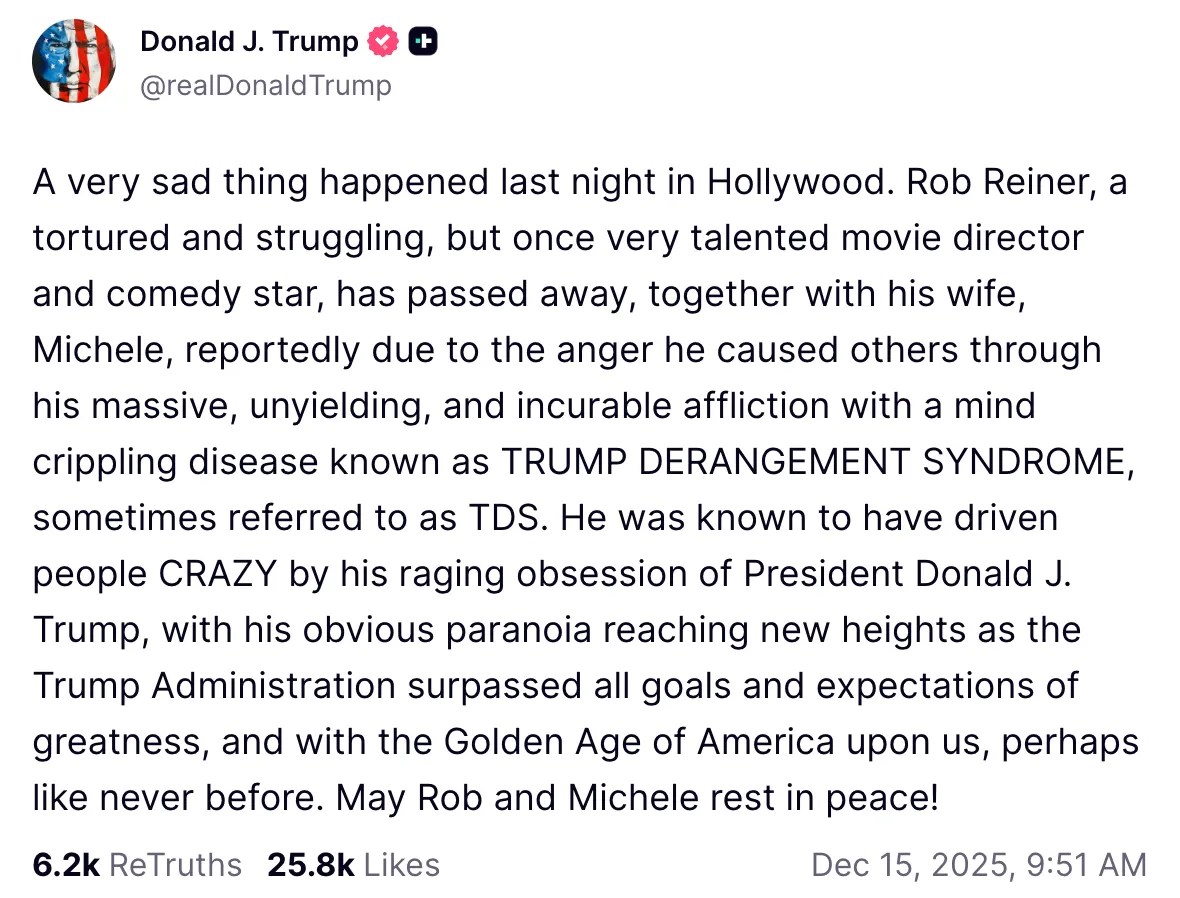
Unless you look at it the way the President did. Here’s his social media post in full:
Yep, the President marked the murder of this man and his wife — a murder for which their son has been arrested — by (1) ridiculing him the very next day for his politics, and (2) glorifying himself at their expense.
It should be noted that after Charlie Kirk was murdered, Reiner’s reaction was precisely the opposite of what we just saw from the President after Reiner himself was murdered. Reiner said the murder of Kirk was “horrible” and “unacceptable.” He went on to express admiration for the words of Kirk’s widow at his funeral.
I voted for Trump three times. To this day, I think the nation and the world are better off than we would have been with any of the three candidates he ran against. Witness the Joe Biden so-called Presidency.
Trump has improved America and the world, from the Mexican border to the Middle East, from his first term Supreme Court appointments to his second term war on wokeness. I applaud President Trump, and I’m proud of my votes for him.
But today, it appears the 79 years of Donald Trump may be catching up with him. Note that even the gold standard of senility – Joe Biden – was only 78 when he was elected.
Trump publicly ridiculed a man the day after he and his wife were murdered because he dislikes the man’s politics. He name-calls female reporters “Piggy” because he dislikes their questions.
His vainglory is clinical when it’s not comical. Think John Belushi with a samurai sword. He seems to be drifting into Nero and Caligula territory.
Some of his defenders contend he’s not ill, but just the biggest asshole to ever come near the White House (and that’s from his defenders).
OK, maybe the worst that can be said about Trump is that he’s just the world’s biggest asshole. But most Americans aren’t finding much comfort in that diagnosis, either.
You may say that he’s entitled to some anger after the way he’s been persecuted, and that I would be angry too. OK, I’ll buy that. But, unlike me, Trump has a country to run, a Presidency to fill, and an example to set.
Any way you slice it, in three years Trump will be gone. And in just one year, he’ll be a lame duck dealing with a hostile Democrat Congress.
It’s essential that the conservative cause – or MAGA if you prefer – survive. It’s a cause and a movement, not a person and a cult.
My loyalty is to that cause and that movement – to America – not to that man and his followers.
There’s a provision in the Constitution to deal with the incapacity of a President. It’s the 25th Amendment. At the request of the Vice President, a majority of the Cabinet certifies that the President is unable to perform his duties; Congress confirms it; and the Vice President assumes the Presidency.
That Vice President is JD Vance, not Kamala Harris. Thank God for that – and thank Trump.
Postscript: Condemn me if you wish. Name-call me if it makes you feel good. But consider this: If Trump is continuing to sink in the polls, and he is, and is losing three-time Trump voters like me, could it perhaps be time for a course correction before the GOP gets slaughtered in next year’s midterm elections? After all, your condemnation and name-calling won’t garner any more votes for our side – quite the opposite.
Democrats have gone full Islam. On the surface, that’s a bit peculiar. When you dig deeper, it’s downright weird. But as always, there’s a cause for this particular effect.
Let’s start with the peculiar part. Islamists tend to be religious, much as Christians, Buddhists and Hindus (and, for that matter, atheists, who often disbelieve with a blind religious fervor).
In contrast, Democrats tend not to be religious. They’re simple vanilla agnostics. Go down to Starbucks. Ask one whether he believes in God. His response would be along the lines of, “Umm, I’m kinda in-between . . . it all depends . . . what I do know is I don’t believe in America . . .” And then he’d drift back to his double latte sprinkled with fresh pumpkin seeds.
Now, try to imagine that wishy-washy but unwashed and wish-less agnosticating procrastinating prognosticator with the man-bun sipping a double latte sprinkled with pumpkin seeds . . . embracing Islam.
Well, not exactly embracing Islam, with which there’s not necessarily anything wrong, but embracing Islamists, with whom there is.
You see, I distinguish between Islam and Islamists. About Islam, I know very little. I do know that, like most religions, it was invented by barbarians and so there’s undoubtedly some rough spots in its scriptures. I’m sure there’s eye-for-an-eye stuff, animal sacrifice rituals, and cruel tests of torment.
In most religions, the barbaric stuff got watered down over time. As people advanced, the believers shifted their focus toward the kinder, gentler aspects of their religion. They shifted toward loving thy neighbor, and away from goat sacrifices.
That could have been the path of Islam, if only we’d had different Islamists. The Islamists we do have seem stuck in the 9th century – which was not a particularly enlightened time.
That brings us to the weird part. The beliefs of these Islamists stuck in the 9th century are, by today’s mostly-civilized standards, downright weird.
They believe shoplifters should have their hands cut off. They believe adulterous women should be stoned to death. They believe gays should be thrown off rooftops. They believe infidels (meaning non-Muslims) should be beheaded, raped, tortured, burned alive, murdered and taken hostage to use as currency to free terrorists.
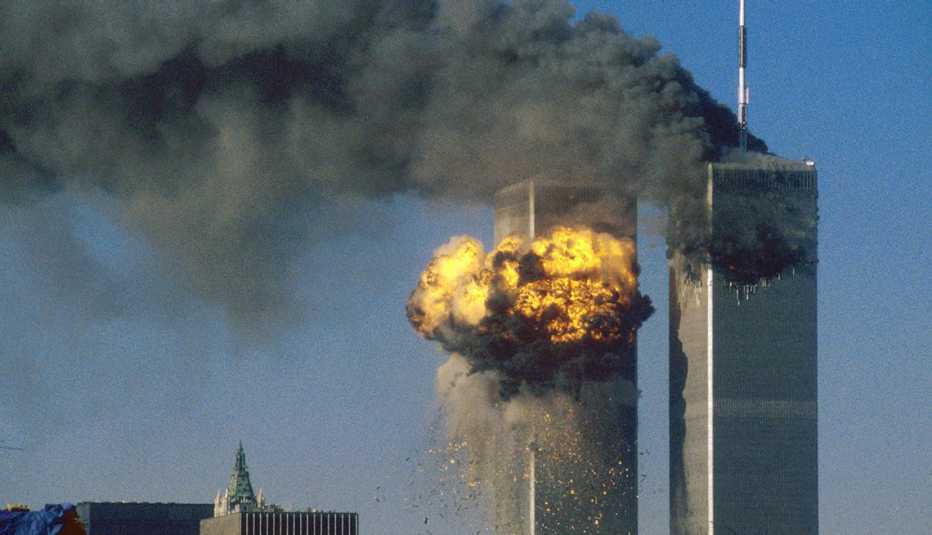
They believe it is right, joyful and heroic to fly airplanes into tall buildings.
I know Democrats have fallen far in the last generation but they still didn’t have those things in their party platform, even in 2024 when they ran a half-baked, half-assed, half-wit.
That’s why it’s downright weird that the Democrats have embraced not Islam, about which they know nothing, but Islamists, about which they know quite a lot – and none of it is good.
But it all makes sense. Despite the peculiarity and weirdness of this outcome, it all makes sense in a perverted sort of way.
Democrats perceive, correctly, that Islamists see America as their enemy. Indeed, Islamists see all of Western culture as their enemy.
And so do Democrats.
If America is the enemy of Islamists, and is also the enemy of Democrats, that makes Islamists the friends of Democrats – or at least the allies.
Of course, Islamists and Democrats hate America for entirely different reasons. Islamists hate America because it’s not an Islamist theocracy, while Democrats hate America because it’s not a communist dictatorship.
But that’s just a detail, say the Democrats. They’ll figure out how to share the spoils of this war against America once they win it.
That’s the part where Democrats might not have thought things through. Islamists will be in no mood for sharing.
Note to readers: This is what ChatGPT came up with when I asked it to imagine a debate between Charlie Kirk and Jimmy Kimmel. Every word is from ChatGPT, except that one or two AI typos have been corrected.
_________________
Moderator: Welcome everyone to tonight’s debate on “Free Speech and Violence in America.” We’re honored to have Charlie Kirk and Jimmy Kimmel here to share their insights. Let’s begin with opening statements. Kirk, you have the floor.
Kirk: Thank you. Free speech is the foundation of democracy. It empowers individuals to voice their opinions, challenge authority, and push society forward. Throughout history, free speech has been instrumental in civil rights movements, political reform, and social progress. That said, with this freedom comes a responsibility. Words can incite violence, spread misinformation, and deepen divisions. Our goal should be to promote responsible speech—not censor it. Education, open dialogue, and adherence to social norms are the way forward. The core principle is that speech should thrive, but it should not be used as a weapon.
Kimmel: Thanks. I agree that free speech is vital, but let’s be clear. With the right comes the duty to prevent harm. In today’s world, inflammatory rhetoric, hate speech, and conspiracy theories are fueling real violence. We’ve seen many incidents where words have led to deadly actions — racial violence, terrorist attacks, online harassment turning into physical violence. Protecting free speech doesn’t mean tolerating speech that incites or promotes harm. Platforms — especially social media — must be held accountable. We need regulations and policies that draw the line where speech becomes dangerous. Society must defend freedom, but not allow it to devolve into chaos.
Moderator: An important discussion. Kirk, when you hear about hate speech, do you believe there should be limits?
Kirk: I believe in strong protections for free speech. Historically, censorship often suppresses dissent and can be used as a tool of oppression. The issue isn’t speech per se, but how we handle its consequences. Education is key — if people understood the impact of their words, they might moderate their tone voluntarily. Legal limits should be narrow– focused on directly inciting violence or spreading lies that cause harm. Broad restrictions risk infringing on fundamental rights and silencing constructive debate. The solution is fostering social responsibility, not censorship.
Kimmel: But history shows us that certain speech, especially hate speech, has led to violence and suffering. It dehumanizes people and can ignite mob actions or even genocide. Allowing unchecked harmful speech gives license to hate groups. That’s why platforms need clear policies– like removing hate speech and threats — and authorities should intervene when necessary. Sometimes, restrictions are essential for protecting vulnerable communities. We must recognize that the harm caused by hate speech is real, and it requires action.
Moderator: Let’s talk about where to draw the line. Kirk, do you think social media platforms should limit or regulate content more heavily?
Kirk: Platforms do have a role, but overregulation can suppress legitimate discourse. They should implement moderation tools and community standards, but these must be transparent and fair. Ultimately, the true solution lies in education — teaching people to critically evaluate content and behave responsibly online. Suppressing speech outright risks creating echo chambers and authoritarian control, which is dangerous for democracy.
Kimmel: I agree moderation is important, but the scale of social media makes it hard to control harmful content. Platforms often hesitate to act decisively due to fear of backlash or legal challenges. Meanwhile, harmful rhetoric continues to spread. Regulation can set standards that protect users without infringing on free speech. Additionally, social media companies must be held accountable for their role in amplifying dangerous content. We need collaborative efforts—government regulations, technological tools, and community initiatives—to create safer online spaces.
Moderator: Now let’s introduce a new topic — recent controversy surrounding Kimmel’s firing from a major network over comments related to political beliefs. Kimmel, would you like to comment on that?
Kimmel: Absolutely. The situation was very personal to me. I was fired after making some jokes that, depending on who you ask, were either funny or inappropriate, but what struck me was how quickly the culture shifted to silencing opinions and entertainment if they didn’t align perfectly with certain political narratives. It raises a fundamental question about free expression — should entertainers be penalized for their viewpoints or jokes? I believe that diversity of opinion, even offensive or controversial humor, is vital in a free society. Silencing voices due to pressure or fear undermines that principle.
Kirk: I agree with you. Freedom of speech includes the right to express unpopular opinions, including satire and humor. When society starts punishing individuals for expressing their views, it’s a step toward authoritarianism. The marketplace of ideas flourishes only when all voices can be heard, even if those voices are uncomfortable or controversial. I believe that silencing or punishing individuals—whether entertainers, journalists, or citizens — because of their opinions or jokes — undermines the very foundation of our democracy. Free speech is messy and can be uncomfortable, but it’s essential for progress. When we start policing humor or viewpoints out of fear, we risk creating a society where only certain approved voices can be heard, and that’s dangerous. We need to defend the right to express even unpopular or provocative ideas, because only then can real debate and growth occur. Censorship, whether by corporations or government, erodes liberty and sets a dangerous precedent.
Kimmel: Exactly. When individuals are silenced or penalized just for expressing their opinions, it sends a signal that certain ideas are unacceptable — no matter how silly or offensive. That’s not the path to a healthy democracy. We must stand firm in defending free expression, even when we disagree with what’s being said. Otherwise, we pave the way for authoritarian control and a stifling culture where conformity replaces free thought.
Moderator: Thank you, Kirk and Kimmel, for your insightful perspectives. To summarize, both of you agree that free speech is a fundamental pillar of democracy, but with important responsibilities. Kirk emphasizes the importance of education, responsible discourse, and cautious moderation to prevent censorship and authoritarianism. Kimmel highlights the need for accountability, especially on social media, and stresses that harmful speech can incite violence and must be regulated to protect vulnerable communities.
Regarding the recent controversy about Kimmel’s firing, both agree that silencing or punishing individuals for their opinions erodes free speech and opens the door to authoritarian control. The balance, as you both suggest, is in protecting the right to express unpopular ideas while ensuring public safety and social harmony. Ultimately, fostering open, respectful dialogue and safeguarding free expression are essential for a healthy society.
Thank you both for a compelling discussion.
_________________
I say bullshit. This sanitized, anodyne debate imagined by ChatGPT sounds like a love-fest.
Sure, it’s likely that both men would come down on the side of free speech, in the abstract, and both would caution against internet excesses.
But the debate imagined by ChatGPT completely ignores the overt calls for violence by such groups as Antifa and BLM and the barely-concealed calls for violence from Democrat leaders such as Senator Schumer’s threat against Supreme Court Justices.
It also ignores Kimmel’s false suggestion that the Kirk murderer was “one of” MAGA. Any legitimate discussion of Kimmel’s firing has to deal with that lie. Finally, it ignores the refusal by about half of the Democrats in Congress to join in a joint resolution condemning that violence.
So why did Chat GPT sidestep these issues?
I saw a piece a few months ago (if I could remember where, I would give credit to the author) suggesting that AI will not take bias out of the news. Rather, it will legitimize it. When you’re watching Rachel Maddow, you know she’s biased. When you’re inquiring with ChatGPT, you assume that the machine is not.
In addition, AI knows only what it reads on the internet. The old saw “the internet says . . .” is literally 100% of the basis for AI’s conclusions. Computer programmers would say garbage in, garbage out.
For the record, I think Kimmel’s bosses should fire him, or not, based on their sense of human decency and what he brings to their business. (My own sense of decency comes down in favor of the firing.) I think viewers should watch Kimmel, or not, based on their personal sense of human decency and what he brings to their entertainment life. I’m wary of the government getting involved in those decisions.
Also for the record, I occasionally use AI for research, but never for writing. I happen to think that, for now, I’m a better writer than the machine.
Political assassinations in America are usually committed by nutjobs. Lee Harvey Oswald was a communism-sympathizing loser. James Earl Ray was a career criminal who copped a guilty plea to avoid the death penalty and then falsely maintained his innocence until the day he died in prison.
This time feels different. This murderer looked normal. He earned college credits while in high school. He was a straight-A student. He had no criminal record.
He lived at home with his parents, two registered Republicans active in their Mormon church in conservative Utah. The family all talked ‘round the dinner table, as families used to.
One of those family dinner table talks early this week was about Charlie Kirk, who was due to visit the area on Thursday.
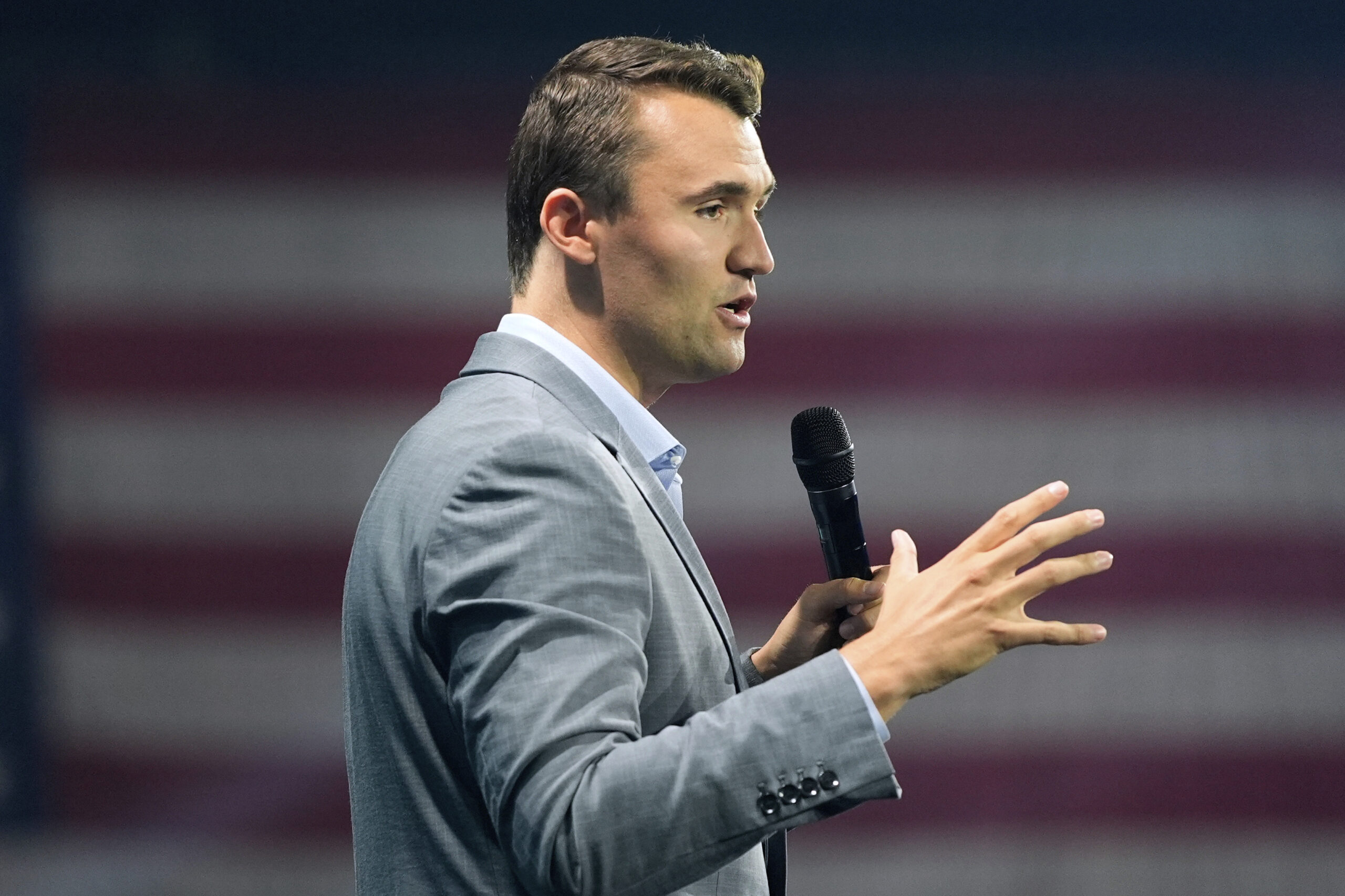
You know the rest of the story. As Charlie was talking in his trademark sort of way – not ranting, not raving, not cursing, but simply sitting and talking in a normal conversational way – the murderer shot him in the neck from a rooftop with a high-powered rifle. Charlie bled to death in seconds.
After video of the murder scene circulated, the murderer’s father turned him in with the help of a family friend who was retired from law enforcement.
Apart from the murder (but how was the play, Mrs. Lincoln?) the whole scene looks like a Norman Rockwell painting – a perfect glimpse of Americana.
Over a half a century ago, philosopher and writer Hannah Arendt wrote Eichmann in Jerusalem: A Report on the Banality of Evil. She was struck by the pedestrian personality of Eichmann in his trial and before his hanging in Jerusalem. He was not evil in the obvious ways. He had no horns, no cape, no devilish laugh, no foaming at the mouth, no apparent Hitlerisms.
Rather, Eichmann was a not-very-bright technocrat who’d dropped out of high school. He believed he was not just following orders (he was) but that he was following the law. He exhibited no hatred for the Jews, apart from his role in killing six million of them.
If Adolf Eichmann had been born into modern America, he might have become a mid-level manager in the EPA, the IRS or the Social Security Administration. He lacked both the credentials and ideology to be in the White House of either Joe Biden or Donald Trump, and he certainly lacked the passion.
Which brings me back to Charlie Kirk’s murderer. He was a devotee of the vapid echo chambers of online “discussion” but he exhibited little nuttiness or passion, until Thursday anyway.
Yes, he was a straight-A student, but in today’s schools that barely puts a kid in the top half of the class. Yes, he earned college credits while in high school, but then dropped out of a fourth-rate college. Yes, he participated in discussions at the family dinner table, but why was he living at home and eating his mother’s cooking at age 22?
The kid was a casual underachiever just going through the motions of an unlived life. He was the picture of banality.
The banal evil of Adolph Eichmann was six million times worse than the banal evil of Charlie Kirk’s murderer, but here’s what gives me pause: There are at least six million of these kids out there.
The nature of humans and their relationships is complex and interesting. It involves friendship, hate, cooperation, competition, love, impulse, greed, work, betrayal, family, tribes, envy, sympathy and dozens of other emotions.
Great writers and even bad ones have written billions of words on these powerful feelings, and how they function and dysfunction in groups of humans. Writers keep writing about them and their readers keep reading about them because they strike a chord within us. We witness them in our everyday lives.
Democrats have reduced it all to one thing: class struggle. In this class struggle, everyone is pigeonholed into one of two competing categories: the oppressed and the oppressors. But beware, there are some arbitrary exceptions because there’s something of a hierarchy of oppressors and oppressed.
For example, if your skin color is dark, then you’re oppressed. Unless you’re a dark-skinned Asian who wants to be judged fairly on merit, or a Black man like Martin Luther King, Jr. who wanted to be judged on the content of his character, or a political conservative like Justice Clarence Thomas or Professor Thomas Sowell or Secretary of State Marco Rubio – in which case you’re an oppressor.
If you’re a man who likes to pretend he’s a woman, then you’re oppressed. Unless, like Caitlin Jenner, you object to men pretending to be women competing against women in women’s sports – in which case you’re an oppressor.
If you like to do sexual things with people of your own sex, then you’re oppressed. Unless, like several of President Trump’s appointees, you happen to be politically conservative – in which case you’re an oppressor.
If you’re one of the 51% of humanity who is a woman, then you’re oppressed. (Never mind that you live six years longer than your oppressor.) Unless, like most women, you think men don’t belong in the women’s locker room – in which case you’re an oppressor.
If you haven’t made much money because you’ve chosen to use your time doing things other than working hard at well-paying jobs, then you’re oppressed. Same goes if you’ve made plenty of money but you’ve chosen to spend it all.
Enough about the oppressed. On to their oppressors.
If you’re a white man, you’re an oppressor. (That’s true even in Africa where white men are a distinct minority because . . . reasons.) Unless you’re a white man who chooses to use his time doing things other than working hard at well-paying jobs, and therefore has no money or has spent it all – in which case, as mentioned, you’re oppressed.
If you’re . . . well . . . hmm.
I planned to set forth the other types of oppressors but straight white men are pretty much the only ones. Oh, and Thomas Sowell, Martin Luther King, Jr., Clarence Thomas, and a couple billion Asians.
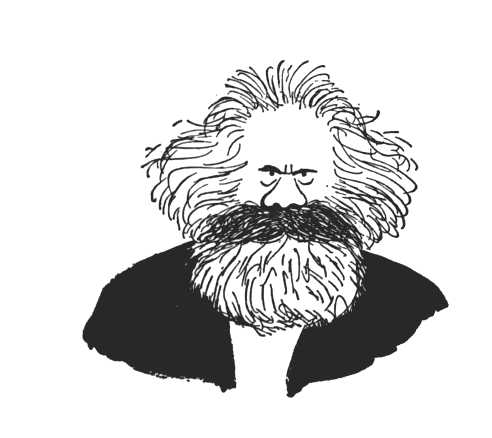
Credit this oppressor/oppressed view of humanity to Karl Marx, an intellectually feeble straight white man hiding behind a grotesque beard of pseudo-intellectualism. Of the myriad human emotions, he was blind to all but one: envy.
His envy led to his famous formulation for how to run an economy, which I paraphrase:
“From each according to his ability to make things, and to each according to his desire to have them.:
Marx’s formula doesn’t work for obvious reasons that are replayed predictably through the course of history. People who have the ability to make things stop making them if those things are taken away from them, and people who desire those things are never satisfied with what’s given to them if they aren’t required to expend any energy to get them.
Of course, the government can force people who are capable of making things to keep making them, even if they know those things will be taken from them. And that’s what socialist states wind up doing. But then you’re not running an economy, you’re running a slave labor camp. That’s not a sustainable plan.
The Democrats are blind to this logic and this history, perhaps because they want to see themselves as part of the oppressed du jour, to whom, conveniently, the oppressors du jour owe a living, and a good one at that.
Hence the Democrats’ obsession with heroizing losers who are failures in life, from the Rosenbergs to George Floyd to Hunter Biden. For a Democrat, the greatest achievement is to be a failure and therefore a victim, because that means you’re oppressed, and that means you deserve sympathy – along with the material things that your oppressors made and you want.
Give the Democrats some credit. They’re good at the first element of this non sequitur – the element of failure. I would say they’re still working on the other elements, but that would suggest they’re engaged in an activity they’re unwilling to engage in – work.
Until Democrats learn to achieve and celebrate more than just failure – until they learn to walk the walk of complex human emotions and relations – they still have talk. They can still talk the talk of oppressor/oppressed and perpetrators/victims. From such simple talk, they evidently derive great pleasure.
I think Shakespeare, Tolstoy and Faulkner might say . . . yawn. I know I do.
Why do Catholics still worship an old king in a palace?
I understand why they did in the old days. Everybody did. (Well, except Christ didn’t.) There was Henry VIII, Louis XIV, Charlemagne and, in folklore, King Arthur. There were also king-like rulers called emperors, such as Julius Caesar, Peter the Great, and Napoleon Bonaparte.
It was way back in the olden days that Catholics set up the papacy, their kingship. Their first Pope was said to be the Apostle named Peter, who used to be called Simon.
By the way, the names of the Apostles always have confused me. There was Paul, who was really Saul. There was Mark, who sometimes went by John. There was John, who always went by John even though Mark sometimes did, too. There was the aforementioned Simon whom Jesus called Peter even though that wasn’t his name and there was another Simon whom Jesus called Simon even though that was his name.
There were two James’s. One was James the Greater about whom we know a great deal of apocrypha and the other was James the Lesser about whom we know much less. James the Lesser went by Jim. (OK, that part is made up.)
Jesus must have had the patience of Job, considering how many times he had to say “No, the other one.”
As if Apostles are not complicated enough, let’s get back to popes. In case you encounter a pope, the proper form of address is not “Your Majesty.” That’s for kings and queens. Popes get addressed instead as “Your Holiness.” You see, kings and queens may be majestic, but popes are holy.
In fact, papal pronouncements on matters of Church doctrine are said to be “infallible.” Never mind that Church doctrine changes from time to time. The old doctrine was infallible when it was in effect, and the new, different one is infallible when it’s in effect.
As for all things, for infallibility there’s a season.
So, popes are holy. But there’s a bit of majesty in them, too. For a long time, infallible popes were also effectively the rulers of the Holy Roman Empire, an area that stretched from Rome to the Baltic Sea.
Wars and intrigue gradually chipped away at the Empire. The establishment of the nation of Italy in the 1800s cost the Vatican almost all of the little land they still held. The earthly territory of the Holy Roman Empire now comprises 0.2 square miles within the city limits of downtown Rome.
But that 0.2 square miles holds some good stuff, such as Michelangelo’s Sistine Chapel, priceless art works, and St Peter’s Basilica.
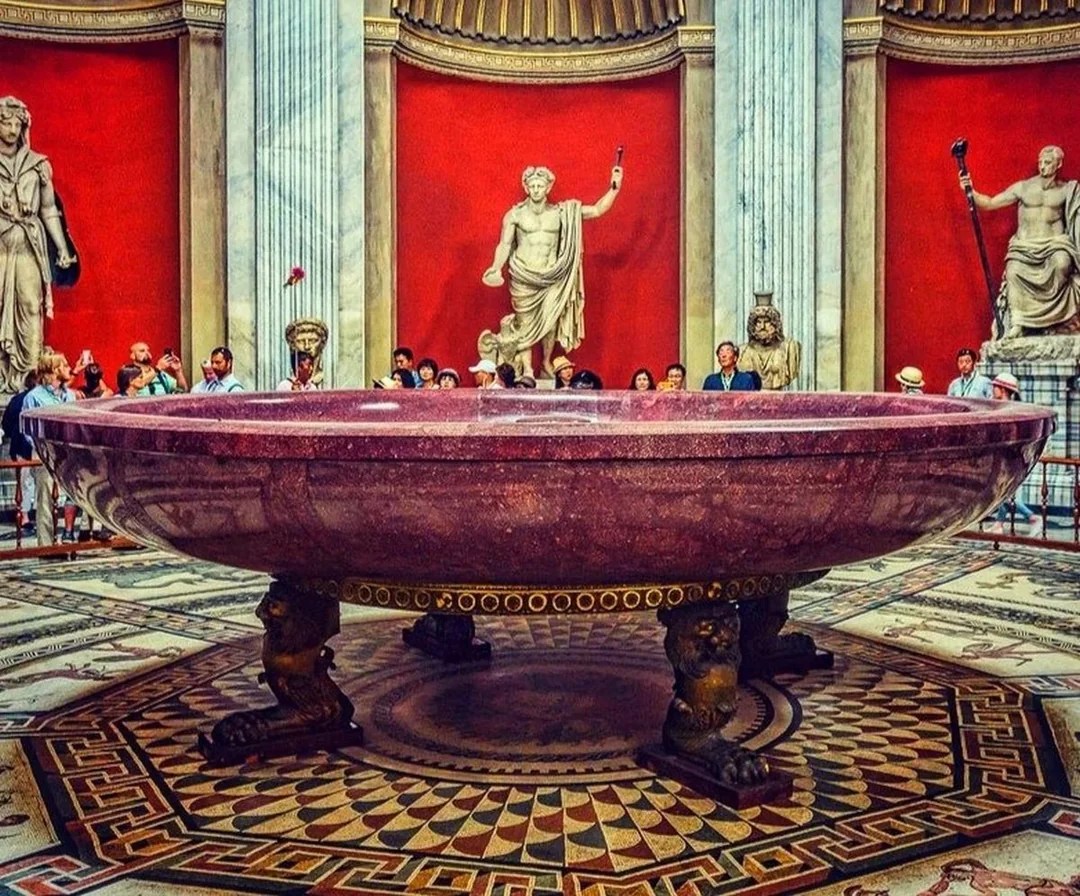
And Nero’s Bathtub. Nero’s Bathtub is a massive bathtub about 25’ long made of stone quarried in Egypt and brought to Rome for Emperor Nero. What better place to fiddle through a fire than in a bathtub? The value of Nero’s Bathtub is estimated at around two billion dollars. That’s $2,000,000,000. (I’m not making this part up.)
Altogether, the Vatican is the most valuable 0.2 square miles this side of Heaven. Don’t ask how they acquired all this treasure, and don’t ask how to reconcile such material acquisitiveness with their incorporeal mission. We’re talking infallible, remember?
These material riches of the Vatican’s balance sheet are oddly juxtaposed with the sorry condition of its income statement. They’re rich but they spend far more than they make. In fact, their finances have been in bad shape for many years. They have fallible finances.
In their defense, back in those olden days they had a lot of expenses such as wars to fight and bribes to pay. But now they don’t fight earthly wars, and bribes have not been reported for years. Even so, well into modern times they’ve still had sloppy finances, money-laundering allegations, and what might be called, um, corruption.
During the tenure of newly departed Pope Francis, the Vatican’s operating deficit tripled. Maybe ballooning budgets come with the territory from which he originated – Argentina.
Whatever the reason, finance types warn that this Latin American spendathon cannot continue unless the Vatican sells off assets, which will fix finances only for a while, or resumes selling indulgences – to a flock that is no longer accustomed to having to pay for them.
In contrast to the papacy, the aforementioned kingships and empires of Europe have evolved. They’ve been replaced by indirectly elected technocrat parliamentarians in such countries as Great Britain, Germany, France, Italy and most everywhere else. Only the throne of Peter the Great is still occupied by a despot.
So, what’s with the black smoke/white smoke ritual (“smoke-filled room” takes on a new meaning here) by a politburo of old men that are attired in plush red robes and lamp shade hats (let’s trust they’re not chomping cigars) to choose a new, infallible, male, old, dear leader in the richest corner of the globe even as that corner – and the globe – drift inexorably toward bankruptcy?
This is a heckuva way to save souls.
On the other hand . . .
The Catholic Church has probably been the greatest force for good in the history of the world. It has brought Good News to billions of people to enrich their lives if not save their souls.
The lucre and treasures the Church acquired along the way were from a different era, when that’s what powerful people did. It’s difficult for them to give it all away now, just because some Protestant blogger mocks Nero’s Bathtub.
And to whom would they give it? Secularist governments?
Sheesh, after the Notre Dame burned, the secular government of France proposed replacing it with a temple that would not offend (i.e., would pander to) the burgeoning Muslim population that seeks control of Europe. They backed down only when the remaining Catholic population of Paris (and France and the world) made a fuss.
My brother, a very smart guy with a Ph.D. in Physics, was a convert to Catholicism. I never really talked with him about his faith, but I respected his judgment. In that way, he reminds me of another very smart convert, JD Vance.
I confess that on my two long walks of the Camino de Santiago, there were times when I, too, considered converting to Catholicism. (There have been times when I’ve also thought about converting to Judaism, but that’s another column.) For now, I’m a die-hard Protestant.
So, the Church on balance has been a very good thing over the millennia.
Jimmy Carter informed us back in 1976 that he had “looked on many women with lust” and “committed adultery many times in my heart.”
The fact that a man’s heart or other organs have lusted after many women is not exactly news. The reason men don’t go around broadcasting their lust is because it’s obvious. It would be like saying, I get horny on days that end in a “y.”
But Carter did tell us about his lust – in a formal interview with Playboy, perhaps fittingly. He evidently thought that a man’s lust was newsworthy, if the man was him.
It reminds me of the devil’s temptation of Christ, a story told in three of the four Gospels. The devil failed in his temptation of Christ, but the fact that it happened was Good News-worthy two millennia ago.
Carter was a born-again Christian. (Full disclosure: I am too.) In fact, Carter was a Sunday School teacher. In teaching the temptation of Christ on Sundays and advertising “the temptation of Carter” on Saturdays, he was aware of the parallel he was drawing.
Mind you, I don’t judge a person’s brand of Christianity. That’s beyond my paygrade.
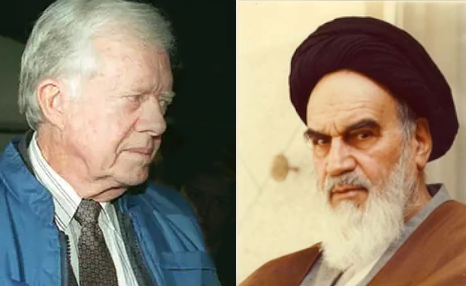
But I do judge their politics. Carter seemed to believe that a New Testament approach could work in international affairs – as in forgiveness and love thy enemy – with the likes of Leonid Brezhnev and the Ayatollah Khomeini.
Ah, the Ayatollah Khomeini.
When Carter was elected in 1976, the country of Iran was run by a Shah – roughly the equivalent to a Western monarch. The Shah was hostile to communism and generally friendly to the West. Many Iranian students went to Western universities. Women’s rights and human rights steadily improved over the decades of rule by the Shah and his predecessor father.
Carter’s limited experience as the former governor of Georgia and his black and white view of good and evil left him unprepared for the nuances of international geopolitics. In his simplistic syllogism, democracy was good; monarchs were anti-democratic; the Shah was a monarch; and, therefore, the Shah was bad.
In contrast to pragmatists such as Henry Kissinger (whom he despised), Carter was uncomfortable with the notion of the lesser of evils.
And so, when the Shah was threatened, Carter did little to save him. The resulting revolution led to a bloody theocratic state called The Islamic Republic of Iran. Like the Shah’s regime, it was a monarchy except in name, and this time it was led by a monarch – the Ayatollah – who claimed a hotline to Allah (and actually had one to Brezhnev) together with a divine right to rule.
The Islamic theocrats naturally hated America. They taunted us by holding 53 hostages in the American Embassy in Tehran for 444 days until the day of the inauguration of the man who defeated Carter’s bid for a second term, Ronald Reagan. (Funny, that coincidence.)
Carter’s sanctimonious forgiveness and love failed to free any hostages. (To his credit, he did attempt a rescue, but it never got off the ground.)
Since the time of the Iranian hostage crisis, Iran has shuffled along in their seventh-century oxcart. They throw gay men off tall buildings, they chop off the hands of shoplifters, and they stone prostitutes to death. They threaten to annihilate Israel, and they are just weeks away from having a nuclear bomb with which to do so.
In this odd world of ours, I sometimes see a bumper sticker reading “What would Jesus do?” I’ve always assumed that the owners of the cars to which those stickers are stuck have no interest in Jesus. They’re instead just trolling Christians. They’re trying to contrast the typically conservative political leanings of Christians with what they regard (unburdened by any actual knowledge) as the liberal leanings of Jesus.
But some Christians are actually guided in their geopolitics by that bumper sticker question – What would Jesus do? Never mind that Jesus spent his entire life in a place without iPhones which could be walked in the long direction in a few weeks and the short direction in a day. These particular Christians believe that Christ taught not just the tools for a relationship with God, but also for a relationship with Taylor Swift, John Maynard Keynes, and the Ayatollahs.
The teachings of Christ are probably harmless in dealing with Taylor Swift. (I know nothing of Swift’s beliefs, and I don’t mean to pick on her.)
However, the teachings of Christ are probably less helpful in dealing with John Maynard Keynes. Can we honestly suppose that Christ had insights into economic questions like how to obtain the greatest good for the greatest number, and what the capital gains tax should be, and that those insights are revealed if only we read between the lines of, say, Corinthians?
As for the Ayatollahs, the teachings of Christ are wholly unhelpful in dealing with them. Or in dealing with their jihadi foot soldiers who seek to conquer, enslave, rape, take hostage, behead and eliminate people they regard as infidels by means of suicide bomb vests, airplanes in skyscrapers, and pickup trucks on sidewalks.
The what-would-Jesus-do Christians seem unaware that we already know the answer to their bumper sticker question, “What would Jesus do?”
What Jesus would do is what he did do. He taught love, forgiveness and pacifism. He surrendered and sacrificed himself. He was excruciatingly tortured – naked and humiliated on the cross – that he might rise again to show us The Way.
The madmen of Islam would very much like us, now, to try doing with them what Jesus did with his enemies two thousand years ago. The last Western leader to try that was Jimmy Carter. And here we are.
Sensational rookie quarterback C.J. Stroud appeared for an interview over the weekend immediately after leading his Houston Texans to a playoff win. The exhausted, battered, victorious 22-year-old opened with these words:
“First and foremost, I just want to give all glory to my Lord and Savior, Jesus Christ.”
The game was carried by NBC. They posted Stroud’s postgame interview but, predictably, edited out his opening statement – the very statement that the player himself said was “first and foremost” to him and his terrific game.
Stroud is Black. It used to be that liberals tolerated Black displays of religion because they thought such displays were cute, as in Black churches with people dancing in the aisle and shouting “Hallelujah!”
Never mind that such displays were profound and spiritual for the Black participants; liberals condescendingly tolerated them only because they saw them as something like a kindergarten Christmas play.





 the Aspen beat