
This is a heckuva way to run a Church, but on the other hand . . .

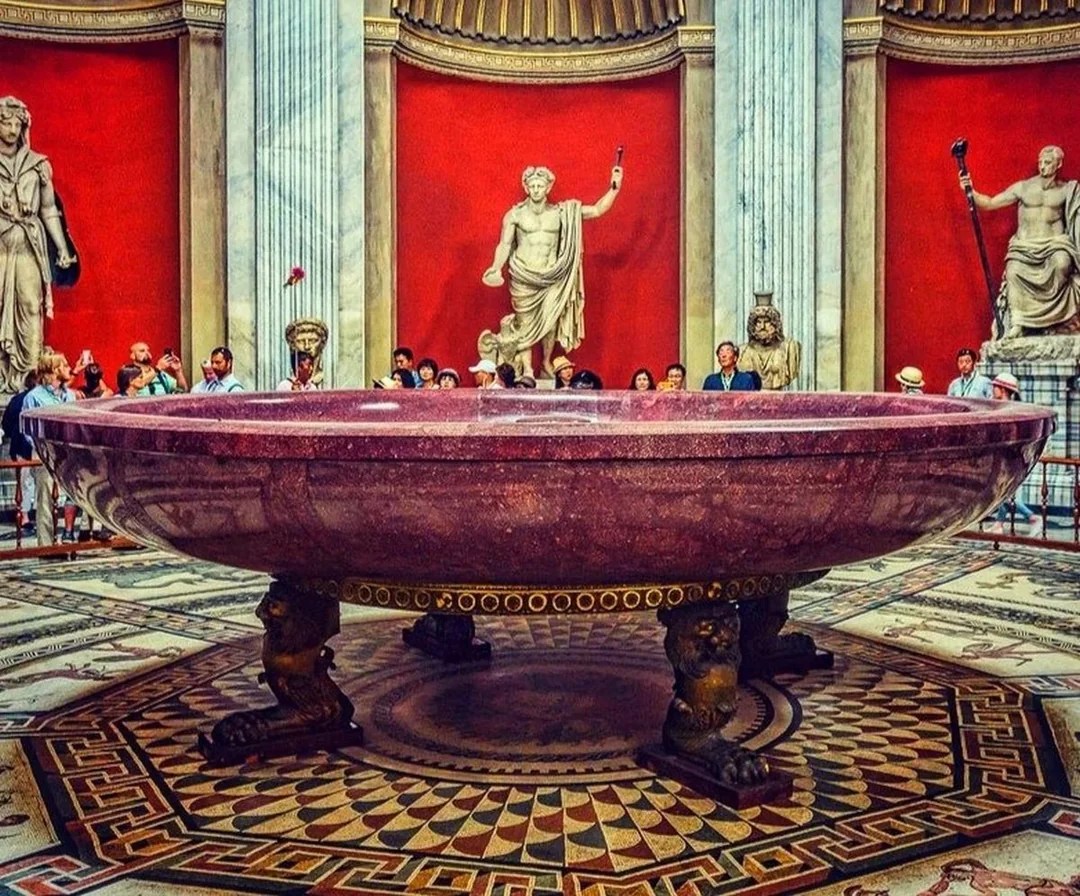
Nero’s Bathtub at the Vatican

Why do Catholics still worship an old king in a palace?

I understand why they did in the old days. Everybody did. (Well, except Christ didn’t.) There was Henry VIII, Louis XIV, Charlemagne and, in folklore, King Arthur. There were also king-like rulers called emperors, such as Julius Caesar, Peter the Great, and Napoleon Bonaparte.

It was way back in the olden days that Catholics set up the papacy, their kingship. Their first Pope was said to be the Apostle named Peter, who used to be called Simon.

By the way, the names of the Apostles always have confused me. There was Paul, who was really Saul. There was Mark, who sometimes went by John. There was John, who always went by John even though Mark sometimes did, too. There was the aforementioned Simon whom Jesus called Peter even though that wasn’t his name and there was another Simon whom Jesus called Simon even though that was his name.

There were two James’s. One was James the Greater about whom we know a great deal of apocrypha and the other was James the Lesser about whom we know much less. James the Lesser went by Jim. (OK, that part is made up.)

Jesus must have had the patience of Job, considering how many times he had to say “No, the other one.”

As if Apostles are not complicated enough, let’s get back to popes. In case you encounter a pope, the proper form of address is not “Your Majesty.” That’s for kings and queens. Popes get addressed instead as “Your Holiness.” You see, kings and queens may be majestic, but popes are holy.

In fact, papal pronouncements on matters of Church doctrine are said to be “infallible.” Never mind that Church doctrine changes from time to time. The old doctrine was infallible when it was in effect, and the new, different one is infallible when it’s in effect.

As for all things, for infallibility there’s a season.

So, popes are holy. But there’s a bit of majesty in them, too. For a long time, infallible popes were also effectively the rulers of the Holy Roman Empire, an area that stretched from Rome to the Baltic Sea.

Wars and intrigue gradually chipped away at the Empire. The establishment of the nation of Italy in the 1800s cost the Vatican almost all of the little land they still held. The earthly territory of the Holy Roman Empire now comprises 0.2 square miles within the city limits of downtown Rome.

But that 0.2 square miles holds some good stuff, such as Michelangelo’s Sistine Chapel, priceless art works, and St Peter’s Basilica.

And Nero’s Bathtub. Nero’s Bathtub is a massive bathtub about 25’ long made of stone quarried in Egypt and brought to Rome for Emperor Nero. What better place to fiddle through a fire than in a bathtub? The value of Nero’s Bathtub is estimated at around two billion dollars. That’s $2,000,000,000. (I’m not making this part up.)

Altogether, the Vatican is the most valuable 0.2 square miles this side of Heaven. Don’t ask how they acquired all this treasure, and don’t ask how to reconcile such material acquisitiveness with their incorporeal mission. We’re talking infallible, remember?

These material riches of the Vatican’s balance sheet are oddly juxtaposed with the sorry condition of its income statement. They’re rich but they spend far more than they make. In fact, their finances have been in bad shape for many years. They have fallible finances.

In their defense, back in those olden days they had a lot of expenses such as wars to fight and bribes to pay. But now they don’t fight earthly wars, and bribes have not been reported for years. Even so, well into modern times they’ve still had sloppy finances, money-laundering allegations, and what might be called, um, corruption.

During the tenure of newly departed Pope Francis, the Vatican’s operating deficit tripled. Maybe ballooning budgets come with the territory from which he originated – Argentina.

Whatever the reason, finance types warn that this Latin American spendathon cannot continue unless the Vatican sells off assets, which will fix finances only for a while, or resumes selling indulgences – to a flock that is no longer accustomed to having to pay for them.

In contrast to the papacy, the aforementioned kingships and empires of Europe have evolved. They’ve been replaced by indirectly elected technocrat parliamentarians in such countries as Great Britain, Germany, France, Italy and most everywhere else. Only the throne of Peter the Great is still occupied by a despot.

So, what’s with the black smoke/white smoke ritual (“smoke-filled room” takes on a new meaning here) by a politburo of old men that are attired in plush red robes and lamp shade hats (let’s trust they’re not chomping cigars) to choose a new, infallible, male, old, dear leader in the richest corner of the globe even as that corner – and the globe – drift inexorably toward bankruptcy?

This is a heckuva way to save souls.

On the other hand . . .

The Catholic Church has probably been the greatest force for good in the history of the world. It has brought Good News to billions of people to enrich their lives if not save their souls.

The lucre and treasures the Church acquired along the way were from a different era, when that’s what powerful people did. It’s difficult for them to give it all away now, just because some Protestant blogger mocks Nero’s Bathtub.

And to whom would they give it? Secularist governments?

Sheesh, after the Notre Dame burned, the secular government of France proposed replacing it with a temple that would not offend (i.e., would pander to) the burgeoning Muslim population that seeks control of Europe. They backed down only when the remaining Catholic population of Paris (and France and the world) made a fuss.

My brother, a very smart guy with a Ph.D. in Physics, was a convert to Catholicism. I never really talked with him about his faith, but I respected his judgment. In that way, he reminds me of another very smart convert, JD Vance.

I confess that on my two long walks of the Camino de Santiago, there were times when I, too, considered converting to Catholicism. (There have been times when I’ve also thought about converting to Judaism, but that’s another column.) For now, I’m a die-hard Protestant.

So, the Church on balance has been a very good thing over the millennia.

Still, it has its quirks.
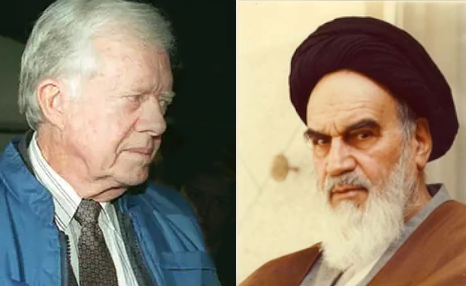
Jimmy Carter playing God paved the road for radical Islamists playing Satan

Jimmy Carter informed us back in 1976 that he had “looked on many women with lust” and “committed adultery many times in my heart.”

The fact that a man’s heart or other organs have lusted after many women is not exactly news. The reason men don’t go around broadcasting their lust is because it’s obvious. It would be like saying, I get horny on days that end in a “y.”

But Carter did tell us about his lust – in a formal interview with Playboy, perhaps fittingly. He evidently thought that a man’s lust was newsworthy, if the man was him.

It reminds me of the devil’s temptation of Christ, a story told in three of the four Gospels. The devil failed in his temptation of Christ, but the fact that it happened was Good News-worthy two millennia ago.

Carter was a born-again Christian. (Full disclosure: I am too.) In fact, Carter was a Sunday School teacher. In teaching the temptation of Christ on Sundays and advertising “the temptation of Carter” on Saturdays, he was aware of the parallel he was drawing.

Mind you, I don’t judge a person’s brand of Christianity. That’s beyond my paygrade.

But I do judge their politics. Carter seemed to believe that a New Testament approach could work in international affairs – as in forgiveness and love thy enemy – with the likes of Leonid Brezhnev and the Ayatollah Khomeini.

Ah, the Ayatollah Khomeini.

When Carter was elected in 1976, the country of Iran was run by a Shah – roughly the equivalent to a Western monarch. The Shah was hostile to communism and generally friendly to the West. Many Iranian students went to Western universities. Women’s rights and human rights steadily improved over the decades of rule by the Shah and his predecessor father.

Carter’s limited experience as the former governor of Georgia and his black and white view of good and evil left him unprepared for the nuances of international geopolitics. In his simplistic syllogism, democracy was good; monarchs were anti-democratic; the Shah was a monarch; and, therefore, the Shah was bad.

In contrast to pragmatists such as Henry Kissinger (whom he despised), Carter was uncomfortable with the notion of the lesser of evils.

And so, when the Shah was threatened, Carter did little to save him. The resulting revolution led to a bloody theocratic state called The Islamic Republic of Iran. Like the Shah’s regime, it was a monarchy except in name, and this time it was led by a monarch – the Ayatollah – who claimed a hotline to Allah (and actually had one to Brezhnev) together with a divine right to rule.  

The Islamic theocrats naturally hated America. They taunted us by holding 53 hostages in the American Embassy in Tehran for 444 days until the day of the inauguration of the man who defeated Carter’s bid for a second term, Ronald Reagan. (Funny, that coincidence.)

Carter’s sanctimonious forgiveness and love failed to free any hostages. (To his credit, he did attempt a rescue, but it never got off the ground.)

Since the time of the Iranian hostage crisis, Iran has shuffled along in their seventh-century oxcart. They throw gay men off tall buildings, they chop off the hands of shoplifters, and they stone prostitutes to death. They threaten to annihilate Israel, and they are just weeks away from having a nuclear bomb with which to do so.

In this odd world of ours, I sometimes see a bumper sticker reading “What would Jesus do?” I’ve always assumed that the owners of the cars to which those stickers are stuck have no interest in Jesus. They’re instead just trolling Christians. They’re trying to contrast the typically conservative political leanings of Christians with what they regard (unburdened by any actual knowledge) as the liberal leanings of Jesus.

But some Christians are actually guided in their geopolitics by that bumper sticker question – What would Jesus do? Never mind that Jesus spent his entire life in a place without iPhones which could be walked in the long direction in a few weeks and the short direction in a day. These particular Christians believe that Christ taught not just the tools for a relationship with God, but also for a relationship with Taylor Swift, John Maynard Keynes, and the Ayatollahs.

The teachings of Christ are probably harmless in dealing with Taylor Swift. (I know nothing of Swift’s beliefs, and I don’t mean to pick on her.)

However, the teachings of Christ are probably less helpful in dealing with John Maynard Keynes. Can we honestly suppose that Christ had insights into economic questions like how to obtain the greatest good for the greatest number, and what the capital gains tax should be, and that those insights are revealed if only we read between the lines of, say, Corinthians?

As for the Ayatollahs, the teachings of Christ are wholly unhelpful in dealing with them. Or in dealing with their jihadi foot soldiers who seek to conquer, enslave, rape, take hostage, behead and eliminate people they regard as infidels by means of suicide bomb vests, airplanes in skyscrapers, and pickup trucks on sidewalks.

The what-would-Jesus-do Christians seem unaware that we already know the answer to their bumper sticker question, “What would Jesus do?”

What Jesus would do is what he did do. He taught love, forgiveness and pacifism. He surrendered and sacrificed himself. He was excruciatingly tortured – naked and humiliated on the cross – that he might rise again to show us The Way.

The madmen of Islam would very much like us, now, to try doing with them what Jesus did with his enemies two thousand years ago. The last Western leader to try that was Jimmy Carter. And here we are.

I’m sick and tired of media hatred and censorship of Christians

Sensational rookie quarterback C.J. Stroud appeared for an interview over the weekend immediately after leading his Houston Texans to a playoff win. The exhausted, battered, victorious 22-year-old opened with these words:

“First and foremost, I just want to give all glory to my Lord and Savior, Jesus Christ.”

The game was carried by NBC. They posted Stroud’s postgame interview but, predictably, edited out his opening statement – the very statement that the player himself said was “first and foremost” to him and his terrific game.

Stroud is Black. It used to be that liberals tolerated Black displays of religion because they thought such displays were cute, as in Black churches with people dancing in the aisle and shouting “Hallelujah!”

Never mind that such displays were profound and spiritual for the Black participants; liberals condescendingly tolerated them only because they saw them as something like a kindergarten Christmas play.

Continue reading

Jesus is not our mom

Note: I first wrote and published this years ago. I occasionally revise and republish it.

Two thousand years ago, a carpenter lived a conventional life for 30 years in a tiny village in the Middle East. Then something got into him. He became, as they might say today, “radicalized” for the last three years of his short life.

Historians agree that Jesus did exist. There are reliable ancient records of him. But most of what we know are opaque and contradictory accounts written decades after his death in what we now call the Gospel of the New Testament.

In one sense, those Gospel accounts are profoundly simple. They say Jesus was the Messiah prophesized in the Hebrew Bible. As such, he performed miracles to save those needing saving. He came back from the dead. That’s the word.

But in a personal sense, the Gospels present a more complicated man than the one presented in Sunday School or even adult church services.

Continue reading