Glenn K. Beaton is a writer and columnist living in Colorado. He has been a contributor to The Wall Street Journal, RealClearPolitics, Powerline, Instapundit, Citizen Free Press, American Thinker, Fox News, The Federalist, and numerous other print, radio and television outlets. His most recent book is "High Attitude — How Woke Liberals Ruined Aspen"
A reader emailed me recently to say he disagreed with my position on an issue. That’s fine, I get such emails all the time, and I typically respond to them. I’ve had some good discussions that way.
The funny thing about this one, however, is that the reader never walked me through the substance of his counterargument. Instead, he told me he usually liked my stuff because it is pretty logical, but in his judgment this particular piece was not. He didn’t say what was illogical about it
He implied that he would stop reading my work if I persisted in these unspecified illogicalities. I think he intended that as a threat.
Then he implied that my position was not only illogical for unspecified reasons, but was aligned with the other tribe. The thrust was that the other tribe is always wrong, and so if I happen to agree with them on a given issue, that makes me wrong as well. In addition to being traitorous.
I think he intended that, too, as a threat. As in, “If you persist in being a traitor, I’ll stop reading you.”
I got to thinking. This reader is exactly the sort of person who should read me. By reading me, he occasionally gets exposed to a position outside his comfort zone, expressed by someone he has enough regard for to take the time to read regularly.
However, he evidently is not interested in being taken outside his comfort zone. He likes his comfort zone just fine. It’s comfortable, in fact. What he wants is validation of his comfortable comfort zone.
He’s not alone. In today’s political polarization, he’s the rule, not the exception.
Bloggers like me – and even many legacy news sources – have learned to pander to these millions of polarized partisans. They publish what they know the partisans want to hear. They seldom stray off the reservation, lest they lose a reader, and a click, and a dollar.
As for me, I don’t need readers or clicks or dollars. I’m not in this for money (thank goodness). There are no stakeholders or shareholders in my operation. Unlike the Washington Post, there’s no chance I’ll lay off a third of my staff tomorrow. When you have no staff, you have no staff to lose.
I truly do this because I’m a political junkie, because I enjoy writing, and because I like to interact with my readers. If you don’t like what I say, or even if you do, please free to let me know in an email or, preferably, a public comment.
I’m happy to interact in a substantive and sometimes personal way. I’ve made friends in my writing, though in some cases we still haven’t met. (You know who you are.) And I’m talking about real friends – the kind where we can disagree without being disagreeable.
On the other hand, if reading something with which you disagree is intolerable to you – if you insist that everything you read be tribal orthodoxy – there are plenty of other blogger-whores out there happy to pander to you.
They’ll say what you want to hear, every single time. They’ll please and pleasure you, orgasmically, and even pretend to have a simultaneous one with you – so long as you keep clicking.
I went walking on Christmas Day and crossed paths with others doing the same. Unprompted, most wished me a “Merry Christmas.” Some simply said “hi” or gave me a nod. Only a few said nothing at all.
None wished me “Happy Holidays.” And there were no Kwanzaa carols in the air.
Yes indeed, “Merry Christmas” survived the invention of both “Happy Holidays” (a misguided attempt to avoid offending Jews by greeting them with a wish for merriment when they were not merrily profiting from the writing of most of our modern Christmas carols) and Kwanzaa, a late-20th century invention that was something like DEI for religious holidays to pander to people who think Christ is a dead white European who preached that camels could pass through the eye of a needle easier than poor Black people could get to heaven.
Christmas also survived the climate-change lobby. It survived the Gaia worshippers.
It survived the nihilistic, faithless Millennials (and has been embraced by their successors, the faith-seeking Gen Z), it survived the Godless Democrats, it survived the proselytizing atheists.
It survived 9/11, it survived October 7.
It survived the faith-mockers, it survived “Pope” Francis, it survived the Episcopalians, it survived yard signs of the self-devout self-proclaiming their virtue.
And not only did Christmas survive us, we survived it.
We survived electronic Christmas cards. We survived ghosts of fruitcakes from Christmases past (they never go bad, you know, or at least they never go worse). We survived aluminum Christmas trees, we survived plastic Christmas trees, and we survived dead Christmas trees.
We survived LED candles, we survived the mall.
We survived the still-unfilled promise of joy to the world and we survived Joy to the World. We survived a noisy night and we survived Silent Night. We survived Come All Ye Faithful and we survived Santa Claus is Coming to Town.
We survived We Three Kings even amid the chants of “no kings!”
We survived the cancelation of Baby it’s Cold Outside.
Speaking of which, your correspondent became a grandfather a couple of weeks ago, which is not to be confused with a grand father or even a mediocre father.
I came through it all fine, and I’m mostly happy and healthy, thank you for asking.
But it’s not all just about me, there are also other people involved. They’re happy and healthy as well.
I have a feeling that the silent nights in their home will be few and far between in the upcoming few months, but I’m starting to understand joy to the world. You see, it happens one little world at a time.
Now, if I can just get through New Years Eve unscathed . . . Isn’t that when they do the mistletoe thing?
A good part of a person’s success in the game of life is a product of nature and nurture – his genes and the parenting he received. People who were unlucky enough to receive bad genes, or bad parenting, or both, tend to be unsuccessful.
Tragically for America, these people who are unsuccessful at life are the very people who are disproportionately successful at having babies. Those babies tend to inherit their parents’ bad genes and learn their bad parenting.
When those babies grow up (or, often, just partially grow up) they, like their parents, are unsuccessful at life but disproportionately successful at having babies. Those babies, in turn, wind up short-changed by both nature and nurturing.
What I’ve just described already takes us through three generations. In the end, there’s no end. We’ve set up a vicious and expanding cascade of poverty and failure.
The effect is a policy of survival – and propagation – of the un-fittest. Charles Darwin would predict adverse consequences for our species.
Before you take offense, I hasten to add that general rules often are riddled with exceptions. I grew up in in a family of six with modest means. We all turned out OK. But the fact that it sometimes rains in the desert doesn’t disprove the general rule that deserts are dry.
The welfare state makes it all the worse. This was recognized as early as 1965 by intellectuals such as Daniel Patrick Moynihan, the future Democrat Senator from New York back when the Democratic Party sometimes produced rigorous thinking rather than identity politics. Moynihan’s work focused on poor Black families but it’s not a Black issue per se; it’s a poverty issue.
Moynihan criticized social welfare policies where we pay unsuccessful people to have unsuccessful babies to propagate their failure at life, thereby amplifying this vicious cascade of poverty.
The more babies they have, the more money we pay them. Then their babies have babies, and we’re off to the races.
Perhaps our policy should be exactly the opposite. Perhaps we should discourage unsuccessful people from having unsuccessful babies.
A smart start to getting out of this hole would be to stop digging. We should stop paying unsuccessful people to propagate. To that end, eliminate the $3,000 child tax credit.
Then go a step further. Pay people not to have babies. A simple way to accomplish that would be to pay them to undergo sterilization.
That sounds cruel, but is it really? If “my body my choice” justifies people aborting unborn babies because they’re inconvenient, then surely it justifies people accepting money to prevent the babies’ conception. For gosh sakes, the manufacturers of condoms accept money to prevent the conception of babies.
Moreover, many if not most of the babies these people have are utterly unplanned. If it’s cruel to prevent unwanted pregnancies, then why haven’t we outlawed those condoms – along with birth control pills, the rhythm method, premature withdrawal, abstinence and chastity?
I recognize that courts are wary of government measures that produce sterilization. Courts might view a system where the government pays people taxpayer money conditioned on them being sterilized as tantamount to the government sterilizing them involuntarily.
So don’t do it through the government. Let foundations and philanthropists administer the system with private funds. A foundation or a rich guy (Elon, do you hear me?) could say, “Here’s $3,000 for anyone under 50 who wants to get sterilized. And we’ll pay the medical bills, too.”
The people that we want not to have babies would find that offer tempting, because $3,000 is a lot of money to those people. But the people we want to have babies would not find that offer tempting, because that’s not a lot of money to them.
Over time, we just might reduce the population of undesirables (not to be confused with deplorables).
You might ask, what about America’s fertility crisis? Yes, it’s a fact that American (and European) birthrates are less than what’s required to maintain the current populations. And so, the argument goes, we should provide incentives for people to procreate.
That argument is premised on the notion that when it comes to people, the more the better. I question that notion, especially when I’m forced to endure crowded freeways, crowded hiking trails, and crowded crowds.
We have eight billion of us. Is that not enough? I don’t know about you, but I rarely think, “Gee, I wish there were more people here.”
From a pure financial perspective, it’s true that an ever-increasing population is necessary to continue our Ponzi scheme called Social Security, where we need more and more workers to support more and more retirees who live longer and longer (though the effects of rationed medical care – which seems inevitable and already encroaching upon us – will partially solve that problem).
I submit that the way to fix the Ponzi scheme of Social Security is not to produce infinitely expanded pools of young suckers to support it, but to phase out the scheme. Like all Ponzi schemes, it’s unsustainable. We cannot increase our population forever to produce an ever-increasing pool of hard-working suckers to support an ever-increasing number of long-lived retirees. At some point, we run out of space, resources and suckers.
Even if the number of suckers we breed to support the burgeoning population of retirees is sufficient in quantity, they are apt to be insufficient in quality. How many generations of bad nature and nurture can a society withstand?
“I can hardly wait to see your nine-incher, Glenn!” Those were the words of a dear hiking buddy with whom I’ve had a long platonic friendship.
But I’m getting ahead of myself.
Beginning last summer, I felt less than my usual acerbic, aerobic self, especially when hiking at altitude with my group around Aspen. I finally awoke one morning feeling downright crappy, and a little light-headed. I’m not prone to illness. I haven’t vomited for at least 30 years, and my last cold was over ten years ago. I figured something was wrong.
I drove myself to the local emergency room. Cleverly, or so I thought, I skipped breakfast because I figured they’d want to draw blood for tests.
They did draw blood, and did lots of imaging. They found nothing wrong.
Except I passed out. That alarmed me and everyone else until we figured out it was due to plummeting glucose levels. That’s what happens in early afternoon if you haven’t eaten a thing for 20 hours. So much for my cleverness in skipping breakfast.
Over the next two months, I became a regular in the ER and in the medical offices. Each time was with the same symptoms: Intense fatigue, light-headedness, and now some cognitive and memory issues. Each time, they found nothing wrong.
They did notice my bicuspid aortic valve – a defect that I was born with and have been aware of for many years. The aortic valve is the exit from the heart to the aortic artery. All the blood pumped to your body goes through it. It’s supposed to be three-leafed, but about one percent of the population gets short-changed in the aortic valve line at birth and gets only a two-leafed version.
A bicuspid aortic valve is usually not fatal. Many people never realize they have it. But it’s not as efficient, and it can deteriorate over time.
They saw my bicuspid aortic valve through a routine echocardiogram. They apply an echo transducer to the chest, something like the transducers applied to a woman’s belly to generate an image of a baby in the womb.
The echocardiogram showed that I had “mild regurgitation” through my bicuspid aortic valve, and would need to have it replaced sometime in the next few years. But it was not an emergency and did not account for my symptoms.
I was starting to think my symptoms were imagined, and the docs probably were too.
Almost on a lark, I saw yet another cardiologist. This one was suspicious about the echocardiogram images showing only mild regurgitation at my defective aortic valve. He ordered up a different sort of echocardiogram. For this one, they put me under an anesthetic and put the transducer down my trachea to get a view of the valve from a different angle.
That angle showed the regurgitation at the bicuspid aortic valve was not mild, but “severe.” The valve had deteriorated to the point that blood was backflowing from the aorta back into the heart. They checked me into the hospital that very day and performed open heart surgery to replace the valve as soon as they could round up a surgical team.
The lead surgeon happened to be a petite blond woman. Her blondness was of no consequence, medically speaking, but I noticed her small, strong fingers that would soon be fishing around in my chest. I thought, “That makes sense – all surgeons should be petite women.”
For the replacement valve, they can use a mechanical prosthesis or a biological one. We chose the biological one. It’s fabricated from natural bovine heart tissue. So, I have a bit of Bessy in me. At least it wasn’t porcine tissue.
Surgery entails a nine-inch incision lengthwise over the sternum (hence the remark by my friend which I quoted above). Then they cut through the sternum, still lengthwise, and pry open the split sternum and chest cavity with a steel prying cage that looks like something from a tire store.
That exposes the beating heart. A vein and an artery are accessed with catheters connected to a heart-lung bypass machine to maintain the oxygenation of the blood. The heart is then stopped with drugs, and remains stopped for an hour or two during the next steps.
The surgeon cuts into the heart to expose the aortic valve, carves it out, takes measurements, and sews in the prosthetic valve of the right size. Then the heart is closed with stiches, the bypass machine is disconnected from its arterial and venous access points, the heart is restarted, the prying cage is closed and removed, the sternum is stapled or wired together, and the skin incision is stitched up. The whole operation usually takes 4-6 hours.
I once had simple knee surgery where they used an epidural to numb me from the hip down. I elected to stay conscious the whole time and observed the surgery on a video monitor.
That was not an option for the heart surgery.
I awoke that evening with a tube down my throat. My first assigned task was to convince them that I was well enough for them to remove it. I succeeded, and they did.
I spent another four nights in the hospital. With encouragement, I was able to walk to the bathroom right away, and each day I walked a bit farther down the hallway. By the last day, I was walking a single flight of the stairwell. It wasn’t exactly the Matterhorn, but you have to start somewhere.
At home, it was tricky to get around without feeling pain in the sternum and thereabouts. After about three months, the direct pain was pretty much gone, except there would be odd bouts of intense pain or cramps in the intercostals between the ribs.
Heart arrhythmias are common after open heart surgery because the surgical incisions cut through established electrical pathways. The body finds alternative pathways that are incorrect and mistimed.
I got the full measure of arrhythmias. Atrial fibrillation was first, where the heart races and flutters. My heart rate would be 64, then 42, then 163, then 81, all in the span of a few seconds.
For that, I underwent the usual treatment of “cardioversion” where the patient is anaesthetized and the heart is shocked with a high-voltage current to reset the proper electrical synchronization. The burn marks left on the chest are usually small and heal quickly.
Then there were the premature ventricular contractions, or PVCs, where the sensation is that the heart is skipping a beat. All people get a few PVCs now and then, and they tend not to be dangerous, but mine would go on for hours or days. They were typically loud enough to keep me awake all night. Eventually, they subsided (I think).
The whole experience is disruptive to one’s metabolism, one’s head, and one’s emotions. I sincerely believe I’m a different person now.
That person is not yet as mentally acute. There’s a name for the symptom of brain fog after heart surgery involving a heart-lung bypass pump. They call it “pump head.” I confess to having a bit of pump head. It often improves over time.
I’m also not as aerobically strong. That, too, may improve – especially now that I have a proper and efficient aortic valve for the first time in my life. I’m not ready to hang up my hiking boots quite yet, or my spurs.
And I’m different in my personality. I’m relearning things, relearning people, and relearning myself. I choose to see it as a blessing. How many people get the chance to reinvent themselves, free of the baggage of who they were?
Meanwhile, I’ve got this nine-incher. Got that going for me.
You know them. They were in your living room and part of your family conversations every night, especially during those 60-second breaks.
Before America was siloed into warring tribes by ratings-hungry cable TV and, later, by click-hungry internet sites, these men defined fatherhood for two generations. They were uncool before uncool was cool.
I’m aware this isn’t Fathers Day, other than in a specific religious sense. But Christmas always brings back family memories for me, particularly of my dad, which gets me thinking about the role of dads everywhere.
You’ll have your own favorite dads, but here are mine, in no particular order. Feel free to add and subtract.
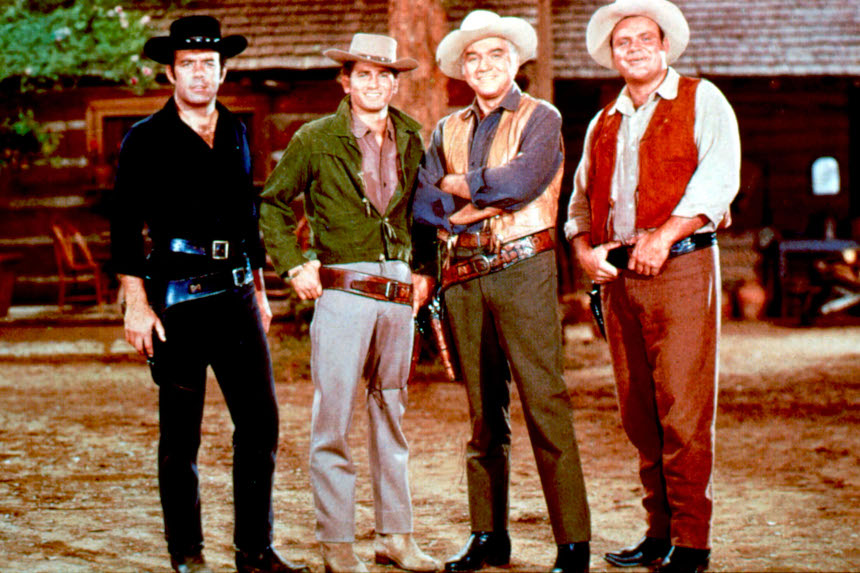
Ben Cartwright, of Bonanza
Ben came west, and founded the Ponderosa Ranch. He married and buried three women who gave him three sons. He was a strong and kind man back in the days when we thought that was a good thing.
Each episode of the show was a morality play, as much of television was back in the days when we had morality. A recurrent theme was the need for men to man-up. Ben taught that lesson many times, usually by example. And sometimes it meant something different than viewers initially assumed.
Frasier Crane, in Frasier
I suppose experts in comedy would say that a fussy, pretentious, good-hearted psychiatrist is easy material (Bob Newhart, anyone?) but Kelsey Grammer is so darned good as an over-actor (and also as a just-right actor on the Shakesperean stage) that he pulls it off. Best. TV Comedy. Ever.
Andy Taylor, of The Andy Griffith Show
I always wanted to dislike Sheriff Taylor (played by Andy Griffith) because the show was just so hokey. But Griffith was an accomplished actor, the writing was pretty good, and so I mostly failed.
I succeeded much better with Barney Fife. Bumbling incompetence with handguns does not amuse me.
Ward Cleaver, of Leave it to Beaver
Not really. Just seeing if you’re paying attention. I couldn’t – and still can’t – get past the fact that this dude calls his young son “The Beaver.” What’s up with that?
Tony Soprano, of The Sopranos
This show was pretty edgy. Tony led a life of crime, but, out of love, he desperately wanted to guide his family into something legitimate. He ever got a therapist!
If only Joe Biden had been watching.
Jed Clampett, of The Beverly Hillbillies
The hat. This one is all about the hat. I wanted the hat. Well, the hat and the jalopy. Well, the hat, the jalopy and Elly May.
Ricki Ricardo, in I Love Lucy
I never liked Lucille Ball, but to this day it’s remarkable that her husband Ricki was presented as a charismatic Latin immigrant bandleader married to red-headed Lucille.
You couldn’t do that today, because Ricki was the bad kind of immigrant – legal, Cuban and probably Republican.
Jim Anderson, in Father Knows Best
This is another one that could not be presented today. Maybe you could get away with “Birthing Parent Has a Truth That Works For Them.”
Atticus Finch, in To Kill a Mockingbird
OK, this was a movie, not a TV show. And, OK, I offer it up mainly to show off my movie chops. But Atticus Finch (played by Gregory Peck in his finest role) sets the standard for strength and courage in explaining and exemplifying the nuances of both to his young daughter. Ben Cartwright would be proud. The writing isn’t bad either.
That’s my list from the past. Today, I look for the next generation of fathers in the entertainment media. Two come to mind.
One is Joe Biden, who is not an entertainer strictly speaking but that’s about all he’s good for anymore.
Joe does not make my list of fathers I admire most.
Another is Deion Sanders. I don’t know Prime, and don’t pretend to understand him or relate to him. But one thing is clear: He holds his sons to very high standards of professional (yes, professional) achievement.
But where’s Ben Cartwright, for God’s sake? Where’s Sheriff Taylor? We can’t even get our hands on a good-father mobster like Tony Soprano.
When I was young, I had a father who was quirky (OK, that’s an understatement) but full of decency. Sure, there were things he simply was not capable of. But maybe that had something to do with his own father dying in the depths of the Great Depression when Dad was five. Maybe it had to do with flunking the 6th grade twice due to dyslexia (which went under the medical term “stupidity” at the time). Maybe it had to do with dropping out of school in the 8th grade to support his widowed mother, the turmoil of joining the army underaged, earning his GED, and somehow working his way into the middle class to support a family of six in an 800 square foot house.
I never heard the man say “I love you” to anyone, including my mother. But I was certain this unusual person did love me, just as Sheriff Taylor loved lovable Opie and Ben loved unlovable Adam. That’s how dads were. Television said so.
In today’s world, there isn’t enough of that certainty. The more our world of global information fragments, the less our moral compasses point in the same direction.
Our parents’ generation had no time to pursue happiness. They were too busy saving the world.
But the blood, sweat and tears sacrificed by “the greatest generation” in saving the world wound up making them happy, too.
Their offspring — a generation that has bled less blood, perspired less perspiration and shed fewer tears than any generation in history — perceive “happiness” differently. They see happiness not as the incidental effect of a life lived well. For them, it’s the whole purpose of life.
“Happiness” is all we want. Our parents became happy by being great. We, in contrast, think we can become great by being happy.
We don’t exactly know how to achieve our happy goal, but we think we know how not to. “Happy life,” we happily theorize, must be the opposite of “hard work.”






 the Aspen beat