Joe, don’t go!

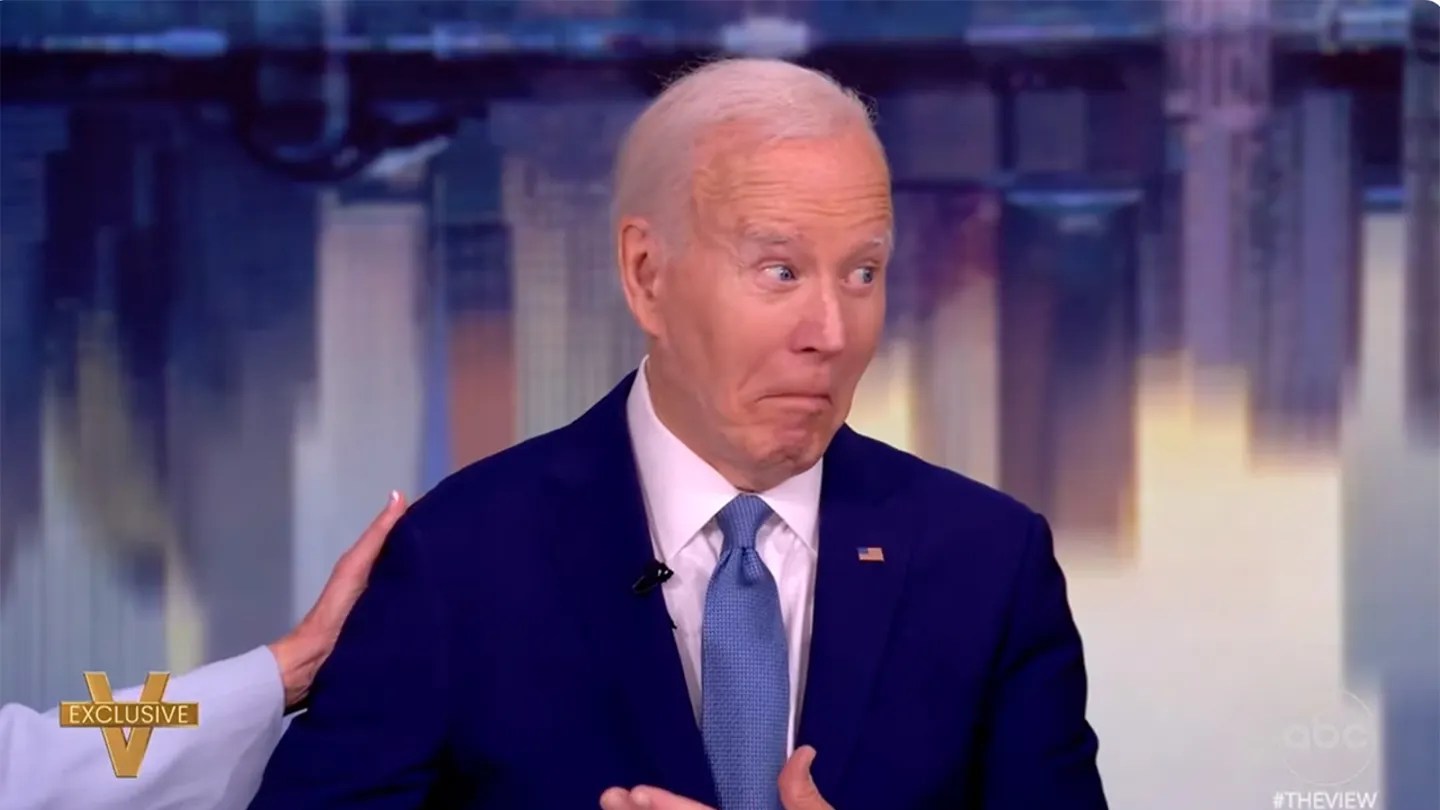
On those rare occasions when I’m in need of an emetic, I’d rather have a finger stuck down my throat than have the image of Joe Biden stuck through my retina.

But he’s baaaaaack anyway. Democrats hate that he’s back.

What my enemy hates, I should like.  And so, I do. Even though it hurts my eyes and turns my stomach.

Democrats hate it for the same reasons that I like it. Every Joe sighting reminds people of why they voted against him. He demonstrates that he’s a creaky, corrupt, cardboard cutout that is incapable of thought and practically incapable of reading a teleprompter containing the thoughts of people who do his thinking for him.

Every appearance reminds people that the Democrats lied that he was “sharp as a tack” right up to the minute that he proved beyond a reasonable doubt that he was dull as a dullard, at which time they dumped him like a stained, plaid Laz-Z-Boy from the 70s and declared that their hand-picked replacement (why bother with primaries to ascertain the people’s preference when you have Nancy, Chuck and Barack?) was

. . . wait for it . . .

. . . “sharp as a tack.”

And joyous, to boot. And no known hair plugs, capped teeth, or criminal family.

I almost feel bad for Joe that the Democrats are not even pretending to welcome him. Almost.

“Joe, please go” Is their typical greeting. Guffaws are their typical reaction to his tiresome contention that he would have won the election (if only he’d had the courage not to quit). Yawns are elicited by his warnings that the Republicans want to end Social Security, end motherhood, and end the world.

Rage is the emotion generated by him reminding Democrats of his truculent, selfish refusal to quit when the quitting was good – back when the primaries were playing out and a competent new candidate could be chosen in the way they’re supposed to be. Embarrassment is what they feel when they see him stumbling, bumbling, humbling and crumbling on a stage.

Mind you, I don’t blame Joe for being semi-senile. Lots of people wind up there. Supreme Court Justice Ruth Bader Ginsburg in her final years comes to mind.

Ginsburg is another person whom I adore because she screwed the Democrats by quitting long after the quitting was good. Ginsburg’s encroaching senility so clouded her judgment that she could not see it encroaching, and so she failed to quit in time for Barack Obama to name her replacement.

She died at age 87 while still on the bench (when she was not in the hospital). After decades of reliably liberal votes, the legacy she left is that her replacement is Amy Coney Barrett, nominated by Republican President Trump and confirmed by a Republican Senate.  

Back to Joe being back. Surely, he can still distinguish between friends and enemies. Given that his friends wish he’d go away for good, and his enemies are happy he doesn’t, one might ask, why doesn’t he go away?

This might shock you, but politicians have big egos. They crave attention. It’s not exactly a monastic profession.

I don’t hold that against them. The need for attention is fundamental to mankind (and, to a slightly lesser extent, womenkind). Some people achieve it by being loved, others achieve it by being hated, and still others achieve it by writing stupid blogs where they weave themselves into the narrative.

What I hold against Joe is not his basic need for attention. What I hold against him is his terrible policies, his family corruption, his gross incompetence, and his shameless lies.

I’m glad he’s back to remind Americans of those things. As he continues to decline, I hope he sticks around. Cement that legacy, Joe.

Is the American Pope a case of follow-the-money?

To everyone’s surprise, the new Pope is an American. Like almost everyone else in the world, I’d never heard of him before yesterday. But he looks like a straight shooter and a stand-up guy. And, as popes go, he looks pretty healthy.

For readers in my tribe who are dismayed that he once expressed some passing criticism of President Trump’s summary deportation of illegal aliens, I ask you: What’s a clergyman supposed to say – kick the SOBs out?

I did not expect to see this – an American Pope – now or ever. Reports are that the smoke-watchers crowding the Vatican grounds didn’t either, and were a bit disappointed.

That’s not because Europeans hate or even dislike Americans. The practice of scorning American tourists ended at least a generation ago. The days of ugly Americans are now replaced by the days of rich Americans – and everyone likes customers who are rich.  (That said, it doesn’t hurt to greet people in their language when you’re in their country. “Buenos dias” and “bonjour” fetch a lot more smiles than “Hey, howya doin?”)

So don’t be fooled by Americans who sanctimoniously advertise to fellow Americans that they identify themselves as Canadians, not Americans, when they go to Europe, ostensibly to trick the Europeans into liking them. Those Americans are revealing a dislike for Americans alright – by themselves. Those Americans hate America, and they project that hatred onto the world.

Although Europeans don’t hate Americans the way some Americans hate Americans, I still wouldn’t expect the sun-drunk, ecstasy-filled citizens of Rome milling about St. Peter’s Square this week to be whispering, “Let’s pray they elect an Americano!”

And they weren’t. So why did the Cardinals elect an Americano?

Here’s a relevant factoid: The Vatican has deep financial problems.

Here’s another relevant factoid: When the Notre Dame burned a few years ago, guess who donated the greatest amount for the rebuilding, apart from the French themselves (several of whom were extraordinarily generous). It was the Americanos.

Connect the dots. 

I hope the strategy pans out. We need the Catholic Church more than ever before – and I say that as a Protestant.

The fix is in to repeal Colorado’s Taxpayer Bill of Rights

Back in 1992, the citizens of Colorado passed an amendment to the state constitution to limit tax increases. They called it the Taxpayer Bill of Rights, or TABOR.

TABOR did not eliminate taxes, nor did it prohibit tax increases. Instead, it merely limited tax increases to the rate of inflation plus the population growth of the state.

Even those limits can be exceeded by a mere majority of the voters of the jurisdiction seeking to exceed it. If the voters of Colorado want to raise the state income tax rate, for example, they can do so with a simple majority vote in the next election. Likewise, if the citizens of a municipality want to raise the city sales tax, they can do so by a simple majority vote in the next election.

The people of Colorado love TABOR. That’s true even now, when Colorado is a solid blue state with a Democrat governor, a Democrat majority in the state legislature, an all-Democrat state Supreme Court, and a population that voted for Kamala Harris by an 11-point margin.

But the Democrat establishment hates TABOR, and it’s not just because it has the dreaded “Bill of Rights” phrase in its name. They hate it because it accomplishes its objective – it limits tax increases that are not approved by the citizens being taxed. Democrats want taxes to go up far faster than inflation and population growth, and they want it to happen without the OK of the voters.

Democrats have tried to repeal TABOR, have tried to challenge TABOR in court, and have tried various work-arounds, all unsuccessfully.

But Democrats might succeed with their latest challenge. The Democrat-controlled legislature is passing a resolution calling for the legislature as an entity to sue the state for a court declaration that TABOR is a violation of the U.S. Constitution. The purported violation is that TABOR runs afoul of the Constitutional mandate that states be run by a “republican” form of government. That’s “republican” with a small “r.”

A “republican” form of government is one where the people elect representatives to pass laws, as distinguished from a direct “democracy” where the people themselves pass the laws. The Democrats contend that a system where people have the right to approve or disapprove tax increases by direct vote, is not a “republican” government, and therefore is in violation of the U.S. Constitution.

Note the irony. The Democrats are suing on the grounds that the Constitution prohibits a democratic form of government and mandates instead a republican one.

Whatever the semantics, the Democrats have a lousy argument. But the fix is in.

You see, the plaintiff in this lawsuit will be the state legislature which, as mentioned, is controlled by Democrats. Fair enough.

But the defendant in the lawsuit will be the State of Colorado – which is also controlled by Democrats.  In fact, the attorneys who will represent the state in a purported “defense” of TABOR are the Colorado Attorney General’s Office. That office is an elected position, and is currently held by a declared Democrat who ran as one.

In short, to get TABOR thrown out, the Democrats are bringing a collusive political lawsuit against other Democrats. One set of Democrats sues a second set of Democrats, and the second set pretends to defend the suit. Wink-wink.

It gets worse. The federal district court in Colorado where this case would be heard is comprised of mainly Democrat appointees. Five of the seven active judges were appointed by Joe Biden.

The final insult is that the taxpayers will pay the legal fees for both sides of this farcical suit. Because the plaintiff legislature is a state entity, the state will pay for its lawyers. Because the defendant state is also obviously a state entity, the state will also pay for its lawyers. Although the Colorado Attorney General’s Office which will pretend to “defend” the lawsuit may not do so vigorously, it will certainly run up a healthy legal bill.

Last time this happened, the state spent over half a million dollars on lawyers, just for representing one side of the case. This time, the state will pay for the lawyers on both sides, and lawyer rates are higher now.

Welcome to Cali-rado.

Should we kill all the alligators, or get out of the swamp?

Lawyer advising client engaged in expensive litigation: The goal should be to get out of the swamp, not to kill all the alligators.

Dishonest media-alligators undermined President Trump’s first Presidency with bogus charges of Russian collusion. Corrupt deep state-alligators fabricated allegations to defeat his re-election in 2020. Partisan prosecutor-alligators in New York and Georgia brought bogus charges in trying to derail his election last year.

Overreaching judge-alligators in some of the federal district courts now seek to undermine his national security policies – an area that the Constitution largely reserves to the President. 

It’s a testament to Trump’s courage and stamina – and to the nation’s structure and people – that he has fought and mostly beaten the alligators over the last ten years. In his spare time, he got himself elected President twice and survived two assassin-alligators.

He’s been up to his elbows in alligators. I understand why he’s going after them now. I probably would, too.

It’s also important to note, in fairness to Trump, that we didn’t elect him to get us out of the swamp; we elected him to drain it. Draining the swamp is inevitably hard on the alligators who feed there.

But here’s the issue. Not all of Trump’s targets today are alligators and not all are even in the swamp. 

Such as Big Law.

I don’t expect you to feel sorry for girly men and manly girls pulling down seven-figures to say res ipsa loquitur. And it’s a fact that Big Law (which I’ll define as the several dozen American law firms with over 1,000 lawyers) is a mostly liberal crowd. That is evident from their political contributions which are largely to Democrats, and from their pro bono activities which are mostly for liberal causes.

But you could say the same thing about nuns. (Not the seven-figures part.)

In my practice, seldom did I see Big Law behaving like a political institution. In fact, the firms that comprise Big Law are rivals which rarely act concertedly or even cooperatively. Rather, they make a good living by fighting with one another on behalf of their opposing clients.

Those clients are notably moderate, since the executive ranks of the Fortune 500 include very few radicals. In their choice of lawyers to represent them in their next billion-dollar merger or bet-the-company antitrust case, they aren’t exactly looking for Che Guevara.

As for individual lawyers, the recipe for success in Big Law has nothing to do with political leanings. The recipe is: do great work, have great clients, and bill great hours. (I had at least one of those ingredients when I was in Big Law, and wound up doing OK.)

Big Law is simply not an alligator, and, even if it is, it’s not in the D.C. swamp (with the possible exception of the firm that was involved in the Steele Dossier, an involvement from which the firm has distanced itself after the departure of a key lawyer).

Even if Big Law firms are indeed Democrat institutions, notwithstanding what I’ve pointed out above, being a Democrat merely makes a person hypocritical, socialistic, loathsome, and halitotic. It doesn’t make them a criminal.

So, is it appropriate to bring the enormity of the U.S. Government to bear on private enterprises like Big Law for the sin of choosing one political doctrine over another?

If so, then why limit it to Big Law? Why not have the government go after Big Business for their political leanings? Why not go after Big Billionaires for theirs? Why not go after Big You and Big Me for ours?

Why not go after Big Nuns?

Before you moan “damned straight!” consider the fact that someday there will be another Democrat President, someday there will be another Democrat Congress, and someday there will be another Democrat Supreme Court.

If America is to continue, it will be as a nation of predictable laws and sound principles, not a series of regimes exacting revenge on their predecessor regimes.

That said, I can hardly wait for Trump and Musk to bring down the teachers’ unions.

Glenn K. Beaton practiced law in the federal courts, including the Supreme Court.
Liberals imposed their racial discrimination by attaching strings to federal money. How’s that working out now?

Executive orders and administrative agency rules going back to the 1960s required businesses contracting with the U.S. Government to engage in “affirmative action.”

That was the euphemism of the day for racial discrimination. They couldn’t just call it “racial discrimination” because that term had, naturally and appropriately, developed a negative connotation. It suggested a world where people were judged not by the content of their character, but the color of their skin. 

Over the ensuing decades, that euphemism “affirmative action” developed a similar negative connotation. By favoring people with certain skin colors, “affirmative action,” just like “racial discrimination” before it, suggested a world where people were judged not by the content of their character, but the color of their skin.

And so, the euphemism “affirmative action” was retired in favor of a new euphemism, “Diversity, Equity and Inclusion.” Capitalizing the words was evidently to make the term look grander.

Moreover, the capitalized words lent themselves to acronymizing into “DEI.” We thus doubly disguised “racial discrimination” with the use of an acronym for a euphemism.

But the double disguise was deliberately transparent. Everyone knew “DEI” meant “Diversity, Equity and Inclusion,” which meant “affirmative action,” which meant “racial discrimination,” which meant that people were judged not on the content of their character, but on the color of their skin. 

These farcical theatrics reached their comedic conclusion with “President” Joe Biden, who promulgated Executive Orders, probably signed by autopen while he was mindlessly eating ice cream cones, requiring that companies doing business with the government submit written statements certifying their commitment to judging their employees by the color of their skin and not by the content of their character.

The requisite commitment to racial discrimination was not limited to government contractors. Practically everyone receiving federal money – and that’s practically everyone – had to show they were committed to racial discrimination. Schools receiving DOE money, cities receiving HUD money, states receiving DOT money, anybody getting any money from any government alphabet – hell, the whole world – had to show its DEI commitment.

But alas, DEI, like its predecessor euphemisms, had already taken on a negative connotation of being what it was – an acronym for Diversity, Equity and Inclusion, which was a euphemism for affirmative action, which was a euphemism for racial discrimination.

It was time for a new euphemism. Conveniently, a new President had just been elected.

But the new President did something no President had done in generations. He effectively said, “No more racial discrimination, regardless of what acronym or euphemism you choose to call it by.”

He said he was reversing the Executive Orders and abolishing the federal regulations that required companies, schools, cities and states to certify their commitment to racial discrimination.

He even said he would require the opposite from them – he would require them to certify that they do not engage in racial discrimination. And he has threatened to withhold federal money from them if they continue their racial discrimination.

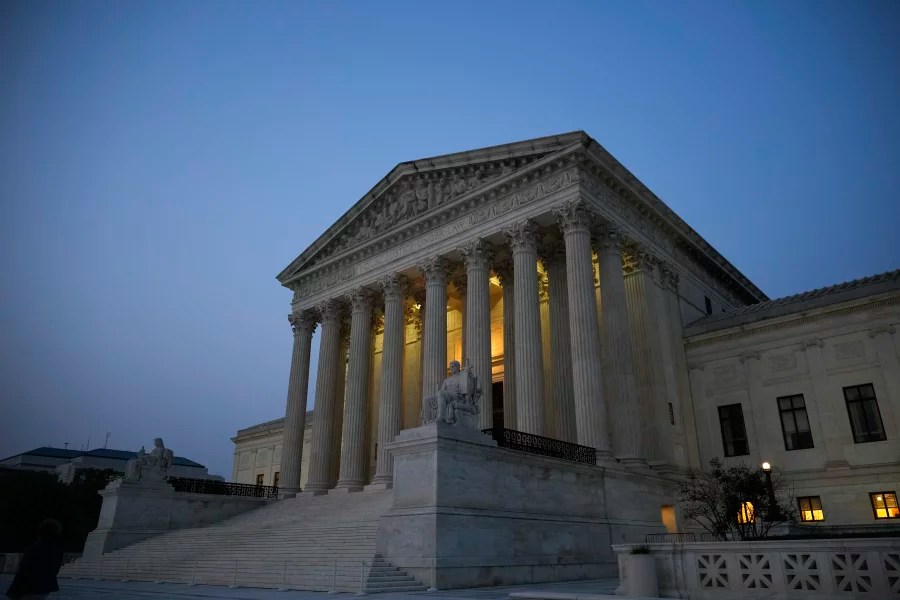
In all of this, he appears to have the Supreme Court on his side. Chief Justice John Roberts declared in a case some years ago that:

“The way to stop discrimination on the basis of race is to stop discriminating on the basis of race.”

For that tautology, liberals of course called him a racist. But he and a majority of the Supreme Court finally followed through in a case two years ago outlawing racial discrimination at the liberal establishment’s headquarters, Harvard University.

Of course, some schools and companies will simply provide false certifications. They will certify that they don’t engage in racial discrimination, even as they continue to. People who employ acronyms and euphemisms to disguise their actions can be expected to similarly employ lies to conceal those same actions.

But this is a start. And to put teeth into it, the President has at his disposal an entire Department of Justice which appears newly devoted to real justice – not the social kind.

Is it productive for Trump to push legal limits?

I won’t leave you in suspense. I’m a lawyer, so the answer is sometimes yes, sometimes no.

If you’re in the tribe that thinks whatever Trump does is wrong, or the opposite tribe that thinks whatever Trump does is right, then read no further. Just skip the analysis and instead warm up your cheers or your jeers for the Comments below, as your tribe dictates.

But if you’re in neither tribe, but are just a political partisan (which is different than being in a tribe) or a political neutral (are there any these days?) then read on.

It’s important to recognize at the outset that Presidents push legal limits all the time, and they often lose when the matter is adjudicated in the courts. The actions of Joe Biden’s administration were frequently struck down as being in violation of applicable laws or Constitutional provisions. That includes actions on important matters concerning the immigration laws, the environmental laws, the deference to administrative agencies, the wage laws, and student loan forgiveness.

Before you exclaim “Yeah, Biden was a crook,” be aware that this is something that just happens with Presidents, including Bush, Obama, Reagan and nearly every other one. Abraham Lincoln illegally suspended the Constitutional habeas corpus rules, thereby precluding wrongly imprisoned American citizens from seeking court reviews of their cases.

(All that said, Biden was indeed a crook.)

It would be a simpler world if the good guys and bad guys and all the rest of us always knew exactly what’s legal and what’s not. We’d just send the bad guys to jail when they did something that’s not. We wouldn’t need trials, courts, judges and juries.

But our world is complicated and fact-dependent, and so is the law.

That’s why I have no problem with President Trump testing the limits. If he didn’t, he wouldn’t be doing his job – a job I voted for him to do, three times (in three elections, I hasten to add).

A good example is the issue of birthright citizenship. The 14th Amendment appears to state that a person born in this country is automatically a citizen of the country, regardless of whether the mother is in the country legally.

But the Amendment contains a vague qualifier “subject to the jurisdiction thereof.” Trump’s argument is that this qualifying phrase excludes from citizenship a baby born in this country if its mother is here illegally. 

Although I hope Trump’s argument will succeed, I think it ultimately will not. But it’s a non-frivolous argument, and I would not be shocked if the Supreme Court ultimately buys it (though I would indeed be surprised).

In such a case, it’s fine for President Trump to make the argument. Let it go up to the Supreme Court, as Trump has requested, and let them decide the matter. That’s the way the system is supposed to work, and it nearly always does.

By the way, six of the nine Supreme Court Justices were appointed by Republicans who might lean toward Trump’s view of the matter.

(Here’s where you can complain that some of the Republican-appointed Justices are not “real conservatives.” Fine. But if that’s the case, then the blame lies with the Republican Presidents who appointed them – who was President Trump in his first term in the case of three of the six.)

Now here’s where things get dicey. What happens if Trump’s argument on birthright citizenship fails at the Supreme Court?

Trump himself has said he has no intention of violating court orders. That should end the matter. If it doesn’t, then we truly have a crisis, and I don’t mean that in a good way.

We had a hint of a crisis this week. The Department of Justice put Venezuelan immigrants alleged to be gang members on planes to deport them. There was apparently no contention that they were here legally, but there was also no due process finding that they were indeed members of the identified gang.

A judge ordered that they not be deported for another two weeks so that the matter could be given minimal due process. Meanwhile, the individuals were safely in the DOJ’s custody.

The judge at a hearing explicitly told the DOJ that they should instruct any planes already in the air to turn around. However, the judge’s subsequent written order did not include that instruction.  

Be aware that judges often issue orders orally. There’s no magic about reducing an order to writing.

But the White House has contended that the absence of the judge’s oral turn-around order in his written order meant that it was no longer in effect. Therefore, they say, they were free to let the planes proceed without intending any violation of the court’s order.

I find that argument dubious.

But I’m very glad they made that argument, rather than simply stating “We don’t follow court orders we don’t like from judges we don’t respect.”

That sort of belligerence would be unconstructive, and would cost Trump the support of most Americans. We’ve come too far to lose it all in an ill-advised cafeteria food fight.

Unfortunately, however, that’s the belligerence I’m seeing in some of the internet commentary from the tribe.

Let’s look at the big picture. In virtually all democracies (almost by definition), the final interpretation of laws is made by the judicial branch, not by an executive branch. The Constitution that we conservatives hold dear requires the executive to defer to the courts in interpreting the nation’s laws.

If the executive doesn’t like a law, his remedy is to get the law changed if the people’s representatives concur. It’s not to say “I can do whatever I want because the people elected me.”

That could be our system, but it clearly is not. If it were, then all the judges – and, for that matter, all the legislators – could just go home. But it would be to a very different home.

Glenn K. Beaton practiced law in the federal courts, including the Supreme Court.
Liberals lost their “cool”

Tesla electric cars were cool a few years ago. They signaled all the virtue of a Toyota Prius, but without the ugly body shape and C-O-E-X-I-S-T bumper sticker. And they were a lot faster.

Electric vehicle devotees – you probably know some – hailed the immigrant behind Tesla as an engineering genius and good green guy. His immigration to the United States was not illegal, but even that wasn’t held against him. He was the liberals’ favorite African-American since the Hawaiian dude.

That’s all so 2023.

Tesla cars haven’t changed much. They’re still electric, still look better than a Prius, still come without the bumper sticker, still get you 0 to 60 mph in the bat of an eye, and still get you 0 to $7,500 with a lightning-fast tax credit paid for by conservative schmucks driving F150s.  

But people didn’t buy Tesla’s for the car, or even the tax credit. They bought them for the cool. Liberals thought or at least believed that they could be cool by saving the planet, while being cool while showing people they were cool, while being cool.

How cool is that?

Ah, but their do-cool lacked due-diligence. Turns out, their darling EV immigrant from Africa is a Republican.

Egad!

And this Republican African-American (call him Uncle Elon) failed to mention his Republicanism when they bought the car.

Liberal buyers just assumed he was one of them. After all, only one of them would sell an overpriced car that might take hours to fill-er-up at electricity filling stations that are spaced wider apart than the car’s range – all for the sake of coolness.

But it turned out that this brilliant entrepreneurial scientist wasn’t one of them at all. Sure, he’d sold them exactly what he promised – a car deemed cool by the enviros – but he himself wasn’t enviro-certified.

By failing to inform his buyers at the point-of-sale that he was not a liberal, Uncle Elon had tricked them.

Liberals were then faced with a choice. Should they save the planet by driving an enviro-car made by a hated Republican, or save their coolness by ditching the car and nurturing their hate for the Republican?

Of course, they chose to save their coolness and nurture their hate. Liberals won’t let the damned planet stand in the way of their coolness and hate.

When it comes to their hate, they won’t even let the law stand in the way. They’re now vandalizing Tesla cars and torching Tesla dealerships.

To my way of thinking, that’s not cool.

There’s a broader point to be made. This Tesla trashing is a microcosm of something bigger. Liberals in general aren’t cool anymore.

Their peak coolness was with that Hawaiian dude. He was destined to stop the rise of the oceans (and he apparently did – they’re barely rising), save the planet, and “fundamentally transform” an America in need of it.

It went downhill from there. Joe Biden is remembered as a lazy, senile, corrupt doofus, stuffing his face with an ice cream cone. He was much worse than that, policy-wise, but you can get away with a lot of bad policy as a Democrat so long as you stay cool (see, Hawaiian dude). Joe didn’t.

Then, the Democrats hopped aboard the tranny train. At first, it seemed kinda cool. It reminded them of scenes they pretended to have participated in, like Woodstock and Selma.

But then the tranny thing got out of hand. There were pre-K tranny story hours, trannies in the girls’ bathrooms, and trannies beating and even crippling girls in sports.

Not cool. Trannies fell out of fashion.

Then, liberals decided to help poor, oppressed Latin Americans yearning to breathe free. All 664 million of them. Their help was in the form of abolishing the southern border to the United States, inviting them in, and giving them drivers licenses and welfare. A good many were criminals – even gang members.  

Not cool. Illegal immigrants fell out of fashion.

So, what do you do?

Well, if you’re a liberal, you figure you can recapture your coolness with a few new props. Ditch the Tesla (tell the insurance company it was stolen) and buy a Ford F150. Get one with monster tires and a big chrome grill, and be sure to tailgate the Tesla in front of you.

And if you’re a conservative, well, you don’t want to be caught dead in a F150. Trade it in for a Tesla. You can get a good deal right now. When the monster pickup behind you tailgates and flashes his lights at you, be sure to tap the brakes and give him the one-finger salute.

And the first one now will later be last, for the times, they are a-changin’

Robert Zimmerman

Chief Justice Roberts isn’t your hired gun

The Republican-appointed Justices on the Supreme Court are now six of the nine. Unsurprisingly, the ideological tilt of the Court is more conservative than it’s been in two or three generations.

It shows. Last year, the Court took the conservative side in reducing deference to administrative agencies; deciding expansively in favor of presidential immunity (which of course benefits both liberal presidents and conservative ones, but the particular case that was decided benefited a conservative one, namely Donald Trump); limiting the obstruction of justice laws (which could also benefit liberals, but the particular case decided concerned the Jan. 6 protestors); allowing the removal of vagrants from public property; and striking down a ban on “bump stocks” that are used to convert a legal semi-automatic rifle into something akin to a “machine gun.”

In the few years prior, the Court took the conservative side in outlawing affirmative action in universities; overturning Roe v. Wade; limiting the president’s power to cancel student loans; and siding with religion over gender rights.

But that’s not enough, some of our tribe are howling. Some of the six Justices appointed by Republicans are not toeing the party line, they complain.

Indeed, in a few recent cases, Chief Justice Roberts and Justice Amy Coney Barrett, in particular, and, to a lesser degree, Justice Kavanaugh, have failed to come out on the “right” side of cases. And so, they’re derided as something less than “real conservatives” because they have failed occasionally to vote with the conservative “block.”

The critics point to the three liberal Justices, who typically do vote as a “block.” Getting a fix on this, however, is not easy. As I noted above, sometimes it’s not obvious which side of the law is doctrinairely the liberal one and which is the conservative one, apart from the liberal and conservative litigants who happen to be litigating that particular case.

For example, if President Trump wants to do something in the next four years that is legally equivalent to canceling student loans, what people see as the “liberal” side and the “conservative” side of Presidential power could flip.

But I will admit that on other issues, the liberal and conservative sides are ascertainable apart from the identity of the particular litigants in the case. On those issues, it is fair to say that in recent cases the three liberals have pretty much voted as a block, while the six conservatives sometimes have not.

In support of that conclusion, one source notes that in the ten politically-charged decisions last year that were 5-4 decisions (meaning at least one conservative “defected”) the three liberals voted as a block every time, while the six conservatives split seven times.

Some in my conservative tribe shout that the conservative Justices should vote as a conservative block, just as the liberals vote as a liberal block. Fight fire with fire, goes the reasoning.

I see two problems with that approach. One is practical and the other is moral.

The practical problem, as I’ve already stated at least twice, is that it’s not always apparent which side of the law – apart from the particular litigants in that case – is the “conservative” side and which is the “liberal” side. Today’s case decided on an expansive reading of the Second Amendment could, tomorrow, present a compelling opposite decision on law-and-order grounds.

You see, individual rights – whether they’re Second Amendment or First Amendment or simply common law or statutory rights – do not exist in a vacuum.  For every “right” held by one person there is a corresponding obligation on other persons to permit the exercise of that right. One person’s right to free speech means other people have an obligation to hear or at least tolerate that speech.

That obligation sounds trivial, until the speech by one person that others are obligated to tolerate is speech advocating, for example, another Holocaust or a speech mocking a child’s disabilities or a speech that arguably incites violence or perhaps is defamatory or maybe it’s just simply untrue. 

The task of the law is to balance rights of one set of people with the obligations of the rest of the people.

It’s not easy. To say simplistically that conservatives stand for lots of “rights” for some people gets you nowhere, because it is to say, simultaneously, that they stand for lots of obligations for other people.

That’s the practical problem with demanding that conservatives vote as a block just because liberals do.

The moral problem is that we conservatives are better than that. In war – which, after all, is just politics in another form – one side sometimes commits war crimes. That does not justify war crimes by the other side. If it did, where would that end?

I’m glad Americans don’t commit war crimes just because our adversaries sometimes do, and I’m glad Supreme Court conservatives vote for the law, not for the litigants.

Mexico sues Smith & Wesson, Supreme Court shoots them down

One summer day in 1924, a train stopped at a station on Long Island. A man carrying a harmless-looking package ran to catch it. He struggled to board the train as it departed. One of the train employees on board reached for his hand as another on the platform gave him a boost from behind.

The package fell onto the tracks. It turned out to be a package of fireworks. The fireworks exploded. 

So, the exploding fireworks injured someone, right?

Not exactly.

The court opinion was written by Benjamin Cardozo, the brilliant judge who was then on the New York state supreme court (which they called, and still call, the New York Court of Appeals). Cardozo later became a storied member of the U.S. Supreme Court. In his words:

“The shock of the explosion threw down some scales at the other end of the platform, many feet away. The scales struck [Helen Palsgraf], causing injuries for which she sues.”

Today, of course, the phrase “injuries for which she sues” is redundant.

This case has been studied by generations of first-year law students. The legal question presented is, should the railroad be liable for Mrs. Palsgraf’s injuries?

Cardozo said the answer is no. People who are negligent are not liable for all the consequences of their negligence. They are liable for only those consequences that are reasonably foreseeable.

Cardozo seemed to accept for purposes of argument that the railroad employees were negligent in boosting the package-carrying man onto the train, and implied that the railroad might be liable if the package were labeled as combustible and the injury had occurred to that man.

But Mrs. Palsgraf was just too far away physically and causatively. The employees could not have reasonably foreseen (1) that their normal boost to a passenger carrying a harmless-looking package would knock the package out of his hands, (2) that the package would land on the hard tracks, (3) that the package would contain combustible fireworks, (4) that the fireworks would explode, (5) that the explosion would knock down heavy scales at the other end of the platform, (6) that the scales would fall onto Mrs. Palsgraf, and (7) that she would thereby be injured.

This principle in law is called “proximate cause.” A person committing a negligent act is generally liable for only the consequences that are “proximate” to that act – the ones that are reasonably foreseeable.

If the law were otherwise, imagine the weird outcomes. If you negligently run a red light, and three miles later someone jumps in front of your car, then you could be liable for his injuries. Because, after all, you would not have been at that exact spot at that exact time if you had not negligently run the red light three miles back.

Which brings us to Mexico.

Like America, Mexico has a gun violence problem. The guns are manufactured mostly in the United States, and smuggled illegally into Mexico. There, the guns are used by bad “we-don’t-need-no-stinkin’-badges” Mexicans to shoot good Mexicans.

Mexico has not been willing and able to address their gun violence problem any more than Chicago has. Putting gangsters in jail would cost them their votes, and might well cost them their lives.

So Mexico thought of another approach. They sued the American gunmaker Smith & Wesson back in 2021 for manufacturing and selling guns in the United States that were transported across the border into Mexico.

You see, Mexico is less interested in stopping gun violence by gun-toting gangsters who have, shall we say, “leverage” over the Mexican government, and more interested in profiting from the gun violence by taxing the manufacturers of the guns.

Mexico faced two obstacles in their case. First, there was the formidable Mrs. Palsgraf. The “proximate cause” between Smith & Wesson’s manufacture of the guns and the guns’ misuse by Mexican bandits was doubtful.  

Second, the United States had enacted legislation on this very point in 2005. Even if Mexico were to get past Mrs. Palsgraf, a law called the Protection of Lawful Commerce in Arms Act (the “PLCAA”) expressly insulates firearm manufacturers from blanket liability for the wrongful use of firearms that they legally sell.

Mexico filed suit anyway.

They didn’t file in San Antonio, which you’ll remember was the site of their last great victory over the Yanquis. And they didn’t file in Tennessee, where Smith & Wesson are located along with their friends Jack Daniels and Phillip Morris.

(Speaking of which, “Alcohol, Tobacco and Firearms” should be the name of a convenience store, not a government agency.)

Mexico instead filed suit in a federal district court located in . . . Massachusetts.

That was clever.

But it didn’t work. The District Court judge tossed the case.

Mexico then appealed to the federal court of appeals sitting in . . .  c’mon, you know . . . Boston.

That did work. The Court of Appeals reversed, in deciding that Mexico had a viable case.

Don’t think the fix was in at the Court of Appeals, however. The opinion was written by a judge appointed by a President with a distinctly un-Mexican name, Barack Obama.

Smith & Wesson then appealed to the Supreme Court, now dominated by six conservative-ish Justices, three of whom were appointed by our conservative-ish President. The Supreme Court is not in Boston and is not even in Massachusetts. These days, it’s in Heaven.

The formal opinion of the Supreme Court won’t be issued until around June, but the Justices were not exactly poker-faced at this week’s oral argument. The conservative Justices practically laughed at the arguments of the American lawyer who represented Mexico.

Even two of the three libs asked questions that seemed hostile to Mexico’s case. That included a Justice who is liberal but (or is it “and”?) very smart, Justice Kagan.

What’s the lesson? Sometimes, the wheels of justice turn slowly, but grind exceedingly fine. Adios amigos.

Glenn K. Beaton practiced law in the federal courts, including the Supreme Court.
Was Michelle Obama a DEI bride?

I have nothing against Michelle. The media tells us that she’s pretty, she’s smart, she’s accomplished, and I’m sure she’s charming. As her husband said about Hillary Clinton, she’s “likable enough.”

OK, I’ll admit that I didn’t particularly like her comment that the first time she was proud of America was the night Barack was elected. Surely there was a time in her first 45 years before then that she felt some pride in America. How about when the 1980 Olympic Hockey Team beat the Russians? How about when we put a man on the Moon? How about when we passed the Civil Rights Acts? 

In any event, I always thought she could have congratulated her husband for being elected President of the nation without gratuitously insulting that nation. If she truly thought so little of the nation that she’d never before been proud of it, how could she be proud that he’d been elected President of it? 

And how could the incoming First Lady be so rude to the country? A more gracious statement still true to her feelings might have been something like “I was so proud of America that night.”

Also, I think the media fawning over her beauty was a bit overdone, to the point that it seemed racially condescending to me. Beauty is in the eye of the beholder, but to my eye she is not as beautiful as Jackie Kennedy was. But, for that, blame the media and their eyes for their contrary judgment, not Michelle. 

As for Michelle’s considerable accomplishments, one was indeed comparable to Jackie’s — it was to marry well. Michelle married a bright, rising politician by the name of Barry Soetoro. 

Soetoro had been born to an 18-year-old white woman and an older Kenyan man who abandoned them. He grew up in Hawaii as a mixed-race boy of a white mother. 

Soetoro became interested in politics, particularly the ethnic type. In that, his white mother — his only parent that was present — was a liability. Being half Black was an asset, but only a half-ass-et. 

With a touch of the self-promoting genius he was to display throughout his career, he changed his name to “Barack Obama,” taking his missing father’s Kenyan name. And he decided he “identified” as all Black.

In one of the self-promotion books he later wrote, he even stated in the preface that he had been born in Kenya. When that became problematic — nay, disqualifying — in his campaign for the Presidency, he “explained” that the preface had been written by someone else and he’d never read it. 

Uh huh. It’s surprising that the press let him get away with that explanation, until you realize that this same press later dismissed the Hunter laptop as fake and assured us that Joe Biden was sharp as a tack. 

This guy now going by Barack had a talent for riding the early 2000s wave of liberal white guilt. Chameleon-like, he could be what he really was — a mixed race kid from Hawaii — or, on demand, he could drop his g’s and be shuckin’ and jivin’ with the bros. 

Hillary might have been likable enough, but Barack was Black enough. And in the year 2008, Black was better. 

Barack had foreseen it all, early on. And he had already orchestrated the show.

There was one problem. Barack had several girlfriends before he got married. The thing in common was . . . they were white. 

That presented a problem because this guy had consciously reinvented himself as a Black leader with a white personality, someone who could garner Black votes with his Blackness while garnering white liberal votes with his whiteness.

So Barack let the white chicks go. Bad fit for his career ambitions. He substituted a bright young lawyer, Michelle. She was ambitious, almost as much as he. And very much Black.

He married her. He won the Presidency. He won the adulation of the media. He won that thing he imagined was ever-arcing toward him — history.

Now in his post-history, his post-presidency, his post-Blackness, and perhaps his post-marriage, he might have won Jennifer Aniston. The rumors are thick that the two of them are an item. Liberal “fact-checker” Snopes says there’s “no evidence” of it, even as they reference numerous insiders who swear it’s true. (When Snopes wants something to be false, the evidence of it is always deemed not evidence. What do they want, a stained blue dress?)

Moreover, there’s a dog that didn’t bark. Michelle was mysteriously absent from two big political events — the inauguration of Donald Trump and the funeral of Jimmy Carter, both of which were attended by everyone who’s anyone, but which Barack attended alone. 

The only question now is, will he change his name back to Barry Soetoro?