
Just give poor people more money

Socialists think poor people have too little money, and rich people have too much.

I happen to think the truth is somewhat the opposite. A big problem is that poor people in America have too much money despite their proven inability to manage it.

Poor people consume monster meals and quart-sized sodas at McDonalds, lease gas-guzzling trucks that are too big for the road, buy lousy food that is too much for them to eat, and get 100” TVs even though there’s nothing on.

But for purposes of the discussion, let’s accept the premise: Poor people have too little money.

Let’s start the discussion with the fact that poor people pay hardly anything in federal income taxes, after considering their low tax rates and credits like the childcare credit. In fact, the top 1% of earners pay about 40% of federal income taxes – much more than any honest calculation of their “fair share” – and the bottom 40% pay practically nothing.

So, it doesn’t help poor people to reduce their taxes. You can’t go lower than zero on their income taxes. So, what to do?

The answer is, do go lower than zero. In other words, give them money. It won’t make them happy for long, but at least it beats the alternative.

That alternative is free stuff. Such as free college tuition, free or subsidized housing, cheap food at government grocery stores (but only if you show an ID, which we are told racial minorities don’t possess, and so racial minorities have to starve), fake “work” from home four days a week, three-day weekends on the other days, food stamps, flip-flops in the office, and purple hair with nose piercings.

OK, it’s not clear that society currently subsidizes purple hair and nose piercings. But it’s more than enough that we tolerate it.

However, here’s where it gets interesting. The Left doesn’t want to give money to poor people. Money is too fungible. Next thing you know, they might be spending it intelligently. They might even – shudder! – save it.

Instead, the Left wants to provide free stuff in lieu of money. That serves two purposes. One, it mandates that the poor recipient will use it for the purpose that the left wants, which is usually amusement. Bread and circuses, you know.

I’m reminded of the discount given to “seniors.” I’m part of the richest demographic in the history of the world. Why do they condescend me with a $3 discount for the city zoo? It’s not because I need the discount. It’s because they think it buys my vote. I’m here to tell you, my vote is not for sale for $3. It’ll take at least $5.

Two, and more importantly, it empowers the Left. The Left gets to control who receives the free stuff, the Left gets the credit for the free stuff, and the Left gets its big cut of the free stuff in the form of administration.

Do you think I’m kidding? The administrative staff at America’s colleges has grown by double to quadruple the faculty staff in the last generation. What the hell are all these staffers doing?

It’s a lot like the mafia.

I have an offer they can’t refuse. Cut out all these Lefty administrators and all these attached strings and just give the poor people the frickin’ money.
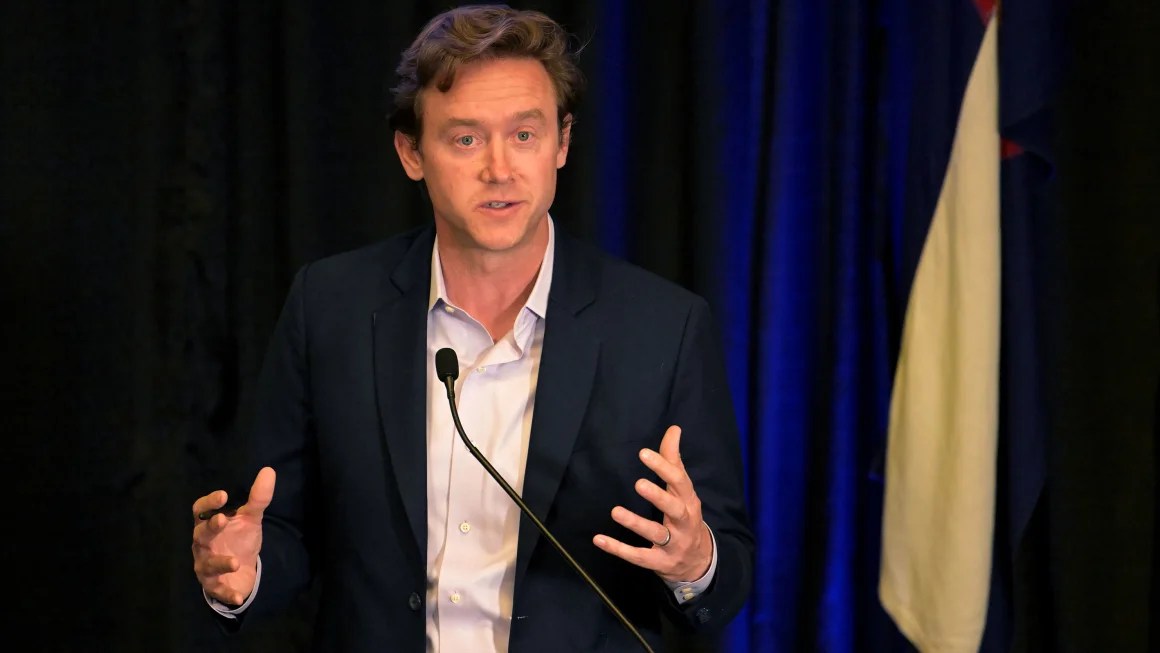
 Denver’s mayor is out to lunch – but he might be the only one

Have you seen the Denver restaurant scene? Me neither. It’s dead and gone.

In a one-year period, the number of restaurants in Denver declined by 183. Of all the restaurant closures in Colorado last year, 82% were in Denver – a place that has only about 12% of the population of Colorado.

Average profits at the few surviving Denver restaurants are only 3-5%. Anyone who dines out knows that this isn’t because prices are down. It’s because costs are up. Restaurant wages in Denver are up 89% since 2019.

The main reason is Denver’s minimum wage of $18.81/hour for ordinary workers and $15.79 for tipped workers. For comparison, in New York City the minimum wage for both is $16.50.

That’s right, the minimum wage for ordinary workers in Denver such as kitchen staff is much higher than in New York City, and for tipped workers such as servers it’s almost as high. For both, it’s higher in Denver than in Aspen.

The mayor has a solution for the unprofitability and resulting demise of Denver restaurants. His solution is . . [drum roll] . . . to slap an extra tax on your tab to make dining out even more expensive.

He proposes tacking a 20% surcharge onto every restaurant tab. The proceeds, he says, would be distributed not to the restaurant owners, but to the non-tipped restaurant staff – the kitchen workers who already enjoy a 20% higher minimum wage than the tipped staff. He says the system that has ruled restaurants forever, where servers who are tipped for good service often take home more money than kitchen staff who are not, is “inequitable.”

That’s not what the market says. The market says the tipped servers have a combination of people skills, hard work, charm, and the ability to remember the orders of half a dozen patrons at once, that makes them very valuable. In other words, they merit more money for their work because their work has more merit.

But what does the market know in comparison to the mayor of Denver? You see, we can’t let merit as defined by the market get in the way of “equity” as defined by the mayor.

As is usually the case with socialist redistribution schemes, there’s a sneaky something in this for the government, too. The 20% surcharge would be “topline” and so the city and state sales tax of 8.81% would apply to it.

That’s right, the city would tax their own surcharge – they would tax their own tax. The total surcharge would thus amount to 20% plus 8.81% of 20%, for a total of almost 22%.

Unsurprisingly, the Colorado Restaurant Association is not thrilled about the mayor’s proposal, to put it mildly.

“It’s government policy that is causing the problem in the first place,” said one member of the Association. “Basic economics tells you that when you want to encourage sales, you lower prices — not add 20% more plus tax to everyone’s costs,” said another. “This won’t fill restaurants any more than raising rents would fill empty office buildings,” said a third.

The remark about empty office buildings in Denver hits another nerve, which I’ll save for another column.

The mayor is on quite a roll. Last year, he spent zillions of dollars of Denver taxpayer money on two pet projects: Attracting more illegal immigrants and attracting more vagrants. He succeeded in both.

Along the way, he taunted the federal immigration authorities. He said after the election that he was willing to get himself arrested and sentenced to prison for interfering with their enforcement of the nation’s laws. He boasted that his little insurrection might put him on the wrong side of the law, but the right “side of history.”

Sounds a little like another Democrat from another era, Bull Connor.

The response of the Feds was along the lines of “Make my Day.”

The mayor’s vanity projects don’t come cheap, and money is scarce, especially as the mayor risks losing federal grants. After spending millions on vagrants and illegals, Denver lacks money to pay for basic services such as parks and libraries.

But the mayor has a solution to that problem too. He proposes to borrow money.

Notice the shell game here. The mayor took ordinary city funds that would ordinarily be spent on ordinary city services, redirects them to spend on illegals and vagrants instead, and then seeks to borrow money to replace those ordinary funds in order to fund the ordinary city services.

Does he imagine that we’re unable to see that the economic reality is that he’s borrowing money to pay for the illegals and vagrants?

The mayor didn’t say how much he wants to borrow, as he doesn’t want to lock himself into an amount that he’ll then exceed. It’s like the Left’s reply when you ask them to put a number on the “fair share” that people who have more money than they do should pay in taxes. Their number is “more.”

I don’t usually resort to name-calling. It’s a primitive form of debate, it’s not very persuasive, and it’s not very enjoyable. The most important Latin I learned as a lawyer was res ipsa loquitur.

But I’ll make an exception here. The mayor of Denver is a nut job.