
The Trump administration has heralded a decline in violent crime in the past few years. America is a safer place.
We’re told that this should be credited to Republican policies for greater law enforcement and more vigorous criminal prosecution. That may be so. I’m certainly in favor of both those policies. But maybe there’s also another factor at work.
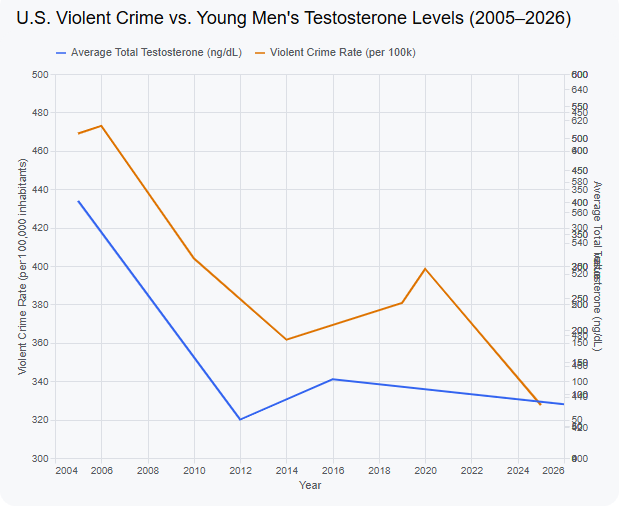
The graph* above shows a clear correlation between declining violent crime and declining testosterone levels. To be sure, there’s an exception around the year 2020 where violent crime spiked but testosterone levels did not. It’s safe to say the spike in violent crime at that point was due to something other than a spike in testosterone levels.
Gee, what could be the reason for the spike in violent crime around 2020? Oh yeah. There was a worldwide pandemic where the Biden administration and many Democrat-controlled cities shut down law enforcement.
Apart from this Covid pandemic crime spree, the correlation is clear.
Now, of course, correlation does not equal causation. Just because a decline in violent crime correlates with a decline in testosterone does not mean that the decline in testosterone caused the decline in violent crime. Logically speaking, it could just as well be the reverse – that the violent crime reduction caused the testosterone reduction. (Are they still castrating criminals?) Or it could be that both were caused by some other factor (but I can’t imagine what) or that each was caused by different factors.
But nonetheless, we’re left with the correlation.
In this particular case, there are reasons to think that correlation does equal causation. Testosterone is the male hormone that is responsible for dense muscle mass, risk-taking and road rage.
Testosterone is the main reason that males are far more likely than females to engage in mountaineering, car racing, entrepreneurialism, Seal Team 6-ing, boxing, exploration – and violent crime.
The males most likely to engage in violent crime are the young ones, in whom testosterone levels are the highest. And among young men, young Blacks are far more likely to engage in violent crime than young whites. Is it any surprise that young Black men tend to have higher testosterone levels – and incarceration levels – than young white men?
That said, let me also say that I’m a fan of testosterone, despite (or maybe because of) its mucho-macho side. In fact, the phrase “testosterone poisoning” makes me want to punch someone. But I have to admit, there are benefits to having less of the stuff. And detriments.
*The graph was generated at my request by AI using data from the FBI on violent crime and from the NIH on testosterone levels. I should mention that AI does not buy my theory because . . . sociology. In any event, cursory research finds that no one has noted this correlation. The contrarian in me says that proves it’s right. If you disagree, let’s settle it outside.
 the Aspen beat