

Ready-Fire-Aim! Virginia Democrats shoot themselves in the foot

The latest battle in the gerrymandering wars took place in Virginia. The Democrats in Virginia had all the guns – they control the governorship, the legislature and a majority of the voters. In a classic example of “Ready-Fire-Aim,” the Democrats promptly used those guns to shoot themselves in the foot.   

It all started a few years ago, back when Virginia was a purplish state. Voters approved an amendment to the state constitution to establish a non-partisan procedure for drawing Congressional Districts. That procedure produced Districts that resulted in a Democrat-Republican split in the elected Representatives of 5-4, which is approximately the same as the split in Virginia voters. So far, so good.

Then Virginia gradually shifted blue. Last fall, Virginia Democrats joined the gerrymandering wars. As is often the case with wars, it started with the political equivalent of stirring songs, glitzy parades, and predictions of victory in a month.

The Democrats figured that with a little creativity and an utter absence of shame – the absence of which has never been in short supply among politicians – they could gerrymander the Districts to shift the 5-4 split in their Congressional delegation to a 10-1 split.

They would be heroes! (And maybe some of them would fill those five new Democrat Congressional seats!)

Sure, it would take another amendment to the state constitution in order to nullify the one from a few years ago that established the non-partisan procedure for drawing Districts. But, as the Democrats reminded themselves, they controlled the three bodies that approve such amendments – the legislature, the governorship and the voters.

Constitutions contain procedures for amending them. The Virginia constitution stated that the legislature is supposed to approve the amendment twice. In between those two approvals, there’s supposed to be an election of the legislature. Only after those two legislative approvals and that intervening election, can the matter be put to the voters in a referendum.

There’s method behind this redundant madness. The thought is that, after the legislature approves the amendment the first time, the voters should get a chance to dis-elect the legislature that approved the amendment. And then the new legislature has to re-approve the amendment.

A constitution is a sacred thing, you see, even if it’s just a state one. Amendments to it are not to be taken lightly.

This is where the Democrats misfired. They got the requisite approval accomplished in the state legislature which they controlled, but the approval came after early voting had already begun on the requisite election of the legislature. In fact, about 40% of the votes had already been cast for that election.

After the election, they got the requisite second approval from the new legislature, and then they narrowly got the approval of voters in a referendum.

The matter went to the Virginia Supreme Court. This week, that Court held that the first approval by the legislature did not occur before the election of legislature, because at the time of that approval the election was already underway and 40% of the voters had already cast their ballots.

In effect, therefore, there was no “election day,” but rather an “election period.” The Democrats mistakenly failed to accomplish the requisite legislative approval for the amendment prior to the commencement of that election period. The result was that 40% of the voters were denied the opportunity to consider that approval in weighing their votes in what was supposed to be a subsequent election.

The matter cannot be reviewed further by the U.S. Supreme Court, because it is purely a matter of state law. The Virginia Supreme Court is the final authority on the subject. The Democrats could start again from square one in Virginia, but it’s too late for the upcoming mid-term election.

There’s a certain poetic justice in this. Democrats like loosey-goosey election procedures such as early and absentee voting for any and all. This time, it shot them in the foot and blew up in their faces. They will use this experience to advocate for gun control, no doubt.

Ending racial gerrymandering ends a failed scheme where legal rights were allocated by race

Imagine a system where arrests, convictions and sentencing for the crime of murder had to be in proportion to the racial composition of the population.

Since Asians are about 7% of the population, the murder arrests, convictions and sentences for Asians in such a scheme would have to be 7% of the total.  Likewise, since Blacks, Latinos and whites make up about 13%, 19% and 62% of the population, respectively, they’d have to account for 13%, 19% and 62% of the murder arrests, convictions and sentencing.

At first glance, that sounds reasonable. But of course, it is not.

The reason is because those four races commit murder at dramatically different rates. FBI data show that whites (if you include Latinos/Hispanics as whites) comprise 82% of the population but commit only 46% of murders. Asians comprise 7% but commit only 1% of murders. (Latinos/Hispanics apart from whites comprise 19% and commit 20% of murders.)

So, who is committing all the murders that whites, Asians and Latinos are not?

Blacks are. Blacks comprise 13% of the population, but commit 51% of murders in the country. If you do the math, the statistical likelihood of a Black person being a murderer is quadruple the likelihood of a white person being a murderer, and roughly 22 times the likelihood of an Asian being a murderer.

A few tangential points are worth your attention. One, this high Black murder rate accounts for a large part (but not all) of the high overall murder rate in America as compared to Europe.

Two, the victims of these Black murderers are also mostly Black themselves. Black-on-Black violent crime in America is, tragically, extremely high.

Three, a few people would contend that Blacks don’t really commit murder at a high rate (though they cannot dispute that they die of murder at a high rate since, after all, there’s a Black body to prove it).

Those people would say that these statistics to the contrary are instead proof that the justice system racially discriminates against Blacks in arresting them, convicting them and sentencing them for crimes they did not commit (but, interestingly, does not discriminate against Latinos or Asians). Nobody really believes that contention – even the people saying it – so I won’t address it.

And four, an interesting tidbit is that the number of men we arrest, convict and sentence for murder is several times the number of women, even though the two sexes are about 50/50 in the population. Does anyone seriously contend that men are victims of sex discrimination in the field of murder arrests?

Back to our hypothetical. A scheme where people must be arrested, convicted and sentenced for murder in proportion to their racial representation in the population, even though murders are not committed in that same proportion, is undeniably unjust and probably criminal.

We would have to arrest many more whites and a lot of Asians for murders they didn’t commit. And we would have to leave un-arrested a lot of Blacks for murders they did commit, all to achieve our fantasy of racially proportionate representation in the law of murder.

This superficially appealing but fundamentally unfair concept of racially proportionate representation in the law brings us to another area of law – the way we elect Congress.

The country is divided into Congressional Districts of equal population – about 762,000 people each. Each district gets one representative. That amounts to the 435 members of the House of Representatives.

Each district typically elects a House member of the party that controls the district. Only 10-15% of the districts are actually competitive. (That’s why members of Congress are seldom voted out of office.)

Because populations shift, the districts must be redrawn periodically. That’s done by state legislatures. In doing so, the legislatures often “gerrymander” the districts. That is, they draw weird-shaped districts in order to distribute the population such that each district has a slight majority of the party doing the drawing. In a state with a 55/45 split between the two parties, the party in power can easily achieve an 80-20 split in the House members elected from that state. There’s more about gerrymandering HERE.

Gerrymandering has been going on for a long time, overtly or covertly. It’s unseemly and might be unfair, but it’s part of our system of representative government. The Supreme Court allows it, because there’s nothing in the Constitution to prohibit it.

But when the gerrymandering is done for the purpose of racial discrimination, there are special rules that have evolved and changed. For a while back in the Jim Crow days, the Democrats who controlled the South racially gerrymandered the districts in a way to prevent the election of Black representatives.

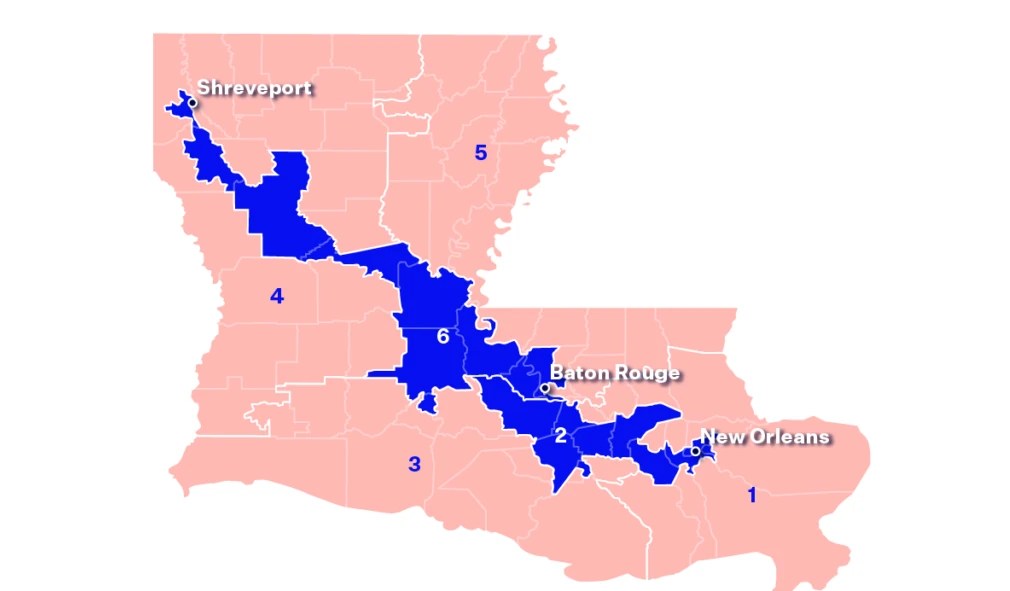
That wasn’t difficult. Even in Louisiana which is about 30% Black, they simply drew the districts such that no district had anywhere close to a majority of Black voters. Divide and conquer was the strategy. The result for many years was that there were none or very few Black members of Congress.

That changed in the last half of the 20th century with the passage of the Voting Rights Act and numerous legal challenges to districting. In fits and starts, judges gradually concluded that the VRA together with the Equal Protection Clause of the 14th Amendment required that a state’s Congressional delegation be Black in proportion to the Black population of the state. In Louisiana, that meant that two of their six representatives should be Black since about 30% of the state population was Black.

That was achieved with gerrymandering. They drew two “majority minority” districts that concentrated the 30% Black population. The resulting districts had a weird shape, but there was some assurance that two Blacks would get elected in those two mostly-Black districts.

It was something like affirmative action. When the number of Blacks qualifying for prestige colleges and jobs was not “enough,” society put its thumb on the qualifications scale. Similarly, when the number of Blacks getting elected to Congress was not “enough,” society put its thumb on the election scale. For a while, Lady Justice peeked to check which race she was judging.  

There’s an expression in law that hard facts make bad law. Imagine a case where a child is run over and crippled after darting into a passing car. The law says the driver was not at fault but our emotions want to help that child, and so we bend the law to obtain a result that’s emotionally satisfying but legally bad.

In racial gerrymandering, the hard fact was that not many Blacks were being elected to Congress despite a significant sentiment that Congress should have more. The bad law that resulted was divvying up Congressional districts by race.

Allocating representation in Congress by skin color is almost as bad as allocating arrests, convictions and sentencing in murder cases by skin color. It denies our individuality. It assumes that Blacks will and should vote only for Blacks while whites will and should vote only for whites. To the extent those assumptions are unfortunately accurate, the effect is to further drive people apart racially. It is all founded on a destructive us/them view of race.

Moreover, this racial divisiveness is self-perpetuating. Politicians become motivated to reinforce their constituents’ destructive beliefs that they can only be represented by a member of their own race, not “the other” race.

In short, racial gerrymandering is founded in racism, and it promotes more racism.

In my upcoming final installment of this series, I’ll discuss the Supreme Court’s landmark ruling last week abolishing racial gerrymandering. It’s the most boldly correct and politically consequential decision in years. And I’ll discuss the media’s disgraceful reporting on it.

A primer on gerrymandering and race discrimination

The 435 members of the House of Representatives represent the people of specific geographic areas. Those areas are drawn up to include equal populations.

The population of a Congressional District is currently about 762,000 people. The intent is for each citizen and 762,000 of his close friends to have a voice in Congress.

This necessarily means that Congressional Districts have vastly different geographic sizes and shapes reflecting different population concentrations. Alaska has only one Congressional District covering the entire sparsely populated state, while one of the 26 Congressional Districts in New York State is just a few square miles of densely populated Manhattan.

Because populations change and shift, Congressional Districts must be redrawn periodically. (It’s different for the Senate where each state gets two Senators regardless of population, and the boundaries of states don’t change.)

The natural question is, who draws up these ever-changing Congressional Districts?

A computer program could do it in milliseconds. Give it a few factors to consider such as natural geographic boundaries, and then ask it to draw up random equal-population globs on the map.

Ah, but simplicity and logic in government are usually subordinated to the political needs, incompetence and corruption of politicians.

In the case of drawing up Congressional Districts, those politicians are among the worst of their kind – state legislators. You know, those brilliant statemen who take a few months off from their ordinary jobs as rocket scientists and brain surgeons in order to inflict on the population of their state whatever legislation best meets the needs of their donors.

The needs of their donors can be summed up with: “Maximize my power by maximizing my political party.”

The legislators thus draw up districts that favor their party. A seventh grader from yesteryear, or a PhD from today, can see how this is easily done. You simply draw the districts so that the majority party has a majority not just in the state as a whole, but in each district.  

Say a state has a population of 7.62 million, with a total number of Congressional Districts of 10 (because 7.62 million people divided by 762,000 people per district equals about 10 districts). Say further that about 3.16 million are Republicans and the other 4.46 million are Democrats (or at least tend to vote that way) for a party split of about 60/40 between Democrats and Republicans.

In an ideal world, the districts might be drawn such that the party split between Democrat and Republican Representatives is about the same as the party split between Democrat and Republican voters – about 60/40 – and so there would be 6 Democrat Representatives and 4 Republican ones.

In the real world, however, here’s where it gets mischievous. In my example, the state legislature is probably controlled by the Democrats, since 60% of the voters are Democrats.

That Democrat legislature will be motivated to “gerrymander” the Congressional Districts to maximize the number of Democrat Representatives and minimize the number of Republican ones.

They achieve this by drawing the Congressional Districts in such a way that Democrats have at least a small majority in every Congressional District. If a map shows a Republican majority in a district, then they shift the geographic boundary of that district to borrow from an adjoining district where the Democrat/Republican split is more favorable. The outcome can be weirdly-shaped districts, such as shown on the above map of Louisiana.

Gerrymandering is always possible, because a statewide political split won’t be reflected in every county and every precinct. Rural counties tend to lean Republican, while urban counties tend to lean Democrat. If the legislature needs a few more Democrats in order to have a majority in a rural district, just shift the district boundary to borrow some from the nearby city.

In my example, that could mean the ten districts in the state wind up with Democrat/Republican splits of something like 55/45, 60/40, 57/43, 62/38, and so on. With their 60/40 overall advantage, the Democrats have plenty of votes to spread around in order to have a majority in each of the ten districts.

This result is odd, and arguably not intended by the Founders. In a state where Republicans have 40% of the voters, they wind up with zero Congressional Representatives. And, of course, they wind up with zero Senators as well, since Senators are elected statewide in this state that is 60% Democrat. Millions of Republicans in a Blue state can be left with no representation in Congress.

In my example above, Democrats are the gerrymanderers. But a recent example of gerrymandering was by Texas Republicans who, spurred on by President Trump, gerrymandered their state to shift about 5 House seats from Democrat to Republican. Democrats are poised to return the favor in Virginia and California, while Republicans are poised to re-return the favor in Florida. We have full-on gerrymandering wars.

Gerrymandering is a volatile issue. It seems at odds with representative government because it allows the majority party to not just out-vote the minority party, but to lock them out of government altogether, at least in a given state’s Congressional delegation.

In the preceding paragraph, I used “minority” in the numerical sense, as in the “minority party” as distinct from the “majority party.” When “minority” is used in gerrymandering in the racial sense, the matter becomes not just volatile, but explosive. That’s the subject of a long-overdue Supreme Court decision this week, which I’ll discuss in my next column.