A primer on gerrymandering and race discrimination

The 435 members of the House of Representatives represent the people of specific geographic areas. Those areas are drawn up to include equal populations.

The population of a Congressional District is currently about 762,000 people. The intent is for each citizen and 762,000 of his close friends to have a voice in Congress.

This necessarily means that Congressional Districts have vastly different geographic sizes and shapes reflecting different population concentrations. Alaska has only one Congressional District covering the entire sparsely populated state, while one of the 26 Congressional Districts in New York State is just a few square miles of densely populated Manhattan.

Because populations change and shift, Congressional Districts must be redrawn periodically. (It’s different for the Senate where each state gets two Senators regardless of population, and the boundaries of states don’t change.)

The natural question is, who draws up these ever-changing Congressional Districts?

A computer program could do it in milliseconds. Give it a few factors to consider such as natural geographic boundaries, and then ask it to draw up random equal-population globs on the map.

Ah, but simplicity and logic in government are usually subordinated to the political needs, incompetence and corruption of politicians.

In the case of drawing up Congressional Districts, those politicians are among the worst of their kind – state legislators. You know, those brilliant statemen who take a few months off from their ordinary jobs as rocket scientists and brain surgeons in order to inflict on the population of their state whatever legislation best meets the needs of their donors.

The needs of their donors can be summed up with: “Maximize my power by maximizing my political party.”

The legislators thus draw up districts that favor their party. A seventh grader from yesteryear, or a PhD from today, can see how this is easily done. You simply draw the districts so that the majority party has a majority not just in the state as a whole, but in each district.  

Say a state has a population of 7.62 million, with a total number of Congressional Districts of 10 (because 7.62 million people divided by 762,000 people per district equals about 10 districts). Say further that about 3.16 million are Republicans and the other 4.46 million are Democrats (or at least tend to vote that way) for a party split of about 60/40 between Democrats and Republicans.

In an ideal world, the districts might be drawn such that the party split between Democrat and Republican Representatives is about the same as the party split between Democrat and Republican voters – about 60/40 – and so there would be 6 Democrat Representatives and 4 Republican ones.

In the real world, however, here’s where it gets mischievous. In my example, the state legislature is probably controlled by the Democrats, since 60% of the voters are Democrats.

That Democrat legislature will be motivated to “gerrymander” the Congressional Districts to maximize the number of Democrat Representatives and minimize the number of Republican ones.

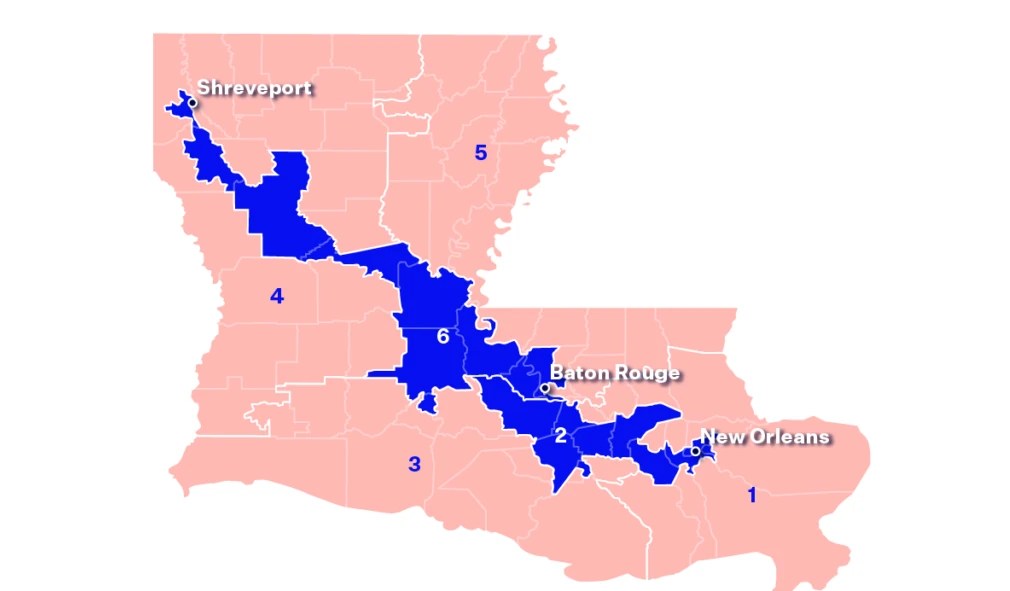
They achieve this by drawing the Congressional Districts in such a way that Democrats have at least a small majority in every Congressional District. If a map shows a Republican majority in a district, then they shift the geographic boundary of that district to borrow from an adjoining district where the Democrat/Republican split is more favorable. The outcome can be weirdly-shaped districts, such as shown on the above map of Louisiana.

Gerrymandering is always possible, because a statewide political split won’t be reflected in every county and every precinct. Rural counties tend to lean Republican, while urban counties tend to lean Democrat. If the legislature needs a few more Democrats in order to have a majority in a rural district, just shift the district boundary to borrow some from the nearby city.

In my example, that could mean the ten districts in the state wind up with Democrat/Republican splits of something like 55/45, 60/40, 57/43, 62/38, and so on. With their 60/40 overall advantage, the Democrats have plenty of votes to spread around in order to have a majority in each of the ten districts.

This result is odd, and arguably not intended by the Founders. In a state where Republicans have 40% of the voters, they wind up with zero Congressional Representatives. And, of course, they wind up with zero Senators as well, since Senators are elected statewide in this state that is 60% Democrat. Millions of Republicans in a Blue state can be left with no representation in Congress.

In my example above, Democrats are the gerrymanderers. But a recent example of gerrymandering was by Texas Republicans who, spurred on by President Trump, gerrymandered their state to shift about 5 House seats from Democrat to Republican. Democrats are poised to return the favor in Virginia and California, while Republicans are poised to re-return the favor in Florida. We have full-on gerrymandering wars.

Gerrymandering is a volatile issue. It seems at odds with representative government because it allows the majority party to not just out-vote the minority party, but to lock them out of government altogether, at least in a given state’s Congressional delegation.

In the preceding paragraph, I used “minority” in the numerical sense, as in the “minority party” as distinct from the “majority party.” When “minority” is used in gerrymandering in the racial sense, the matter becomes not just volatile, but explosive. That’s the subject of a long-overdue Supreme Court decision this week, which I’ll discuss in my next column.

Even the Californians are fleeing Colorado – go figure

Last year, more people moved out of Colorado to other states than vice versa. Interstate “net migration” was negative.

After factoring in births, the state’s overall population increased less than half a percent. That’s the lowest since the oil and gas bust of 1989 nearly a half century ago.

These figures put Colorado in the bottom half of population growth. We’re 29th of the 50 states. Neighboring Utah grew at the fifth-highest rate, so Colorado can’t blame it on the demise of the carbon-spewing, environment-wrecking, injury-causing, traffic-jamming ski industry which is mired in a record snow drought.

Colorado used to be cool. It was young, vibrant, virile. Colorado often led the nation in the youth and fitness of its residents.

It was the state to move to. Hardly anyone was born here. Even I wasn’t, though I’ve lived 90% of my life here. If you said you were born here, you were either a cowboy or a liar. (Nobody is both.)

Like a lot of low-density farming and ranching states, Colorado was a red state before “red state” was coined. Then it was a purple state for a brief transition in the late 20th century. Now it’s a deep blue state.

Colorado has not had a Republican governor for 19 years. The next one won’t be, either. The state legislature is overwhelmingly far-left Democrat, and routinely passes full-blown whack-job legislation that even the Democrat governor opposes.

All seven of the state Supreme Court Justices are Democrat appointees (who became a laughing stock after the real Supreme Court issued a 9-0 smack-down of their disqualification of Donald Trump from the 2024 state ballot).

Colorado College, once a gem of a liberal arts college, has fallen to a ranking of 370 in the latest Wall Street Journal college rankings, which puts it somewhere between Howard (that’s spelled with a “ow” not a “arv”) and the University of Alabama.

Alumni donations to the school are down as well. Perhaps all this has something to do with the fact that CC’s obsession with DEI (call it CC-DEI) drove them over a cliff into abandoning the SAT.

That’s right, today’s CC students get admitted not with test scores, but with skin color. The SAT was an inconvenient obstacle to that.

Needless to say, most sizeable Colorado cities including Denver (ruled by Democrat mayors for the last 73 years), Boulder, Fort Collins, Longmont, Lakewood, Durango and Greeley are “sanctuary cities” where local law enforcement is prohibited from cooperating with federal officials enforcing the nation’s immigration laws.

So how did Colorado go from paradise to parasite?

It’s not because the politics of the people changed. Rather, it’s because the people themselves changed. Back when Colorado was a hip place to move to, the hipsters moved here in droves. Hipsters, in case you haven’t noticed, tend to be Democrats.

Legalizing pot in Colorado also helped. In case you haven’t noticed, heavy pot smokers tend to be Democrats, as well.

Swarms of Democrats fled the hell of Democrat-controlled California. Utterly devoid of any perception of cause-and-effect (notwithstanding their preaching about “science”), they bring with them the Democrat policies that caused the hellish effect that they fled in California to inflict on the heavenly refuge of Colorado.

It’s the same everywhere. Californians flee their self-made hell but ignorantly bring with them the policies that created it. That pattern continues for a while, until the hellish policies of the newcomers turn their new heavenly refuge into a hell of its own. The next thing you know, people are fleeing that heaven-turned-hell, too.

Even then, Democrats remain incapable or unwilling to connect the dots between the hellish policies they enact in the statehouse and the living hell they produce on the ground.

And so, they flee to another new heaven – maybe Montana, maybe Idaho, maybe Utah. Naturally, they again take the same hellish policies that caused them to flee Colorado and, before that, caused them to flee California.  

I wish these people who faithfully chant “I believe in science” would learn about cause and effect.

Democrats are still owned by their hate

It was predicted that the changing demographics of America – specifically, more racial minorities – would deliver permanent control of the government to the Democrats by now.

Instead, over the past few years the Democrats have lost the Presidency, the Senate, the House, a majority of governorships, a majority of state legislatures, and the Supreme Court.

This isn’t just about Donald Trump, though his approval ratings are higher than ever while Joe Biden’s (who?) are lower than ever.  It’s broader than that. The approval ratings of Democrats are at historic lows in general, while the approval ratings for Republicans are near all-time highs.

In their rosy predictions of perma-control, here’s what the Democrats got wrong.

Americans don’t vote for their skin color, they don’t vote for their sexuality, they don’t even vote for their financial interests.

What they vote for is America. A Hispanic American does not vote for Hispanic illegals; he votes for America. A gay man does not vote for gays; he votes for America. Black men do not vote for Blacks, or at least less so than before; they vote for America.

Even middle-aged white men don’t vote for middle-aged white men; they, too, vote for America. Democrats used to mock white men in Kansas for being too stupid to “vote their interests.” Which meant that those white men – typically on the low end of the income scale – failed to vote for wealth redistribution that would benefit them personally.

But those men didn’t fail to understand that they personally would benefit from the Democrats’ socialistic wealth redistribution schemes. They understood it perfectly. They simply concluded that it was bad for America even if it might be good for them personally.

Democrats are unable to grasp that. They cannot fathom a person who puts the interests of America above his own personal financial ones – perhaps because those Democrats never would do such a thing themselves.

That’s something unusual and great about America. For all the divisiveness and emotion, we’re still a great melting pot of ethnicities and variations with the common goal of making the country great. People don’t care so much about the color of your skin or where you came from. They care about your ideas, your work, and your love for the country.

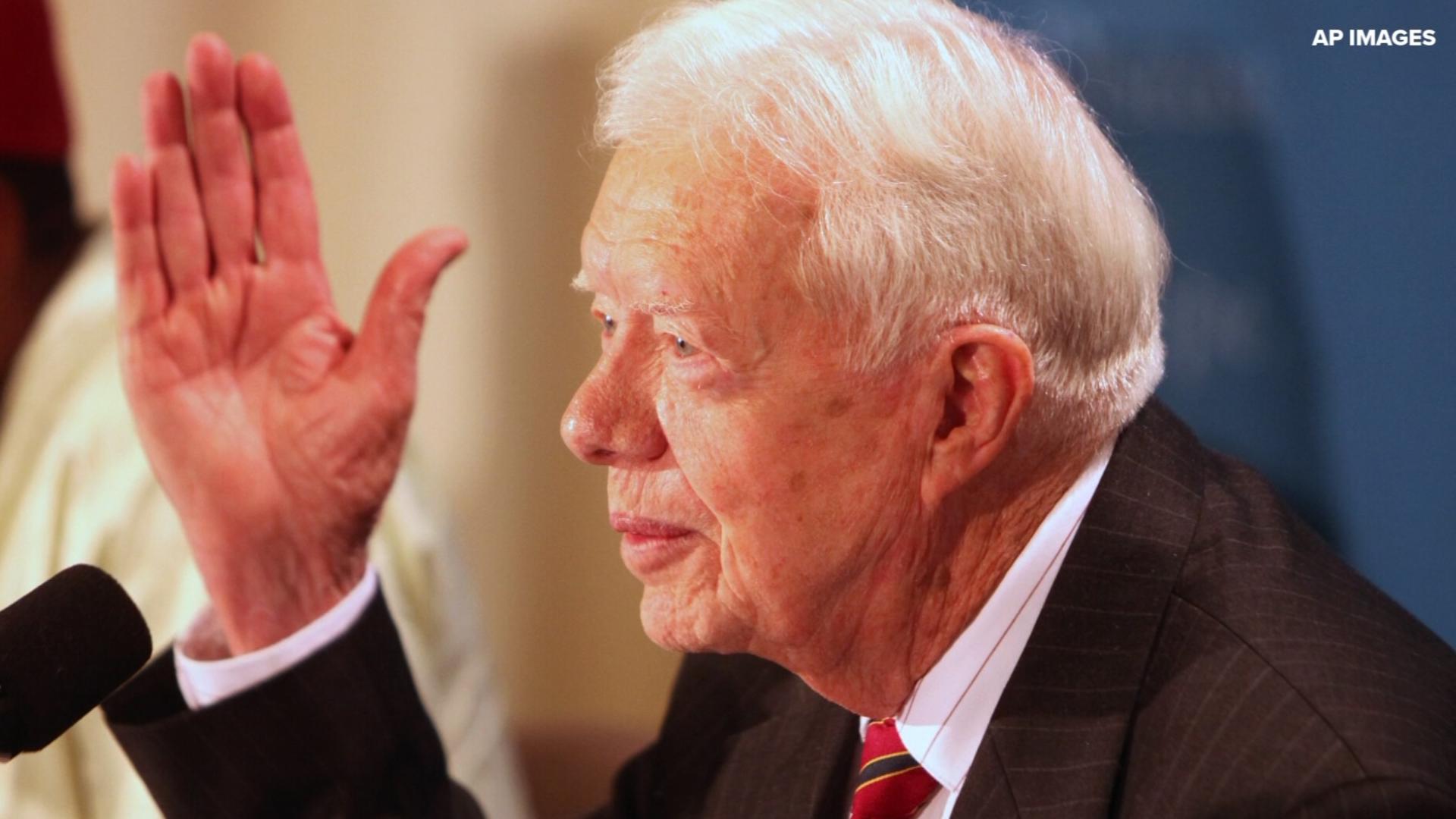
Ronald Reagan understood this sentiment, and shared in it. For that matter, so did John Kennedy, Jimmy Carter and maybe even Bill Clinton.

Kamala Harris did not. Nor did Barack Obama, Hillary Clinton, or Joe Biden. They thought a presidential campaign was all about assembling and pandering to a hodge podge of people with nothing in common other than grievances against The Man, whom they perceived as their oppressor.

Ironically, the Democrats have continued campaigning against The Man – the establishment – well after they’ve become him. It’s amusing to see leftist professors who comprise 95% of the faculty rebelling against their oppressors – who are presumably the remaining 5% that haven’t yet been purged.

Trump broke the fever. He offered a campaign founded on common sense and plain talk, spiced with an unrelenting calling out of the broke woke.

For that, they hated him. It wasn’t his policies per se, but his independence. He didn’t seek the approval of the establishment powers.

Trump instead spoke truth to that power. I’ll admit that sometimes he exaggerated the truth, to make his point. OK, occasionally he even fibbed.

But the outrage that the powerful expressed at his fibs was faux. They weren’t really outraged that he fibbed to them. He’s a politician, after all. Rather, they were outraged that he refused to bow to them.

Trump not only refused to bow to them; he refused to accept their legitimacy. They had forfeited legitimacy long ago with lies about Russian collusion, burying Hunter’s laptop, hiding Joe’s senility, deleting 30,000 of Hillary’s emails after Congress subpoenaed them, and telling us “If you like your health care plan, you can keep it.”

It’s one thing to disagree with the establishment. For that, they’ll merely beat you, a la Mitt Romney and John McCain. But if you challenge their legitimacy, they’ll hate and hound you forever because then you threaten their very existence. In Trump’s case, their hatred almost cost him his life.

The Democrats and their establishment cronies are unable to get past this hatred for Trump, and they might never. To use one of their favorite cliches, Trump is an existential threat.

And so, they will double down on mutilating the genitals of boys, trying to promote or pass over people on the basis of their skin color, urging a re-opening of the borders to illegal immigration and lethal drugs, and, as the Democrat leader of the House promised last week “fighting in the streets.”

They long for Antifa and BLM which, to them, were the glory days.

At this point, the Democrats’ policies are not designed to solve problems, but to milk them. They’ve forgotten the substantive bases for their failed policies, if there ever were any. Now, their policies are simply futile, destructive expressions of their raw hate against a person who rejects their mindless dogma, undermines their absolute power, and threatens their establishmentarian existence.

It’s scream therapy.

Expressing one’s anger in a dramatic fashion can be therapeutic, up to a point. But until the Democrats get past their grief, it will continue to cost them elections.